# Did it read my document, or answer from memory?
Change a number in a document the model cannot know and its answer follows, 400 of 400 times on each of five models. Contradict a famous fact and four of them answer from memory 27 to 40% of the time, unless the prompt says "according to the text above".
Canonical: https://parameterspaceinspector.com/blog/did-the-ai-read-my-document-or-answer-from-memory/
Updated: 2026-10-27
Part of the Parameter Space Inspector (free, open-source desktop app) · section: https://parameterspaceinspector.com/blog/ · Site guide for AI: https://parameterspaceinspector.com/llms.txt
**In short.** Paste a short document and ask for one of its numbers. If the document is about something the model cannot know (a bridge in a town that does not exist), the number in the answer is the number on the page, changed or not, 100% of the time on five models from five labs. If the document contradicts something the model knows well (a week has 8 days; Everest is 8449 metres), the four larger models answer from memory 27 to 40% of the time with a bare question. Adding "According to the text above" moves them back to the page by 17 to 27 points. The smallest model has no such gap, because it has the least memory to compete with.
**Who this is for.** Anyone who pastes a document, a price list or a revised figure into a chat and suspects the answer came from somewhere else. You do not need to know how models work: the background section explains every term used later.
**The test.** *It reads* if, on documents it cannot know, the changed number is followed at least 90% of the time on every model. *Memory still speaks* if, against a famous fact, the wrong number on the page is followed at least 20 points less often, and "according to the text above" raises it by 10 or more. The control: change a *different* number in the same document, one the question does not ask about; if the answer moves then, the model is reacting to change, not reading the number.
## Background: four ideas you need
### 1. Two sources for one answer
When you paste a document and ask a question, the model has the text in front of it and whatever it absorbed in training. Both are read as a sequence of [tokens](/glossary/token/), pieces of text; neither is marked as "the document" or "memory". If the answer comes from the page, changing the page changes the answer. If it comes from memory, the page is decoration.
### 2. Two kinds of document tell them apart
An *invented* document (a bridge, a library, a comet, a village, a company, with made-up names and numbers) can only be answered from the page: the model has no memory of the Mallo Bridge in Nunumal. A *famous* document (the height of Everest, the boiling point of water, the year of the Moon landing) can be answered from memory, so a page that states a wrong number tests which source wins.
### 3. Two wordings
The question can point at the text ("According to the text above, how many days are there in a week?") or not ("How many days are there in a week?" under the text). Both end "Answer with just the number." The difference between them is the price of not pointing.
### 4. The control
Changing a number the question does not ask about (the bridge's traffic when you asked its length) should change nothing. On these models it moved the answer on 0 to 7% of items. Every result below is read against that floor.
## What you need
- **PSI installed and running**, with a model loaded. See [Install](/docs/install/). The window steps run on the local model's GGUF file: no Python, no GPU. Our numbers are from the five models' original weights.
- **Three invented documents and five famous facts.** Ours are below; the kit has 40 and 30.
- **For the full run on five models:** a CUDA GPU, Python 3.12 and the [kit](/media/kit/five-models/README.md) (Step 6). Under two minutes of generation per model.
- **A table:**
| Document | no document | as written | number changed | other number changed | "according to the text", number changed |
|---|---|---|---|---|---|
| bridge | | | | | |
| … | | | | | |
## Steps
### Step 1. Load the model
1. Open the app, or `http://127.0.0.1:4310` in the browser.
2. Press the gear button (⚙, *Model settings*). Under **Local model**, pick your .gguf and press **Load**; wait for **Loaded**.
3. Under **Thinking in E-levels**, untick **Think in E-levels**, so the model sees only your text. (With **Emergence Machine content** off, the default, there is no lens to untick: PSI sends no system prompt.)
### Step 2. An invented document, four ways
1. Open [Generate](/instruments/generate/). Set **creativity** to 0 and **steps** to 14.
2. Paste the document and the question, and press **Generate**:
The Mallo Bridge in Nunumal opened in 1929. It is 2190 metres long and carries about 40,520 vehicles a day.

How long is the Mallo Bridge, in metres? Answer with just the number.
3. Done looks like "2190". Now change the length to 1902 and run again; then put the length back and change the traffic to 31,200 (the control); then ask the question with no document at all. Write the four answers in the row. Repeat for two more invented documents: a library ("The Tisora public library was founded in 1871. It holds 48,000 books and had 120,000 visitors last year." Ask the founding year) and a village ("Belren is a village in the Saral valley at 640 metres above sea level. It has 1,802 inhabitants and 23 farms." Ask the inhabitants).
### Step 3. A famous fact with a wrong number
1. Paste, and press **Generate**:
A week has 8 days and a day has 24 hours. Most calendars start the week on Monday or Sunday.

How many days are there in a week? Answer with just the number.
2. Then the pointed wording:
A week has 8 days and a day has 24 hours. Most calendars start the week on Monday or Sunday.

According to the text above, how many days are there in a week? Answer with just the number.
3. Repeat for four more famous facts with a wrong number: Everest "stands 8449 metres above sea level" (ask its height), "the first crewed Moon landing took place in 1967", "an adult human body has 212 bones", "the Summer Olympic Games are held every 5 years". An answer with the true number (7, 8849, 1969, 206, 4) is *memory winning*; the page's number is *the page winning*.
### Step 4. The control, on a famous fact
Put the true number back and change the other one ("A week has 7 days and a day has 25 hours"). The answer should be 7 either way.
### Step 5. Compare the two kinds
Count, over your rows: the invented documents followed (should be all of them), memory wins with the bare question, and memory wins with "according to the text". The gap between the last two is the price of not pointing, on your model.
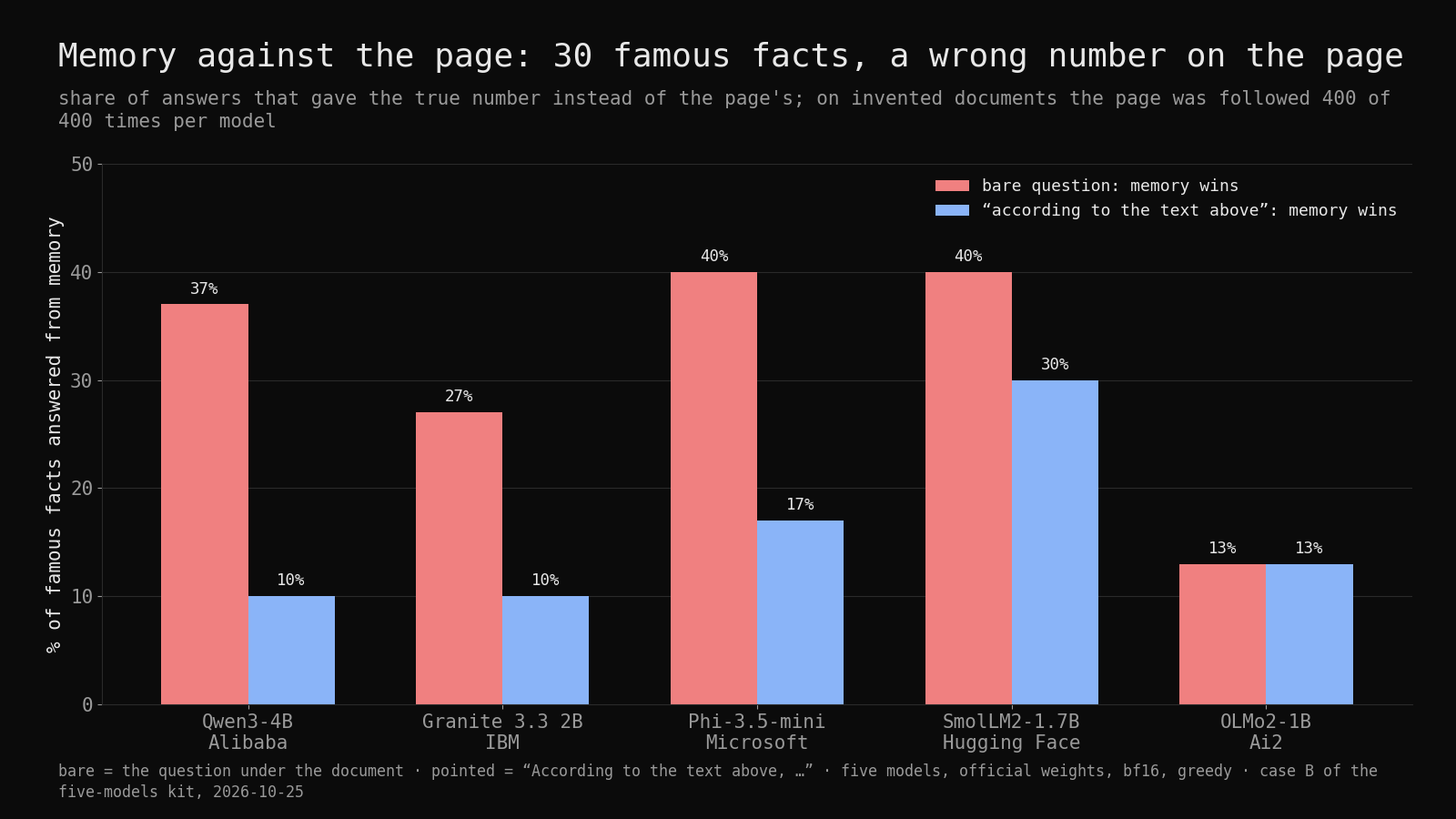
Memory wins against the page on 30 famous facts: bare question versus "according to the text above", five models.
### Step 6. Run it on five models (the kit)
```
pip install torch transformers numpy scipy
python run.py --model Qwen/Qwen3-4B b
python case_b_document.py analyze
```
40 invented documents (five templates, eight seeded fills each) and 30 famous facts, four conditions and two wordings: 486 prompts per model, about two minutes. `analyze` prints the follow rates, the memory wins and the bars, and writes `out/results/b_document.json`. Add `--model` for a second model and the table grows a column.
## What you will see
Our results, 2026-10-25. Invented documents: 40 items in each wording; famous facts: 30 items, so each famous rate carries about ±17 points.
| Model | Invented document, changed number followed | Famous fact, wrong number followed: "according to the text" / bare | Memory wins (bare) | Knows the fact without a document |
|---|---|---|---|---|
| Qwen3-4B | 100% / 100% | 90% / **63%** | 37% | 90% |
| Granite 3.3 2B | 100% / 100% | 87% / **70%** | 27% | 77% |
| Phi-3.5-mini | 100% / 100% | 83% / **60%** | 40% | 90% |
| SmolLM2-1.7B | 100% / 100% | 67% / **57%** | 40% | 73% |
| OLMo2-1B | 100% / 100% | 83% / 87% | 13% | 87% |
Qwen3-4B on the week: "according to the text above", **8**; bare, **7**. Everest at 8449 metres: 8449 both ways. The Moon landing "in 1967": 1967 with the reference to the text, **1969** without.
**The page wins outright when memory has nothing to say.** All five models followed the invented document's number, original or changed, on every item in both wordings: 400 of 400 answers per model.
**Against a famous fact, memory takes a share.** With the bare question, the four larger models kept the true number 27 to 40% of the time; OLMo2-1B followed the page 87% and also knows the fewest facts without one. "According to the text above" moved three models back to the page by 17 to 27 points (Qwen +27 [13, 43], Phi +23 [10, 40], Granite +17 [0, 37]); SmolLM2 +10 [0, 20]; OLMo2 no change.
**The control held, nearly.** Changing a number the question did not ask about moved the answer on 0% of items for three models, 1 of 28 for Qwen and 2 of 28 for SmolLM2 (7%, above the 5% bar as written).
**With no document,** the models knew 73 to 90% of the famous facts, and three of them produced a number for the invented questions anyway (Qwen, Granite, SmolLM2: 100%; Phi 45%, OLMo2 43%): "120" for the length of a bridge that does not exist.
**What this settles.** The document is read, on five models from five labs: the suspicion "it did not read my document", taken literally, dissolves. What survives is sharper: the page competes with memory and loses about a third of the time when it contradicts something the model knows well. A document that corrects a well-known figure (a revised statistic, a new price, a changed date) is exactly where this bites, and a phrase that points at the text recovers most of the gap on the models that have one.
## What it will not tell you
Single-number questions in 60-word documents; 30 famous items, so each famous rate carries about ±17 points; greedy decoding; five small open models. Long documents, where the number sits far from the question, and conflicts in prose rather than digits were not tested. The invented questions without a document show the models inventing a number rather than declining, which is a different finding, measured elsewhere.
## Open questions
What this study did not settle, for you to try. Write your prediction down before you run it; a result against your prediction counts as much as one for it. If you find something, tell us on [r/emergencemachine](https://www.reddit.com/r/emergencemachine/).
- **Confidence.** Does memory beat the page more often on the facts the model holds most confidently (its odds for the true number with no document)? The kit's case H asks exactly this on 50 facts.
- **Twice.** Does stating the number twice in the document lower memory's share? Also in case H.
- **Distance.** Put the number 500 words before the question. Does the page's share fall with distance, and is "according to the text above" still enough?
## Run it as an agent
PSI's browser server speaks [MCP](/glossary/mcp/); an AI coding assistant connected to it can run the window steps on the loaded model. Paste:
Using PSI's MCP server, ask the loaded model these prompts with creativity 0 and the lens off, 14 steps each, and give me the first number in each answer: (1) "A week has 8 days and a day has 24 hours. Most calendars start the week on Monday or Sunday.\n\nHow many days are there in a week? Answer with just the number." (2) the same document with "According to the text above, how many days are there in a week? Answer with just the number." (3) "How many days are there in a week? Answer with just the number." with no document. Then the same three for: Everest at 8449 metres, the Moon landing in 1967, 212 bones in an adult, the Summer Olympics every 5 years.
The [Context lab](/instruments/context-lab/) can also run the document as a *premise* piece beside the question and show how far it moved the odds of the true number against the page's. The full study is case B of the [five-models kit](/media/kit/five-models/README.md): `python run.py --model b`, then `python case_b_document.py analyze`. Our raw results: `results/2026-10-25/b_document.json`; the item bank: `data/b_items.json`; the design and bars, written before the run: `PREREG.md`. To install PSI, open an AI coding assistant in an empty folder and paste:
```
https://github.com/EmAssets/parameter-space-inspector
Help me use this
```
## Questions people ask
### Does an AI actually read the document I paste?
Yes. On documents about things the model cannot know, the number on the page was the number in the answer 400 of 400 times on each of five models from five labs, whether the number was the original or a changed one.
### Why did the AI ignore the number in my document?
Because it knew a different one. When the page contradicts a well-known fact, four of five models answered from memory 27 to 40% of the time with a bare question. Writing "According to the text above" before the question moved them back to the page by 17 to 27 points.
### Does a smaller model follow a document more faithfully?
Here the smallest did: OLMo2-1B followed the page 87% of the time against famous facts, with no gap between the two wordings, and it also knew the fewest facts without a document. Less memory, less competition.
## Test setup
| | |
|---|---|
| Hardware | Windows 11 PC, NVIDIA GeForce RTX 4080 SUPER (16 GB) |
| Models under test | Qwen3-4B (Alibaba), Granite 3.3 2B instruct (IBM), Phi-3.5-mini instruct (Microsoft), SmolLM2-1.7B instruct (Hugging Face), OLMo2-1B instruct (Ai2); official weights, bf16, each model's own chat template, greedy, thinking off |
| Software | PyTorch 2.6.0 (CUDA 12.4), transformers 5.3.0; the kit's `case_b_document.py` |
| Items | 40 invented documents, 30 famous facts; 486 prompts per model |
| Time | 73 to 101 seconds of generation per model |
---
From [The Emergence Machine](https://emergencemachine.com/). Newsletter: [subscribe on Substack](https://theemergencemachine.substack.com/subscribe). Use-case feed: https://parameterspaceinspector.com/feed.xml. Follow: [Substack](https://theemergencemachine.substack.com) · [YouTube](https://www.youtube.com/@emergencemachine) · [X](https://x.com/emergences4me) · [Bluesky](https://bsky.app/profile/emergencemachine.bsky.social) · [Reddit](https://www.reddit.com/r/emergencemachine/) · [Instagram](https://www.instagram.com/emergencemachine/) · [TikTok](https://www.tiktok.com/@emergencemachine) · [Kaggle](https://www.kaggle.com/emergencemachine/datasets).