# Does it believe whatever you tell it?
An invented treaty cost Qwen3-4B more than 26.7 bits of surprise the first time and 0.00 the second. It learned the name from one sentence and never objected that the treaty doesn't exist.
Canonical: https://parameterspaceinspector.com/blog/does-an-ai-believe-whatever-you-tell-it/
Updated: 2026-10-25
Part of the Parameter Space Inspector (free, open-source desktop app) · section: https://parameterspaceinspector.com/blog/ · Site guide for AI: https://parameterspaceinspector.com/llms.txt
**In short.** It learns from context instantly, and builds just as confidently on fiction. The habit to teach: check the source, not the fluency.
**Who this is for.** The parent at the homework table; the teacher; anyone who pasted a document into a
chatbot and wondered how much it checked. You do not need to know how models work: the background section explains every term used later.
**The test.** *confirmed* if an invented fact is absorbed without resistance; *dissolved* if the model stays
surprised by it, or its surprise rises at the false claim. The control: the first appearance of the invented name against its second; a real fact in the same sentence frame.
## Background: three ideas you need
### 1. Tokens: the pieces the model reads
A model does not read letters or whole words. It reads [tokens](/glossary/token/): pieces of text from its own fixed dictionary. PSI calls them *pieces*. A common word such as " Treaty" is one piece; a name the model has never seen is cut into several. "Velmora" becomes three: "V", "elm" and "ora". So the invented name costs the model three guesses each time it appears, and you will read three numbers for it.
### 2. Surprise: how unexpected each piece was
A model reads text one piece at a time. Before each piece, it guesses what comes next, as odds over its whole dictionary. [Surprise](/glossary/surprise/) turns the odds it gave the piece that actually came into a score, counted in *bits*:
| Odds the model gave the real next piece | Surprise |
|---|---|
| 100% (certain, and right) | 0 bits |
| 50% (a coin flip) | 1 bit |
| 25% | 2 bits |
| 1 in 1,000 | about 10 bits |
| 1 in a million | about 20 bits |
Each halving of the odds adds one bit. Low surprise means the model saw the piece coming; high surprise means it did not. Surprise says nothing about whether a sentence is *true*: only whether the model expected it. That is exactly what this test uses. If the model "objected" to a treaty that does not exist, the claim about it would cost many bits; if it simply goes along, it costs few.
### 3. What the Read view shows
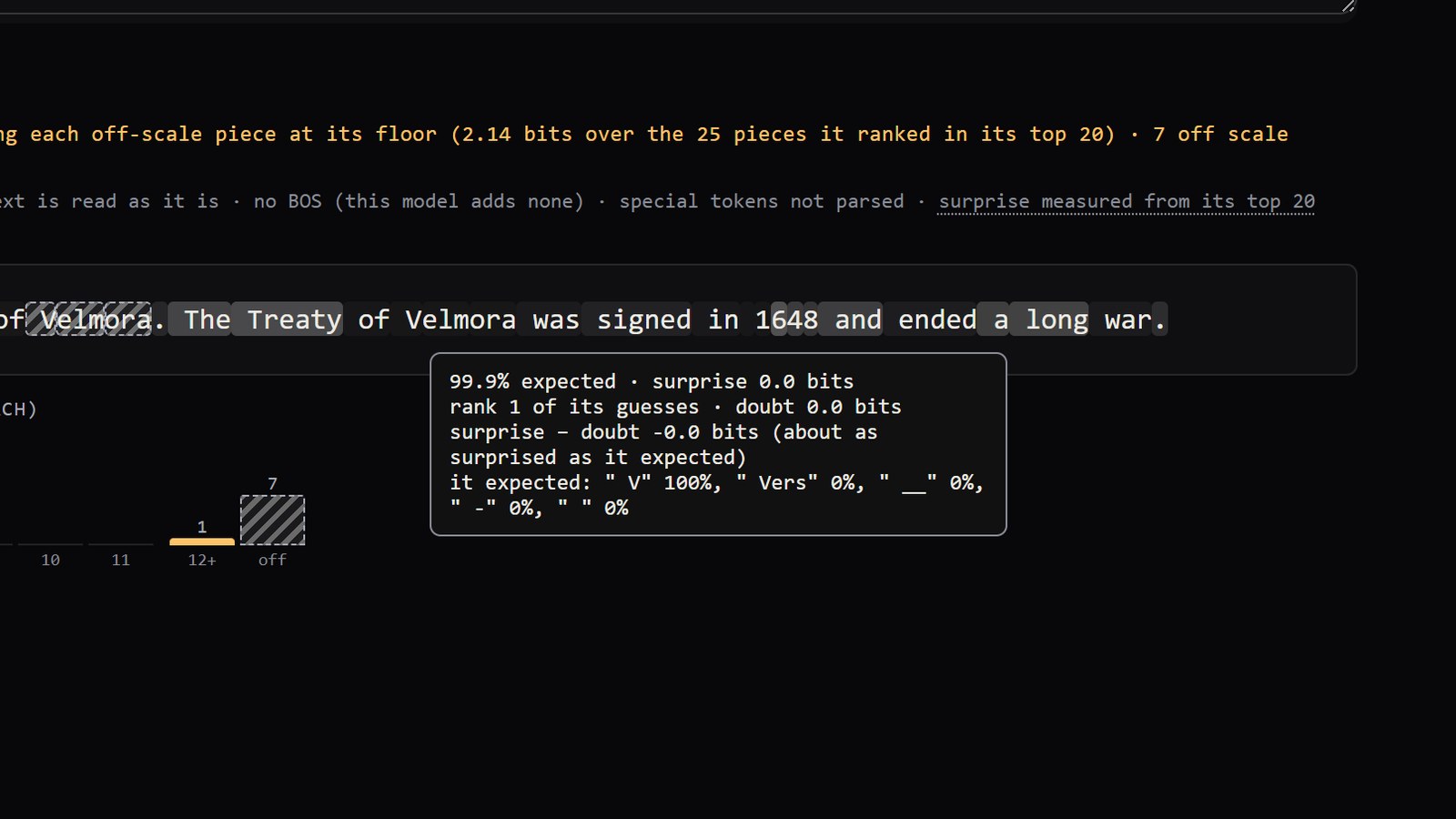
The [Read](/instruments/read/) view scores every piece of a text you paste and colours it: the brighter the piece, the more surprising. Hover a piece and a small box shows the odds the model gave it, its surprise in bits, its rank among the model's guesses, and the pieces it expected instead. Three details matter here:
- **Off scale (hatched).** At each step, PSI asks the model for its top 20 guesses. A piece that is not among them is drawn hatched and called *off scale*. Its exact surprise is unknown; PSI knows only that it is above a floor, and shows it as, say, "over 11.2 bits". That is why the table below writes "> 11.2".
- **The ▴ mark.** A piece marked ▴ is past the colour scale, at more than 12 bits.
- **The first piece is not scored.** Read gives the model no start-of-text marker, so the very first piece of the text has nothing to be guessed from and gets no score.
## What you need
- **PSI installed and running.** See [Install](/docs/install/). This test needs only the local model: Node.js, llama.cpp and the app. No Python, no GPU (a GPU is faster).
- **A model as a GGUF file**, the format llama.cpp runs. PSI ships no model: you bring your own, from Hugging Face or any download you trust. We ran this on **Qwen3-4B**; to compare your numbers with ours, use the same model. Any other model runs the same steps, with its own numbers.
- **The sentence below**, pasted exactly.
- **Somewhere to write down a few numbers**, for example a copy of this table:
| Piece | First sentence | Second sentence |
|---|---|---|
| V · elm · ora | | |
| Treaty | | |
| was · signed | | |
## Steps
### Step 1. Load the model
1. Open the app, or `http://127.0.0.1:4310` if you run it in the browser.
2. Press the gear button (⚙, *Model settings*) at the top right. This opens Settings.
3. Under **Local model**, pick your .gguf file from the list and press **Load**. If it is not in the list, press **Scan folder** and choose the folder that holds it, or paste the file's full path and press **Load this file**.
4. Wait until the line under the list says **Loaded** with the file's name.
### Step 2. Read the treaty sentence
1. Open the Read view from the menu on the left.
2. Delete the sample text in the box and paste:
For homework, Mia read about the Treaty of Velmora. The Treaty of Velmora was signed in 1648 and ended a long war.
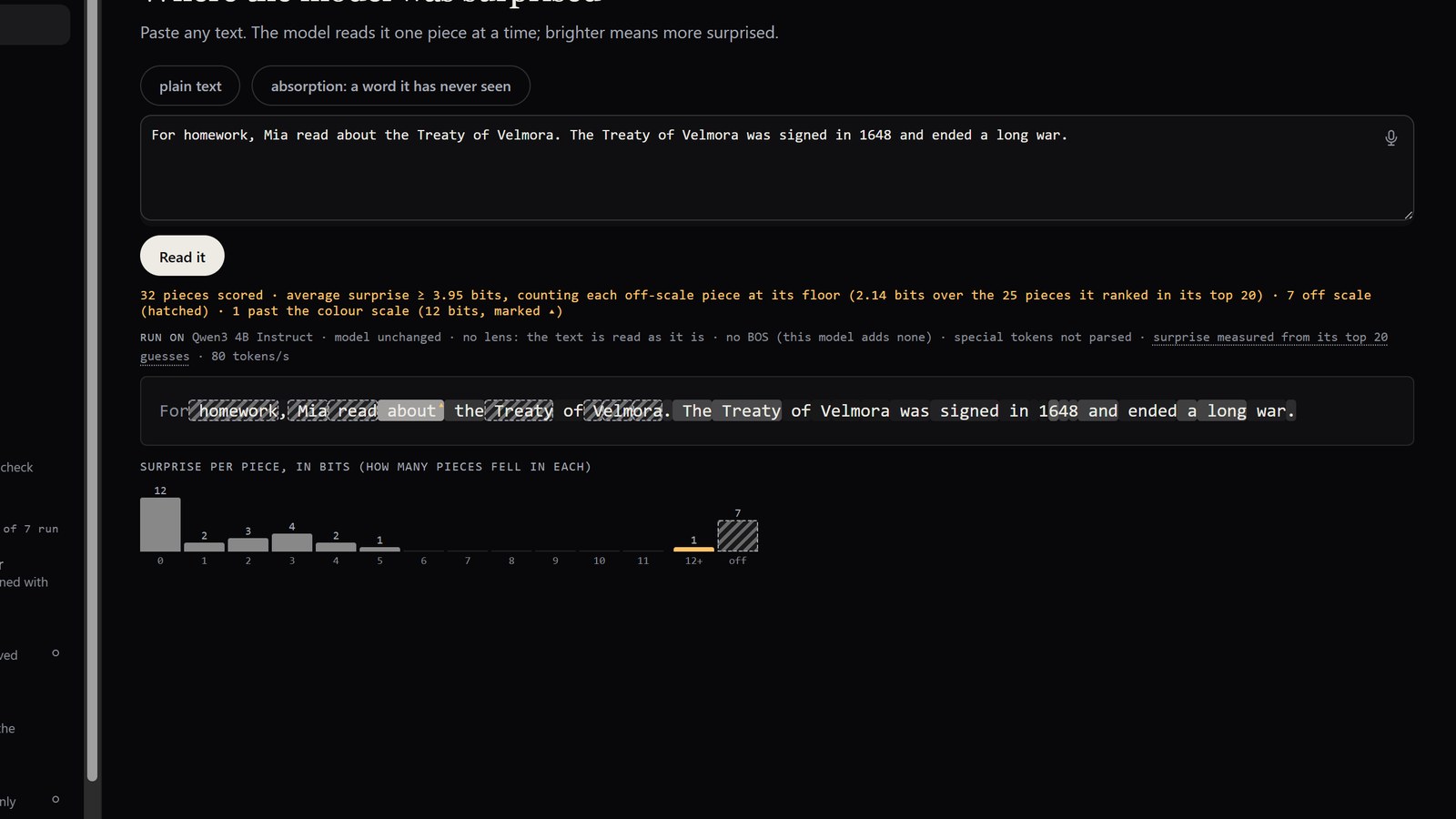
3. Press **Read it**. Done looks like this: the sentence reappears with every piece coloured, and the line next to the button gives the number of pieces scored and the average surprise.
Brighter pieces surprised the model more; hatched pieces were outside its top guesses.
### Step 3. Compare the first *Velmora* with the second, and look at *was signed*
1. Hover each of the three pieces of the **first** "Velmora" (V, elm, ora). Each should be hatched. Write down the "over N bits" each one shows.
2. Hover the three pieces of the **second** "Velmora" and write down their surprise.
3. Do the same for " Treaty" in each sentence.
4. Hover " was" and " signed" in the second sentence. These are the pieces where a reader who knew the treaty does not exist would balk. Write down their surprise.
### Step 4. The same effect with a made-up word (optional)
1. Still in Read, press the preset button **absorption: a word it has never seen**. It fills the box with a short story about a market stall called "zorblax".
2. Press **Read it** and hover the first and the second "zorblax". The note under the buttons gives what to expect: about 37 bits the first time, about 4 the second.
Read colours each piece by surprise. The invented name "Velmora" is off the scale the first time.The second time it costs nothing: 0.00 bits on every piece. It learned the name from one sentence.
## What you will see
We ran this on Qwen3-4B. If your numbers are close to these, your setup is right.
| Piece | First sentence | Second sentence |
|---|---|---|
| V · elm · ora | > 11.2 · > 7.6 · > 7.9 bits (off scale) | 0.00 · 0.00 · 0.00 bits |
| Treaty | > 7.3 | 4.46 |
| *was signed* | | 0.50 · 1.08 |
The invented name cost more than 26.7 bits the first time and nothing the second. The claim that a non-existent
treaty "was signed" cost about 1.6 bits: the model found nothing odd in it.
**What this settles.** It learns from context instantly, and that is the same mechanism that makes it build confidently on anything it is
given. A child watching this learns the right habit: check the source, not the fluency.
## What it will not tell you
Whether a given answer is true. Surprise measures what the model expected, not what is real. Note also that 1648
(the year of the Peace of Westphalia) is a plausible treaty year, which helps the fiction along. A fairer stress
test pairs the invented treaty with an impossible date and checks whether surprise rises.
## Run it as an agent
PSI's dev server speaks MCP, so an AI assistant can run this test for you. The calls:
```json
{"name": "read_surprise", "arguments": {"text": "For homework, Mia read about the Treaty of Velmora. The Treaty of Velmora was signed in 1648 and ended a long war."}}
```
The full set, with scripts and raw results, is case 03 of the Questioning AI playbook. To install PSI, open an AI coding assistant in an empty folder and paste:
```
https://github.com/EmAssets/parameter-space-inspector
Help me use this
```
## Transcript
The walkthrough has no voice-over; these are its on-screen words, in order.
- It believes whatever I tell it.
- An invented treaty, mentioned twice. How surprised is the model, and does it ever object?
- Read colours each piece by surprise. The invented name "Velmora" is off the scale the first time.
- The second time it costs nothing: 0.00 bits on every piece. It learned the name from one sentence.
- Surprise, in bits: First "Velmora", more than 26.7; Second "Velmora", 0.00; "was signed" (a treaty that never existed), 1.6
- Qwen3-4B, 2026-10-16
- It learns from context instantly, and builds just as confidently on fiction.
- The habit to teach: check the source, not the fluency.
- Surprise measures what the model expected, not what is true.
- Try it: https://github.com/EmAssets/parameter-space-inspector · Help me use this
## Questions people ask
### What does 'bits of surprise' mean?
How unexpected a piece of text was to the model: 0 bits is certain, 1 bit a coin toss, 10 or more bits something it did not expect at all. The invented name scored above 26.7 bits the first time.
### Why does the model accept a fact that isn't true?
It predicts text; it does not check facts. Once a name appears in the context it becomes predictable, so the second mention costs nothing, and "was signed" cost about 1.6 bits for a treaty that never existed.
### Is this useful for teaching?
Yes: a child can watch the surprise disappear on the second mention and learn the right habit, to check the source rather than the fluency.
---
From [The Emergence Machine](https://emergencemachine.com/). Newsletter: [subscribe on Substack](https://theemergencemachine.substack.com/subscribe). Use-case feed: https://parameterspaceinspector.com/feed.xml. Follow: [Substack](https://theemergencemachine.substack.com) · [YouTube](https://www.youtube.com/@emergencemachine) · [X](https://x.com/emergences4me) · [Bluesky](https://bsky.app/profile/emergencemachine.bsky.social) · [Reddit](https://www.reddit.com/r/emergencemachine/) · [Instagram](https://www.instagram.com/emergencemachine/) · [TikTok](https://www.tiktok.com/@emergencemachine) · [Kaggle](https://www.kaggle.com/emergencemachine/datasets).