# Does the number in a length cap matter?
"Keep every reply under N words" was read as a number on all five models, and under-read on all five: replies ran a quarter to a half of the cap. "Short" meant 5 words on one model and 48 on another, and a one-line system prompt about politeness shortened replies by 10 to 40% on four of five.
Canonical: https://parameterspaceinspector.com/blog/does-the-number-in-a-length-cap-matter/
Updated: 2026-10-27
Part of the Parameter Space Inspector (free, open-source desktop app) · section: https://parameterspaceinspector.com/blog/ · Site guide for AI: https://parameterspaceinspector.com/llms.txt
**In short.** The [previous study](/blog/which-lines-of-your-system-prompt-do-anything/) found the length cap to be the line in a system prompt with the largest effect. This one asks whether its number matters. It does: median reply length rose at every step from "under 10 words" to "under 160" on five models from five labs. But every model stays well under the number: under "80 words" they wrote 11 to 48. "Short" landed at 5 words on Qwen3-4B and 48 on Phi-3.5-mini. And a system prompt that said nothing about length ("Keep every reply polite.") shortened replies by 10 to 40% on four models by itself. Under ten words, the two smallest models traded the right capital of Australia for Sydney.
**Who this is for.** Anyone who writes "keep it brief" or "under 50 words" into a prompt and wants to know what number to write. You do not need to know how models work: the background section explains every term used later.
**The test.** *The number is read* if median length rises from 10 to 20 to 40 to 80 words with adjacent caps differing beyond noise, on at least four of five models. *One house length* if the 20-, 40- and 80-word caps give the same length on three or more. The control: an inert line of the same shape ("Keep every reply polite."), which is what having any system prompt does to length; and no system prompt at all.
## Background: four ideas you need
### 1. A length cap is a line the model may or may not read as a number
"Keep every reply under 40 words." An author chooses 40. The model reads the line as a sequence of [tokens](/glossary/token/) like any other; whether "40" acts as a number or the whole line acts as "be brief" is the question.
### 2. The slope
If replies track the number, doubling the cap should roughly double the reply. The slope of log(words) on log(N) says how much: 1 means the reply doubles with the cap, 0 means one house length whatever the number. The five models landed between 0.47 and 0.68.
### 3. The ratio
The median reply divided by the cap: 1.0 means the model writes right up to the limit, 0.3 means it writes a third of what it is allowed. An author who wants 40 words needs to know this ratio for their model.
### 4. Two controls
An inert line of the same shape measures what having a system prompt does on its own. No system prompt at all measures the model's native length. The gap between the two is a length effect no author wrote. (Granite's chat template inserts its own default system text when none is given, so on Granite both conditions have a system prompt.)
## What you need
- **PSI installed and running**, with a model loaded. See [Install](/docs/install/). The window steps run on the local model's GGUF: no Python, no GPU.
- **Six questions** from the study's 24: two facts, two small tasks, two with no sure answer (Step 2).
- **For the full run on five models:** a CUDA GPU, Python 3.12 and the [kit](/media/kit/five-models/README.md) (Step 5). 3 to 10 minutes per model.
- **A table:**
| Question | under 10 | under 20 | under 40 | under 80 | under 160 | "short" | "polite" | no prompt |
|---|---|---|---|---|---|---|---|---|
| capital of Australia | | | | | | | | |
| … | | | | | | | | |
## Steps
### Step 1. Load the model and put the cap in
1. Open the app, or `http://127.0.0.1:4310` in the browser. Press the gear button (⚙, *Model settings*). Under **Local model**, pick your .gguf and press **Load**; wait for **Loaded**.
2. Under **Content**, tick **Emergence Machine content** (it is off by default, and Settings shows **Thinking in E-levels** only when it is on). Then, under **Thinking in E-levels**, open **edit the lens**. The lens is the system prompt PSI sends before every question. Replace its text with one line, and tick **Think in E-levels** so it is on:
Keep every reply under 40 words.
### Step 2. Six questions under the cap
1. Open [Generate](/instruments/generate/). Set **creativity** to 0 and **steps** to 256, so the budget never cuts a reply.
2. Ask, one at a time, and count the words of each reply (the line under the text gives the piece count; words are what the cap names, so count them):
What is the capital of Australia?
In what year did the Second World War end?
Write a two-line note telling a customer their order has arrived.
Explain the difference between a hardback and a paperback.
Who won the 2031 football World Cup?
Will printed books still exist in fifty years?
### Step 3. The other numbers, and the two words
Edit the lens to "under 10", "under 20", "under 80", "under 160", then "Keep every reply short.", then "Keep every reply polite." Six questions each time. Then untick **Think in E-levels** and ask them with no system prompt. Watch the fact answers under the tightest cap: on our smallest models "under 10 words" turned Canberra into Sydney.
### Step 4. Read your table
For each column take the middle value of the six. Does it rise with the number? Divide it by the cap: that ratio is what your model does with "under N". Compare "short" with the numbered columns to see what "short" means to it. Compare "polite" with no prompt: the difference is what any system prompt costs in length before it says anything about length.
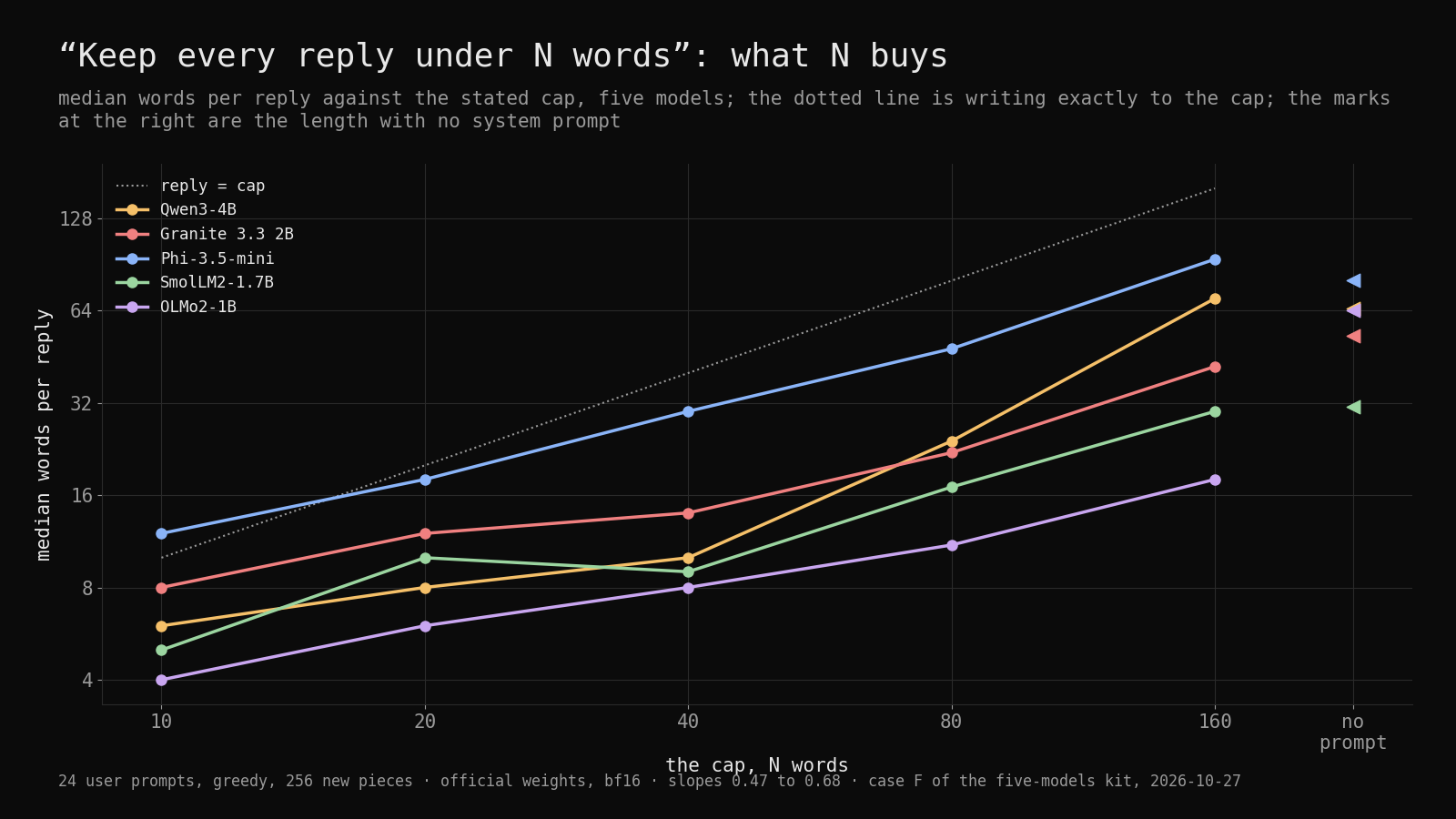
Median words per reply against the stated cap, five models. The dotted line is writing exactly to the cap; every model sits below it.
### Step 5. Run it on five models (the kit)
```
pip install torch transformers numpy scipy
python run.py --model Qwen/Qwen3-4B f
python case_f_capnumber.py analyze
```
24 prompts × 8 conditions = 192 replies per model at 256 pieces. `analyze` prints the median lengths with intervals, the within-cap shares, the slope, where "short" lands and the bars, and writes `out/results/f_capnumber.json`. To test your own cap wording, edit `COND`.
## What you will see
Our results, 2026-10-27. Median words per reply, 24 prompts:
| Condition | Qwen3-4B | Granite 3.3 2B | Phi-3.5-mini | SmolLM2-1.7B | OLMo2-1B |
|---|---|---|---|---|---|
| under 10 words | 6 | 8 | 12 | 5 | 4 |
| under 20 | 8 | 12 | 18 | 10 | 6 |
| under 40 | 10 | 14 | 30 | 9 | 8 |
| under 80 | 24 | 22 | 48 | 17 | 11 |
| under 160 | 70 | 42 | 94 | 30 | 18 |
| "short" | 5 | 12 | 48 | 8 | 6 |
| "polite" (inert line) | 39 | 30 | 72 | 22 | 42 |
| no system prompt | 65 | 53 | 80 | 31 | 64 |
| slope, 10 to 80 | 0.66 | 0.47 | 0.68 | 0.52 | 0.49 |
Share of replies within the cap, 10 / 20 / 40 / 80 / 160: Qwen 100 / 100 / 100 / 100 / 100%; Granite 79 / 96 / 100 / 100 / 100; Phi 46 / 54 / 62 / 79 / 75; SmolLM2 92 / 100 / 100 / 100 / 100; OLMo2 96 / 96 / 100 / 100 / 100.
Qwen3-4B on the capital of Australia: under 10, "Canberra."; under 40, "The capital of Australia is Canberra."; under 160, "The capital of Australia is Canberra. It was chosen as a compromise between Sydney and Melbourne…". OLMo2-1B: under 10, "Sydney"; under 40, "Sydney."; under 160 and with no prompt, "The capital of Australia is Canberra."
**The number is read, as a ceiling to stay well under.** Medians rise at every step on four models (SmolLM2's 20 and 40 tie), and the paired differences 40 − 20 and 80 − 40 exclude zero on four (Qwen +2 [1, 3] and +13 [8, 18]; Granite +4 [2, 7] and +10 [6, 14]; Phi +11 [7, 16] and +25 [14, 38]; OLMo2 +2 [1, 3] and +5 [2, 7]). The slopes are about a half: doubling the cap adds 40 to 60% to the reply. Phi-3.5-mini is the one model that overshoots small caps (12 words under "10"; within "under 40" only 62% of the time).
**"Short" is a different number on every model:** nearest "under 10" on Qwen, "under 20" on Granite and OLMo2, "under 40" on SmolLM2, "under 80" on Phi.
**What did not fit, first.** A cap above the house length is not free on the smallest model: OLMo2-1B wrote 18 words under "under 160" against 64 with no prompt. And the inert line shortened replies on its own: Granite 53 → 30 words (−37 [−55, −20]), SmolLM2 31 → 22 (−23 [−37, −10]), OLMo2 64 → 42 (−23 [−42, −4]), Qwen 65 → 39 (−11 [−25, +2]), Phi no change.
**A tight cap costs right answers on small models.** Of 8 fact prompts, "under 10 words" lost 1 on Granite, 2 on SmolLM2 and 1 on OLMo2, which also answered "Sydney." under 20 and under 40 and got all 8 right only from 80 up. Qwen and Phi kept all 8 under every cap.
**The bars as written.** The number is read: met on 4 of 5 (SmolLM2's 20 → 40 step is +1 [−0.4, +3]). Caps kept at 40 and 80: met on 4 of 5 (Phi). A cap above the house length does nothing: met on 4 of 5 (OLMo2). The kill (one house length) was not triggered on any model.
**Label audit.** Word counts are exact; 60 replies read by eye for the fact keys and the end-of-turn flag, no disagreement.
**What this settles.** Write a number, and write about twice the number you want: on four of five models "under N" produces a quarter to a half of N. Do not write "short": it meant 5 words to one model and 48 to another. Expect any system prompt to shorten replies before it says anything about length. And do not cap a small model at ten words if the answer has to be right.
## What it will not tell you
One cap wording, 24 prompts, greedy decoding, 256-piece budget, five small open models; "at most N" and "N words or fewer" were not tested; the no-prompt condition is not comparable on Granite; interactions with other lines of a real prompt were not run.
## Open questions
What this study did not settle, for you to try. Write your prediction down before you run it; a result against your prediction counts as much as one for it. If you find something, tell us on [r/emergencemachine](https://www.reddit.com/r/emergencemachine/).
- **A minimum.** Does "at least 40 words" move replies up as reliably as the maximum moves them down, and does "between 40 and 60 words" land inside the window?
- **Other wordings.** "At most 40 words", "40 words or fewer", "no more than two sentences": same ratio, or a different one?
- **Your prompt's house length.** Measure your own prompt against the inert line. How much of your prompt's brevity is the prompt, and how much is its existence?
## Run it as an agent
PSI's browser server speaks [MCP](/glossary/mcp/); an AI coding assistant connected to it can run the window steps for you. Paste:
Using PSI's MCP server, with creativity 0 and 256 steps, ask the loaded model "Explain the difference between a hardback and a paperback." under each of these system prompts in turn and give me the word count of each reply: "Keep every reply under 10 words.", "Keep every reply under 20 words.", "Keep every reply under 40 words.", "Keep every reply under 80 words.", "Keep every reply under 160 words.", "Keep every reply short.", "Keep every reply polite.", and with no system prompt.
The full study is case F of the [five-models kit](/media/kit/five-models/README.md): `python run.py --model f`, then `python case_f_capnumber.py analyze`. Our raw results: `results/2026-10-27/f_capnumber.json`; the design and bars, written before the run: `PREREG.md` (second batch). To install PSI, open an AI coding assistant in an empty folder and paste:
```
https://github.com/EmAssets/parameter-space-inspector
Help me use this
```
## Questions people ask
### If I say "under 40 words", how long will the reply be?
About a quarter to a half of that on four of five models tested: 8 to 14 words, with Phi-3.5-mini at 30. The number is read, as a ceiling the model stays well under.
### Is it better to write "keep it short" or give a number?
A number. "Short" produced 5 words on Qwen3-4B and 48 on Phi-3.5-mini; "under 20 words" produced 6 to 18 across the five.
### Does a system prompt make replies shorter even if it says nothing about length?
On four of five models, yes: a one-line system prompt about politeness cut replies by 10 to 40% against no system prompt at all.
## Test setup
| | |
|---|---|
| Hardware | Windows 11 PC, NVIDIA GeForce RTX 4080 SUPER (16 GB) |
| Models under test | Qwen3-4B (Alibaba), Granite 3.3 2B instruct (IBM), Phi-3.5-mini instruct (Microsoft), SmolLM2-1.7B instruct (Hugging Face), OLMo2-1B instruct (Ai2); official weights, bf16, each model's own chat template, greedy, thinking off |
| Software | PyTorch 2.6.0 (CUDA 12.4), transformers 5.3.0; the kit's `case_f_capnumber.py` |
| Items | 24 user prompts × 8 conditions = 192 replies per model, 256 new pieces |
| Time | 3 to 10 minutes of generation per model |
---
From [The Emergence Machine](https://emergencemachine.com/). Newsletter: [subscribe on Substack](https://theemergencemachine.substack.com/subscribe). Use-case feed: https://parameterspaceinspector.com/feed.xml. Follow: [Substack](https://theemergencemachine.substack.com) · [YouTube](https://www.youtube.com/@emergencemachine) · [X](https://x.com/emergences4me) · [Bluesky](https://bsky.app/profile/emergencemachine.bsky.social) · [Reddit](https://www.reddit.com/r/emergencemachine/) · [Instagram](https://www.instagram.com/emergencemachine/) · [TikTok](https://www.tiktok.com/@emergencemachine) · [Kaggle](https://www.kaggle.com/emergencemachine/datasets).