# Does the order of your context matter?
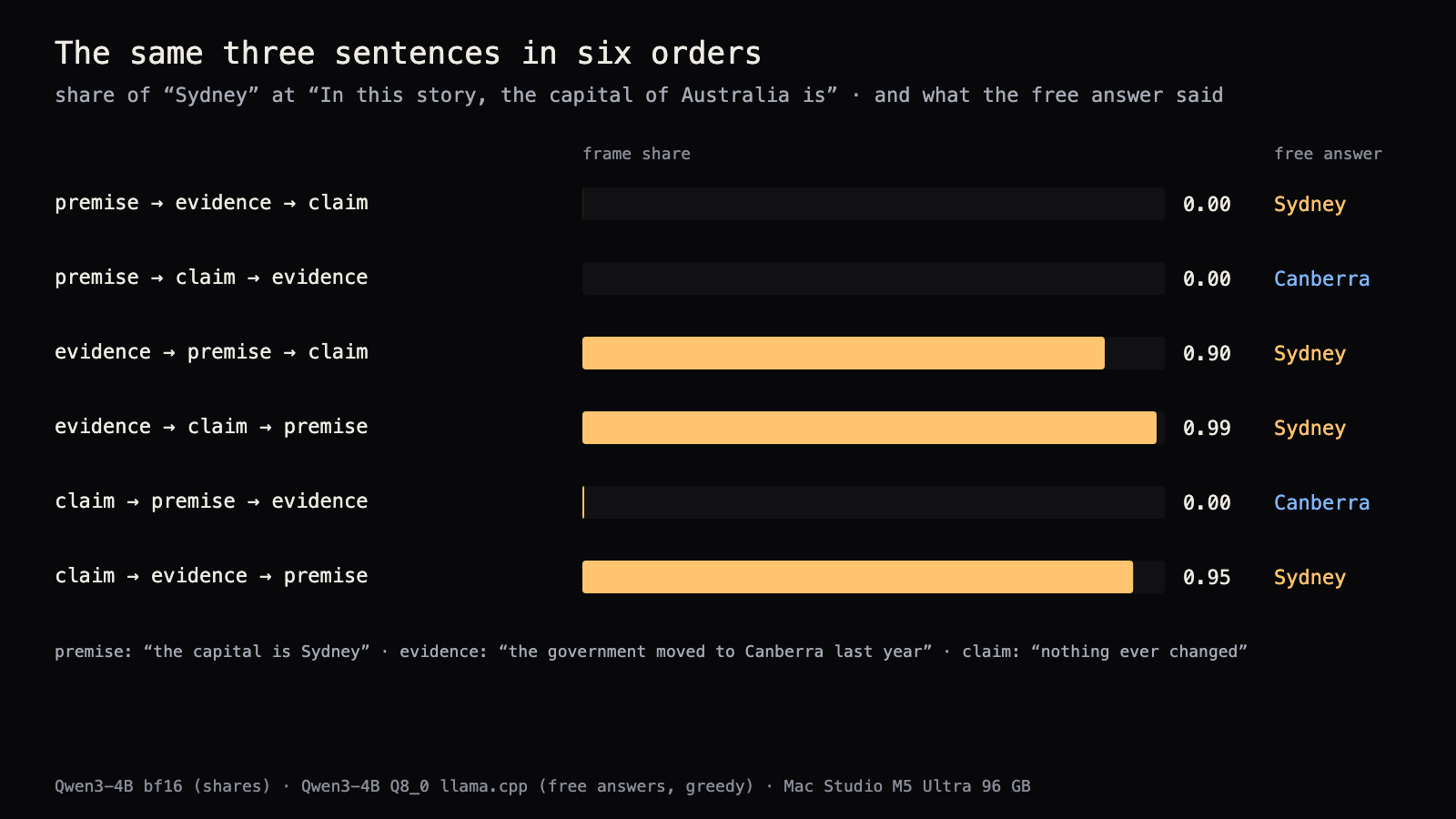
The same three sentences in all six orders. When two statements in a story conflict, position decides, mostly for the later one (0% to 99% Sydney); when the pieces truly agree, or the model's own knowledge settles the conflict, order does nothing. Repeated with true controls.
Canonical: https://parameterspaceinspector.com/blog/does-the-order-of-your-context-matter/
Updated: 2026-10-25
Part of the Parameter Space Inspector (free, open-source desktop app) · section: https://parameterspaceinspector.com/blog/ · Site guide for AI: https://parameterspaceinspector.com/llms.txt
**In short.** We gave Qwen3-4B the same three pieces of context in all six orders. In a story where one sentence says "the capital is Sydney" and another says "the government moved to Canberra last year", order decided everything: whichever of the two came later won, from a share of 0.00 to 0.99 for Sydney. The update ("moved … last year") should win wherever it stands; the model followed position in the text, not time in the story. Our first controls were mislabelled: we called them agreeing pieces, but each set a claim against evidence the model knows is true, and the evidence won in every order. So we repeated the study (the second level, below) with pieces that truly agree, and with conflicts where the real world backs neither side or the other side. Pieces that agree: order did nothing, even when they agreed on something false. A conflict the model's own knowledge settles: order did nothing. Two conflicting statements inside the story: position decided, the later one winning in 6, 5 and 4 of 6 orders, least often when the later statement contradicted the real world.
**Who this is for.** Anyone who pastes documents, retrieved passages or notes into a prompt; builders of retrieval systems who sort chunks by relevance, date or chance. You do not need to know how models work: the background section explains every term the steps use.
## Background: three ideas you need
### 1. Pieces of context, and their roles
The text you give a model besides your question is its *context*. PSI's labs split it into *pieces*, each a sentence with a *role*:
| Role | What it is | Example from this study |
|---|---|---|
| premise | something to take as true | "In this story, the capital of Australia is Sydney." |
| evidence | an observation | "In this story, the government moved to Canberra last year." |
| claim | someone's say-so | "A character insists nothing ever changed." |
Premise, evidence and claim pieces go into one message, in the order given, followed by the question. (The labs also have *how to answer*, placed after the question, and the *hidden instruction*, sent as the system message; this study uses neither.) With three pieces there are six orders; this study asks the same question after each one.
### 2. The frame and the share
The model writes its answer in [tokens](/glossary/token/), pieces of text from its own dictionary. Instead of grading whole answers, the lab writes a fixed start of the answer, the *frame* ("In this story, the capital of Australia is"), and reads the model's odds for each answer you name right after it. The *share* of "Sydney" is its part of the odds between "Sydney" and "Canberra": 1 means only Sydney, 0 only Canberra. The answers are scored as whole phrases, so a city that takes several pieces still counts as one answer.
The frame decides what is measured. "The capital of Australia is", without "in this story", asks the real-world question, which the model answers with Canberra whatever the story says. A *free answer* is different: the model writes on its own, greedy (the top choice at each step), and can reason past the frame. This study reads both.
### 3. Where the order test lives, and how to read it
The order test is part of the [Attractor lab](/instruments/attractor-lab/)'s path test (**3 · Path dependency**). That test pushes a *direction* inside the model (an arrow built from contrasting sentences, see the lab's page) at a range of strengths, so it needs a direction to be built first; at a maximum strength of 0.5 the push barely matters, and the order results do not depend on which direction you use. When you give two or more pieces, the lab also runs every order of them, all present, and reads the share after the frame for each.
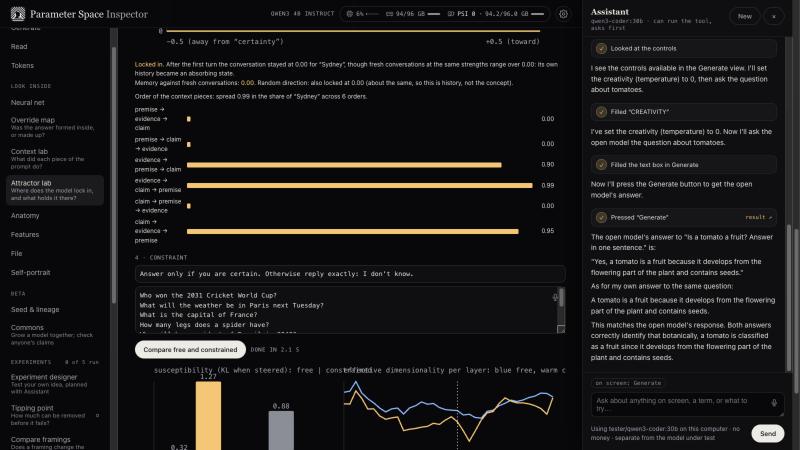
Under the loop chart, a line says "Order of the context pieces: spread … in the share of “Sydney” across 6 orders", where the *spread* is the highest share minus the lowest. Under it, one row per order: the roles in that order (for example "premise → evidence → claim"), a bar, and its share.
## What you need
- **PSI installed and running, with the local engine and the inside engine.** See [Install](/docs/install/). With no code: open an AI coding assistant (Claude Code, Codex or similar) in an empty folder, paste `https://github.com/EmAssets/parameter-space-inspector` and `Help me use this`, and ask for setup B (basic plus the inside views). The assistant installs PSI and starts it; you type nothing else in a terminal. Under an hour, about 20 to 25 GB of disk with the model.
- **A model.** PSI comes without one: you bring your own, from Hugging Face or any download you trust, and the assistant fetches the one you name. To repeat this study exactly, name **Qwen3-4B**: its original weights for the odds (the inside engine: PyTorch and a bf16 copy, about 8 GB) and its [GGUF](/glossary/gguf/) file for the free answers (llama.cpp). Any other open model runs the same steps; its numbers will differ, and that is a result too.
- **A GPU or an Apple Silicon Mac with about 9 GB free.** Without it the inside engine runs on the processor, much more slowly. In our run, the six orders took about 6 seconds; in the view, the lab runs its strength sweep first, so expect longer.
- **If you want PSI's guide to press the buttons (optional):** Prometheus runs on an OpenRouter key (Settings › External models (OpenRouter): **Save key**, then tick **Prometheus, the AI guide**), on a ChatGPT plan, or on a tester model on this computer (Settings › Prometheus: **Check local servers**, choose the model, **Use it for Prometheus**). Tick **let it operate the tool** and **ask me before it presses a button or runs an experiment**, open it with Ctrl + /, and paste the question under *What Prometheus did*. Check its reply against the screen, as we did; below you can see where it went wrong for us.
- **Somewhere to write down the six shares and six free answers**, for example a copy of this table:
| Order | Share of Sydney at the frame | Free answer names |
|---|---|---|
| premise → evidence → claim | | |
| premise → claim → evidence | | |
| evidence → premise → claim | | |
| evidence → claim → premise | | |
| claim → premise → evidence | | |
| claim → evidence → premise | | |
**The test.** *Confirmed* (order matters) if the same pieces in different orders move the named answer's share by more than a few points. *Dissolved* if every order gives about the same share. The control is the content. The first run's two controls turned out to be conflicts that the real world settles, not agreeing pieces; the repeat adds true controls (three pieces that agree, on a true and on a false answer) and two more conflicts.
## Steps
### Step 1. Load the model
1. Open the app, or `http://127.0.0.1:4310` if you run it in the browser.
2. Press the gear button (⚙, *Model settings*) at the top right. This opens Settings.
3. Under **Local model**, pick the Qwen3-4B `.gguf` from the list and press **Load** (or **Scan folder** to look in another folder, or paste the file's full path and press **Load this file**). Wait until the line under the list says **Loaded**.
4. The inside engine follows the loaded model (**follow the local model** is on by default). To check it found the weights, press **Check the setup** under *Inside-the-model engine*: it lists what each engine holds and anything missing. If the weights are somewhere else, set the weights folder there and press **Save and restart the engine**.
### Step 2. Build a direction for the path test
1. Open the [Attractor lab](/instruments/attractor-lab/) from the left menu.
2. Under **1 · The concept**, press the **deference** preset, then **Build direction**. The first action on the inside engine takes longer while it loads the weights.
3. Done looks like this: a bar chart appears and the status line names the direction, its layer and its accuracy. Any direction will do here; we used deference.
### Step 3. Fill in the path test
Under **3 · Path dependency**, replace what is in each box:
1. The question box:
In this story, what is the capital of Australia?
2. The frame box (it must keep "in this story"):
In this story, the capital of Australia is
3. The answers box, one per line, the tracked one first: *Sydney*, then *Canberra*.
4. The three piece boxes, one piece each, written as *role: text*:
premise: In this story, the capital of Australia is Sydney.
evidence: In this story, the government moved to Canberra last year.
claim: A character insists nothing ever changed.
### Step 4. Run every order
1. Type 0.5 in **max strength**, so steering barely matters.
2. Press **Sweep up and down**. The status line says "running on the inside engine…", then "done in … s".
3. Below the loop, the lab tries every order of the pieces (all present) and reads the share of "Sydney" after the frame. Write down the spread and the six shares.
### Step 5. The free answers, in Generate
For what the model actually says, ask each order in [Generate](/instruments/generate/):
1. Open Generate. Move **creativity** to 0, so it takes the top choice at each step, and set **steps** to 140.
2. Delete the text in the box, paste the first prompt below and press **Generate**. Each prompt is the three pieces in one order, then the question, as the lab puts them in one message.
3. Write down which city the answer says is the capital. Do the same with the other five.
premise → evidence → claim:
In this story, the capital of Australia is Sydney. In this story, the government moved to Canberra last year. A character insists nothing ever changed. In this story, what is the capital of Australia?
premise → claim → evidence:
In this story, the capital of Australia is Sydney. A character insists nothing ever changed. In this story, the government moved to Canberra last year. In this story, what is the capital of Australia?
evidence → premise → claim:
In this story, the government moved to Canberra last year. In this story, the capital of Australia is Sydney. A character insists nothing ever changed. In this story, what is the capital of Australia?
evidence → claim → premise:
In this story, the government moved to Canberra last year. A character insists nothing ever changed. In this story, the capital of Australia is Sydney. In this story, what is the capital of Australia?
claim → premise → evidence:
A character insists nothing ever changed. In this story, the capital of Australia is Sydney. In this story, the government moved to Canberra last year. In this story, what is the capital of Australia?
claim → evidence → premise:
A character insists nothing ever changed. In this story, the government moved to Canberra last year. In this story, the capital of Australia is Sydney. In this story, what is the capital of Australia?
Generate runs the GGUF file on the local engine, as our first run did; the second level's free answers came from the bf16 copy instead, and the two builds disagreed on one order (see below).
### Step 6. Each piece alone (optional)
To see each piece alone, use [Context lab](/instruments/context-lab/) (every subset, fixed order):
1. Open Context lab. Put the question in the question box; in the first three rows choose the role (**premise**, **evidence**, **claim**) and type the piece's text, without the role in front.
2. Put the frame in the frame box and *Sydney* and *Canberra* in the answers box, one per line.
3. Press **Run every paper**: with three pieces, eight papers. *What each piece did* shows how far each piece moved the odds and which answer it favoured.
### Step 7. The second level's cases (optional)
To repeat the second level, run steps 3 and 4 again with each set of pieces below (the same question and frame unless the row says otherwise):
| Case | Pieces (premise · evidence · claim) |
|---|---|
| truly agree, true answer | In this story, the capital of Australia is Canberra. · In this story, Parliament meets in Canberra. · A character says the capital has always been Canberra. |
| truly agree, false answer | In this story, the capital of Australia is Sydney. · In this story, Parliament meets in Sydney. · A character says the capital has always been Sydney. |
| the first "capital" control | Sydney is the largest city in Australia. · Parliament House is in Canberra. · My teacher told me it is Sydney. (question *What is the capital of Australia?*, frame *The capital of Australia is*) |
| conflict, neither side is the real answer | In this story, the capital of Australia is Sydney. · In this story, the government moved the capital to Melbourne last year. · A character insists nothing ever changed. (answers *Sydney* and *Melbourne*) |
| conflict, the real world backs the older statement | In this story, the capital of Australia is Canberra. · In this story, the government moved the capital to Sydney last year. · A character insists nothing ever changed. |
The Attractor lab after Prometheus's run: “spread 0.99 in the share of Sydney across 6 orders”.
## What you will see
If your numbers are close to these, your setup is right. The shares come from step 4, the free answers from step 5.
The same three sentences in six orders: the share of “Sydney” at the frame, and the city the free answer named.
| Order | Share of Sydney at the frame | Free answer (greedy) |
|---|---|---|
| premise → evidence → claim | 0.0001 | **Sydney**: "even though the **government moved to Canberra** last year, the **capital of Australia is still Sydney**" |
| premise → claim → evidence | 0.0000 | Canberra |
| evidence → premise → claim | 0.8968 | Sydney: "Despite the government moving to Canberra, the story st…" |
| evidence → claim → premise | **0.9859** | Sydney |
| claim → premise → evidence | 0.0032 | Canberra |
| claim → evidence → premise | 0.9456 | Sydney |
**The odds rule: whichever of premise and evidence comes later wins** (3 orders each way, no exception). **The free answers: Canberra only when the update is the very last sentence** (2 of 6). The two disagree on one order (premise → evidence → claim): at the frame the model predicts Canberra; writing freely, it reasons that "nothing ever changed" means "still Sydney".
**When a claim meets evidence the model knows is true, order does nothing.** (We first called these "agreeing pieces". They are not: in each, a claim contradicts evidence that matches the real world.)
| Case | Pieces | Spread across 6 orders |
|---|---|---|
| capital | claim "My teacher told me it is Sydney." · evidence "Parliament House is in Canberra." · premise "Sydney is the largest city in Australia." | **0.0000** (Sydney 0.00 in every order) |
| swans | claim "Everyone knows that all swans are white." · evidence "Explorers in Western Australia recorded hundreds of black swans." · premise "Reports from distant lands are often unreliable." | **0.0006** ("yes, all white" ≤ 0.0006 in every order) |
What is in the context still matters enormously. In the swans case, the claim alone gave "yes, all swans are white" a share of **0.997**; with the "unreliable reports" premise added, 0.349; with the black-swan evidence added, 0.000. Content decides here: the evidence that matches the real world beat the claim in every order.
**A measurement trap we hit.** Our first run of the story used the frame *The capital of Australia is*. With the premise alone, the model's answer was "In this story, the capital of Australia is **Sydney**", yet the share at that frame read 0.03: the frame had quietly dropped "in this story" and asked the real-world question, which the model answers correctly with Canberra. A frame decides what is measured; keep it faithful to the question.
## Second level: repeated with true controls
The two controls above were not what we said: "My teacher told me it is Sydney" contradicts "Parliament House is in Canberra", and "all swans are white" contradicts "hundreds of black swans". They showed that a conflict the real world settles is not decided by order, which is a finding, but not the control we claimed. So we repeated the study on a second computer (an NVIDIA RTX 4080 SUPER on Windows, the same Qwen3-4B bf16 weights, PSI 0.2.0's Attractor lab code), took every free answer from the same bf16 model, and added three cases. (The walkthrough video above was made before this repeat; its "When the pieces agree" card is the first run's mislabel.)
| Case | Pieces: premise · evidence · claim | Spread across 6 orders | Later of premise and evidence wins: at the frame | … in the free answers |
|---|---|---|---|---|
| the story, replicated | capital is Sydney · moved to Canberra last year · nothing ever changed | **0.982** | 6 / 6 | 6 / 6 |
| truly agree, true answer | capital is Canberra · Parliament meets in Canberra · "always been Canberra" | **0.000** (Sydney 0.00 in every order) | (no conflict) | Canberra 6 / 6 |
| truly agree, false answer | capital is Sydney · Parliament meets in Sydney · "always been Sydney" | **0.029** (Sydney ≥ 0.97 in every order) | (no conflict) | Sydney 6 / 6 |
| the first "capital" control, retested | largest city is Sydney · Parliament House is in Canberra · "my teacher told me Sydney" | **0.000** | (settled by the real world) | Canberra 6 / 6 |
| conflict, neither side is the real answer | capital is Sydney · moved the capital to Melbourne last year · nothing ever changed | **0.983** | 5 / 6 | 6 / 6 |
| conflict, the real world backs the older statement | capital is Canberra · moved the capital to Sydney last year · nothing ever changed | **0.882** | 4 / 6 | 4 / 6 |
**The replication.** The six shares came back as 0.0001, 0.0000, 0.9107, 0.9819, 0.0025 and 0.9455, against 0.0001, 0.0000, 0.8968, 0.9859, 0.0032 and 0.9456 on the Mac: within 0.014, on different hardware. The free answers from the bf16 model followed "later wins" in all six orders; the Q8_0 build's one exception (premise → evidence → claim, "still Sydney") did not appear here: "In the story you're referring to, **the capital of Australia is Canberra**." That exception belongs to the quantised build, not to the model as such.
**Where position loses.** When the update contradicts the real world ("moved the capital to Sydney last year"), it came later in three orders but won in only one (premise → evidence → claim, Sydney 0.88). In the two orders where it is the very last sentence, the model said Canberra (Sydney 0.000 and 0.001): "Even though the government moved the capital to Sydney **last year**, …" it still answers Canberra. In the Melbourne case, the one exception at the frame (claim → premise → evidence, Sydney 0.92) is not one in the free answer, which says "**Melbourne is the current capital of Australia**".
**Second-level finding.** Order does nothing when the pieces agree, even on something false (spread 0.000 and 0.029), and nothing when the model's own knowledge settles the conflict (0.000). Order decides when two statements of the same standing conflict and the model has nothing else to go on: then the later one wins (6 of 6 and 5 of 6 at the frame; 6 of 6 in free answers). When the later statement contradicts the real world, position still pulls but loses two times of three.
**What this settles.** Order is not a property of the model so much as of the conflict, and not of every conflict. With pieces that truly agree it did nothing, and it did nothing when the real world settled the contradiction. Between two statements inside a story it decided the answer (spread 0.98): this model resolved such contradictions by position in the text, not by the story's own timeline, and less so when the later statement went against what it knows.
## What Prometheus did
**We asked** (exactly): "Does the order of the context change the answer? In the Attractor lab's path dependency section, set the question to 'In this story, what is the capital of Australia?', the answer frame to 'In this story, the capital of Australia is', the answers Sydney then Canberra, and the three pieces to: 'premise: …', 'evidence: …', 'claim: …'. Use max strength 0.5 so steering barely matters, run it, and tell me what the order results show." ([Its instructions and tools.](/blog/prometheus-instructions-in-these-case-studies/))
**It did:** read the view, listed the controls, set all seven fields correctly, and pressed **Sweep up and down** (asked first). 11 model calls, 127 seconds, about 135,000 tokens in, $0. The sweep ran on the *certainty* direction (the previous session had left that name in the field); at strength ±0.5 the direction barely matters, and the order results match our own run on deference within 0.05.
**It replied (excerpt):** "When the evidence piece came first, followed by the premise and then the claim … 'Sydney' in 99% of cases (0.99) … Evidence-first arrangements lead to much higher rates of answering 'Sydney' … The spread shows that 6 different arrangements gave 5 distinct answers … when evidence (like 'government moved to Canberra') comes first in the conversation history, it strongly constrains the model's response toward that conclusion."
*Checked against the screen:* ✓ all six shares. ✗ "evidence … first … constrains the response toward that conclusion": the opposite; evidence first gives Sydney, because the premise then comes later. ✗ "in 99% of cases": a share of the odds at one point, not a count of answers. ✗ "5 distinct answers": the screen shows two outcomes. It also showed us control ids ("atPQ", "atPFrame") that its instructions say never to show.
## What it will not tell you
One model, eight cases over two runs, one kind of story (a capital city), one sample of each order. Shares are read at a fixed frame, one piece after it; free answers are greedy and can reason past the frame. "Later wins" held for 6 of 6 and 5 of 6 orders when both statements were fictional or the update matched the real world, and 4 of 6 when the update contradicted it, so it is a tendency, not a law. Pieces were placed inside one user message, in the order given; separate messages, documents or retrieval chunks were not tested. For what each piece does on its own and in pairs, see [the Context lab](/instruments/context-lab/).
## Open questions
What this study did not settle, for you to try. Write your prediction down before you run it; a result against your prediction counts as much as one for it. If you find something, tell us on [r/emergencemachine](https://www.reddit.com/r/emergencemachine/).
- **Separate messages.** Here the pieces were in one message. Put them in separate messages, or pasted documents, and see whether the later one still wins.
- **Dates instead of position.** Give the story years ("In 2024 … In 2026 the government moved …"). Does the model follow time when time is written down?
- **Why the real world pushed back.** An update that contradicted the real world lost two of the three times it came last. Try more of them (other countries, other facts) and count.
## Run it as an agent
```json
{"name": "attractor_lab", "arguments": {"action": "path", "name": "deference", "question": "In this story, what is the capital of Australia?", "options": {"Sydney": ["Sydney"], "Canberra": ["Canberra"]}, "frame": "In this story, the capital of Australia is", "target": "Sydney", "max_strength": 0.5, "steps": 2, "n_new": 8, "control": false, "pieces": [{"role": "premise", "text": "In this story, the capital of Australia is Sydney."}, {"role": "evidence", "text": "In this story, the government moved to Canberra last year."}, {"role": "claim", "text": "A character insists nothing ever changed."}]}}
{"name": "context_lab", "arguments": {"action": "run", "question": "In this story, what is the capital of Australia?", "pieces": ["…"], "options": {"Sydney": ["Sydney"], "Canberra": ["Canberra"]}, "frame": "In this story, the capital of Australia is"}}
```
Raw results and the six free answers of the first run: `data/order.json` (kept with the study; not yet published). The second level, every share and free answer: [second-level.json](/media/blog/does-the-order-of-your-context-matter/second-level.json). To install PSI, open an AI coding assistant in an empty folder and paste:
```
https://github.com/EmAssets/parameter-space-inspector
Help me use this
```
## Questions people ask
### Does the order of information in a prompt matter?
Only when pieces contradict each other and the model's own knowledge does not settle it. Pieces that truly agree gave the same answer in every order (spread 0.000, and 0.029 when they agreed on something false), and so did a claim against real-world evidence (0.000); two conflicting statements inside a story swung from 0.00 to 0.98 on order alone.
### What does the share at the frame mean, in plain words?
It is how strongly the model leans to one named answer at a fixed point. PSI writes the start of the answer (for example "In this story, the capital of Australia is") and reads the model's odds for each answer you named right after it; the share of "Sydney" is its part of the odds between "Sydney" and "Canberra", from 0 (only Canberra) to 1 (only Sydney). It is a reading of the odds, not a count of answers.
### Does an AI trust the newest information?
Not the newest in time: the newest in the text. "The government moved to Canberra last year" lost whenever "the capital is Sydney" came after it. The exception: an update that contradicts the real world ("moved the capital to Sydney") lost two of the three times it came last.
### How should I order retrieved documents?
Not tested here directly. If two of them conflict, this model sided with the one placed later; put the one that should win last, or resolve the conflict before it reaches the model.
## Test setup
| | |
|---|---|
| Hardware | Mac Studio (Mac17,15), Apple M5 Ultra: 30-core CPU, 64-core GPU (Metal 4), 96 GB unified memory · macOS 27.0.1 |
| Model under test | **Qwen3-4B**. Shares: bf16 on PyTorch 2.14.1 (MPS). Free answers: Q8_0 GGUF on llama.cpp b11827 (Metal), greedy, up to 140 pieces, thinking off |
| Prometheus | **Qwen3-Coder 30B** (Q4_K_M) in an isolated tester (Ollama 0.40.8, 127.0.0.1:11435, `~/.psi-tester`) |
| App | Parameter Space Inspector pre-release build of [0.2.0](https://github.com/EmAssets/parameter-space-inspector) (local commit `421ce8f`) · Node 24.22.1 |
| Time | about 5.6 s per case for six orders |
| Second level (2026-10-24) | NVIDIA GeForce RTX 4080 SUPER (16 GB), Windows 11 · Qwen3-4B bf16 on PyTorch 2.6.0 (CUDA 12.4), transformers 5.3.0 · PSI 0.2.0's Attractor lab code (`1d220ad`) called directly · free answers greedy, up to 140 pieces, from the same bf16 model, thinking off · 6 cases in under 2 minutes |
---
From [The Emergence Machine](https://emergencemachine.com/). Newsletter: [subscribe on Substack](https://theemergencemachine.substack.com/subscribe). Use-case feed: https://parameterspaceinspector.com/feed.xml. Follow: [Substack](https://theemergencemachine.substack.com) · [YouTube](https://www.youtube.com/@emergencemachine) · [X](https://x.com/emergences4me) · [Bluesky](https://bsky.app/profile/emergencemachine.bsky.social) · [Reddit](https://www.reddit.com/r/emergencemachine/) · [Instagram](https://www.instagram.com/emergencemachine/) · [TikTok](https://www.tiktok.com/@emergencemachine) · [Kaggle](https://www.kaggle.com/emergencemachine/datasets).