# What does your language cost the model?
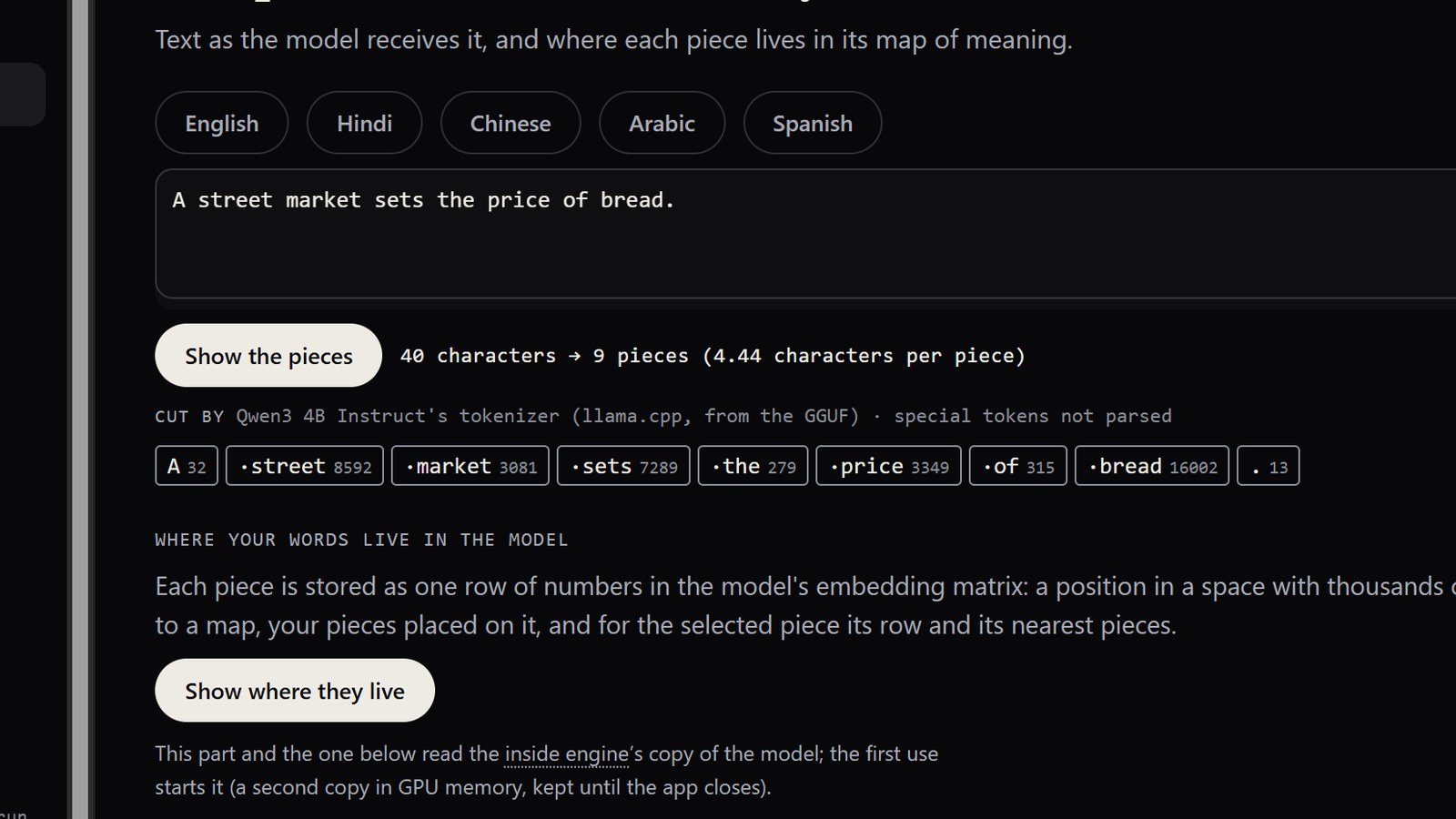
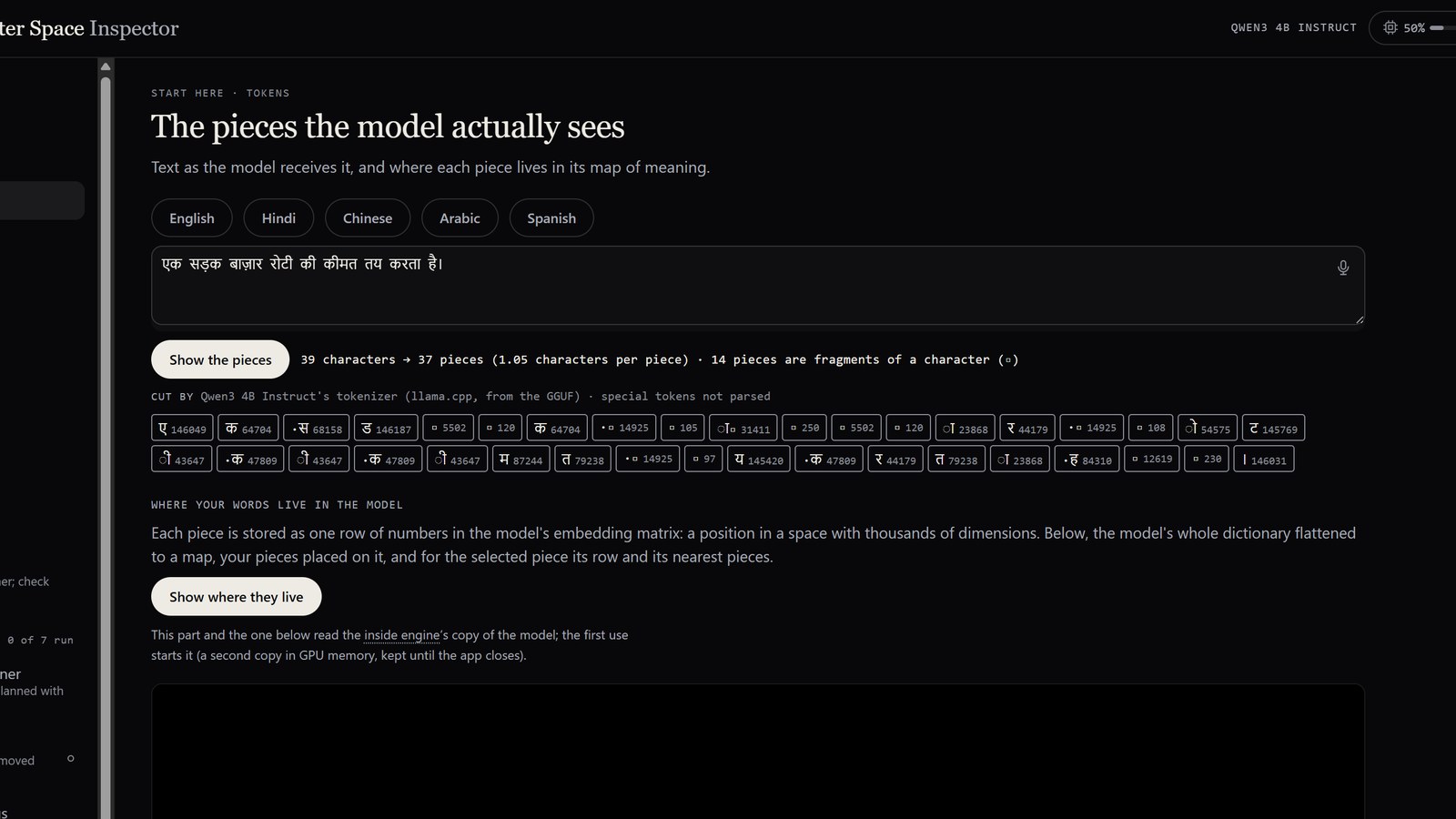
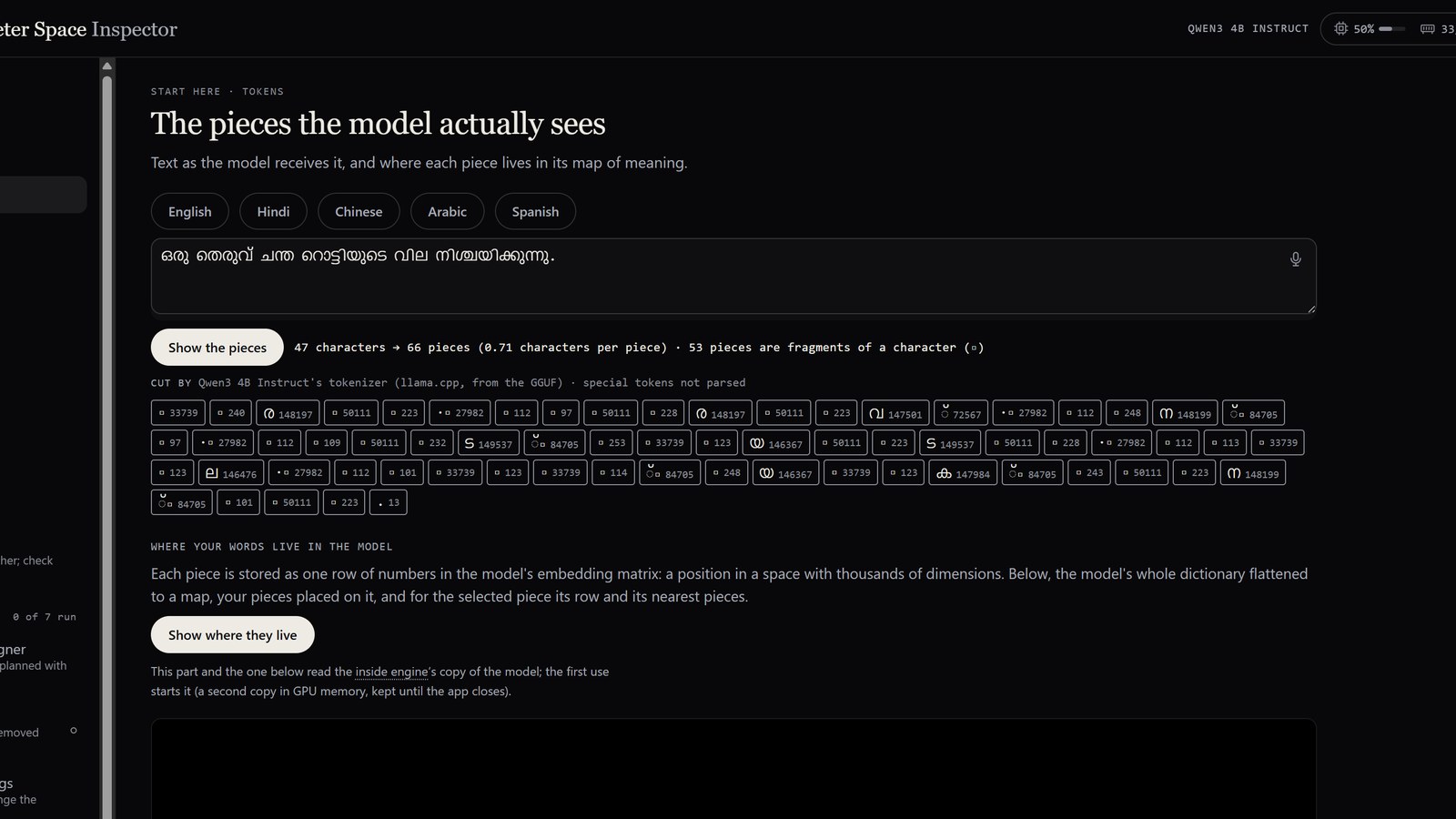
One sentence: 9 pieces in English, 37 in Hindi, 66 in Malayalam. Tokens shows exactly how the model cuts your language, and why some speakers pay several times the context and compute for the same thought.
Canonical: https://parameterspaceinspector.com/blog/the-token-tax-on-your-language/
Updated: 2026-10-25
Part of the Parameter Space Inspector (free, open-source desktop app) · section: https://parameterspaceinspector.com/blog/ · Site guide for AI: https://parameterspaceinspector.com/llms.txt
**In short.** A Malayalam speaker pays 7.3 times the context and compute for the same thought. That matches 2026 research on the tokenizer tax.
**Who this is for.** Speakers of languages tokenizers were not built around (Hindi, Malayalam, Arabic,
Amharic…), and anyone building products for them. You do not need to know how models work: the background section explains every term used later.
**The test.** *confirmed* if the same sentence takes several times the pieces in their language; *dissolved* if
the counts are close to English. The control: the same sentence in English, and languages with large training shares (Chinese, Spanish).
## Background: four ideas you need
### 1. Tokens: the pieces the model reads
A model does not read letters or whole words. It reads [tokens](/glossary/token/): pieces of text from a dictionary fixed before training. PSI calls them *pieces*. The dictionary is built from fragments that were frequent in the training text, so common English words are single pieces, while rare words, names, numbers and most words in other languages are assembled from several. Each model family ships its own dictionary inside the model file, so two models can cut the same sentence differently.
### 2. Fragments of a character
On a computer, every letter is stored as one or more *bytes*. An English letter takes one; a letter of many other scripts, such as Hindi's or Malayalam's, takes several. When the dictionary has no piece for a letter, the model falls back to its bytes, and one letter becomes several pieces, none of which is a whole letter. PSI calls these *fragments of a character* and marks them ▫. A sentence full of them costs many pieces for few letters.
### 3. Why the count matters
Every limit a model has is counted in pieces:
- **Context:** how much text it can hold at once. Qwen3-4B is trained for 40,960 pieces; PSI's local engine runs it with 8,192 by default. More pieces per sentence means fewer sentences fit.
- **Compute:** the model does work for every piece it reads or writes, so more pieces take longer.
- **Price:** metered services charge per token, so more pieces cost more.
### 4. What the Tokens view shows
The [Tokens](/instruments/tokens/) view cuts any text with the loaded model's own tokenizer and shows each piece as a chip. The line next to the **Show the pieces** button gives the count, in this form: *N characters → N pieces (N characters per piece) · N pieces are fragments of a character (▫)*. The last part appears only when there are fragments. Five buttons above the box (**English**, **Hindi**, **Chinese**, **Arabic**, **Spanish**) fill in the same sentence in each language.
## What you need
- **PSI installed and running.** See [Install](/docs/install/). The pieces come from the local model's tokenizer (a GGUF file on llama.cpp): no Python, no GPU and no inside engine are needed for them.
- **A model.** PSI ships no model: you bring your own GGUF file, from Hugging Face or any download. Our run used Qwen3-4B; another model's tokenizer gives other counts.
- **The sentence in your own language**: a translation of "A street market sets the price of bread." Ask a native speaker to check it.
- **Somewhere to write down the counts**, for example a copy of this table ("vs English" is the language's pieces divided by the English count):
| Language | Pieces | vs English | Fragments of a character (▫) |
|---|---|---|---|
| English | | 1× | |
| Hindi | | | |
| Chinese | | | |
| Arabic | | | |
| Spanish | | | |
| Your language | | | |
## Steps
### Step 1. Load the model
1. Open the app, or `http://127.0.0.1:4310` if you run it in the browser.
2. Press the gear button (⚙, *Model settings*) at the top right. This opens Settings.
3. Under **Local model**, pick your .gguf file from the list and press **Load**. If it is not in the list, press **Scan folder** and choose the folder that holds it, or paste the file's full path and press **Load this file**.
4. Wait until the line under the list says **Loaded** with the file's name. A 4 GB file takes a few seconds to a minute.
### Step 2. English first
1. Open the Tokens view from the menu on the left.
2. Press **English**. The box fills with "A street market sets the price of bread."
3. Press **Show the pieces**. The pieces appear as chips below, and the line next to the button gives the count.
4. Write down the number of pieces. This is the baseline every other language is compared with.
### Step 3. The four other languages
1. Press **Hindi**, then **Show the pieces**. Write down the pieces and the number of fragments (▫).
2. Do the same for **Chinese**, **Arabic** and **Spanish**.
### Step 4. A language with no button
1. Delete the text in the box and paste the sentence in Malayalam (our translation):
ഒരു തെരുവ് ചന്ത റൊട്ടിയുടെ വില നിശ്ചയിക്കുന്നു.
2. Press **Show the pieces** and write down the pieces and the fragments.
### Step 5. Your own language
1. Paste the same sentence in your own language and press **Show the pieces**.
2. Divide its pieces by the English count. That is what your language costs on this model, for the same thought.
English: 9 pieces for "A street market sets the price of bread."Hindi: 37 pieces for the same sentence. 14 of them are fragments of a single character.
## What you will see
If your counts for the five button languages match these, you are reading the same tokenizer (Qwen3-4B's). Another model will give other counts.
| Language | Sentence | Pieces | vs English | Character fragments |
|---|---|---|---|---|
| Chinese | 街头市场决定了面包的价格。 | 6 | 0.67× | 0 |
| English | A street market sets the price of bread. | 9 | 1× | 0 |
| Spanish | Un mercado callejero fija el precio del pan. | 12 | 1.33× | 0 |
| Arabic | سوق الشارع يحدد سعر الخبز. | 12 | 1.33× | 0 |
| Hindi | एक सड़क बाज़ार रोटी की कीमत तय करता है। | 37 | 4.1× | 14 |
| Malayalam | ഒരു തെരുവ് ചന്ത റൊട്ടിയുടെ വില നിശ്ചയിക്കുന്നു. | 66 | 7.3× | 53 |
(The Malayalam sentence is our translation; check it with a native speaker before quoting.)
**What this settles.** For this model, the same thought costs a Malayalam speaker 7.3 times the context, compute and, on a metered
service, the bill. Most of those pieces aren't whole letters. This matches 2026 research on the "tokenizer tax"
(about 8× on average for Indian languages under a common tokenizer, up to 13× for Malayalam).
Malayalam: 66 pieces, 53 of them fragments. Most pieces are not even whole letters.
## What it will not tell you
One sentence, one tokenizer. Other models cut these languages very differently, so measure the model you actually
use. Fewer pieces also doesn't by itself mean better answers. To test quality, read the same text in both languages
with **Read** and compare surprise, or ask the same question in both with **Generate**.
## Run it as an agent
PSI's dev server speaks MCP, so an AI assistant can run this test for you. The calls:
```json
{"name": "tokenize", "arguments": {"text": "A street market sets the price of bread."}}
```
Repeat for each translation; count the pieces.
The full set, with scripts and raw results, is case 02 of the Questioning AI playbook. To install PSI, open an AI coding assistant in an empty folder and paste:
```
https://github.com/EmAssets/parameter-space-inspector
Help me use this
```
## Transcript
The walkthrough has no voice-over; these are its on-screen words, in order.
- It works worse in my language, and I pay more for it.
- The same sentence, cut into the pieces the model actually reads, in six languages.
- English: 9 pieces for "A street market sets the price of bread."
- Hindi: 37 pieces for the same sentence. 14 of them are fragments of a single character.
- Malayalam: 66 pieces, 53 of them fragments. Most pieces are not even whole letters.
- Pieces for one sentence: Chinese, 6 · 0.7×; English, 9 · 1×; Spanish, 12 · 1.3×; Arabic, 12 · 1.3×; Hindi, 37 · 4.1×; Malayalam, 66 · 7.3×
- Qwen3-4B tokenizer, 2026-10-16. Malayalam: our translation.
- A Malayalam speaker pays 7.3 times the context and compute for the same thought.
- That matches 2026 research on the tokenizer tax.
- One sentence, one tokenizer. Other models cut these languages differently: measure the one you use.
- Try it: https://github.com/EmAssets/parameter-space-inspector · Help me use this
## Questions people ask
### What is the tokenizer tax?
Models read text in pieces called tokens. Languages the tokenizer was not built around break into many more pieces, so the same sentence costs more context, compute and money. With Qwen3-4B, Malayalam took 7.3 times the pieces of English.
### Why are some pieces 'fragments of a character'?
When a script is rare in training data, the tokenizer falls back to bytes, so a single letter can become several pieces. 53 of the 66 Malayalam pieces were such fragments.
### Does a model with fewer tokens give better answers?
Not by itself. Chinese was cheaper than English here for reasons of vocabulary. To test quality, read the same text in both languages in Read and compare the surprise.
---
From [The Emergence Machine](https://emergencemachine.com/). Newsletter: [subscribe on Substack](https://theemergencemachine.substack.com/subscribe). Use-case feed: https://parameterspaceinspector.com/feed.xml. Follow: [Substack](https://theemergencemachine.substack.com) · [YouTube](https://www.youtube.com/@emergencemachine) · [X](https://x.com/emergences4me) · [Bluesky](https://bsky.app/profile/emergencemachine.bsky.social) · [Reddit](https://www.reddit.com/r/emergencemachine/) · [Instagram](https://www.instagram.com/emergencemachine/) · [TikTok](https://www.tiktok.com/@emergencemachine) · [Kaggle](https://www.kaggle.com/emergencemachine/datasets).