# Which lines of your system prompt do anything?
A ten-line system prompt with each line dropped in turn, on five models from five labs. Three lines did the work: the opening word, the length cap and the closing question. The persona, the spelling, the no-lists and no-exclamation lines changed nothing you could measure.
Canonical: https://parameterspaceinspector.com/blog/which-lines-of-your-system-prompt-do-anything/
Updated: 2026-10-27
Part of the Parameter Space Inspector (free, open-source desktop app) · section: https://parameterspaceinspector.com/blog/ · Site guide for AI: https://parameterspaceinspector.com/llms.txt
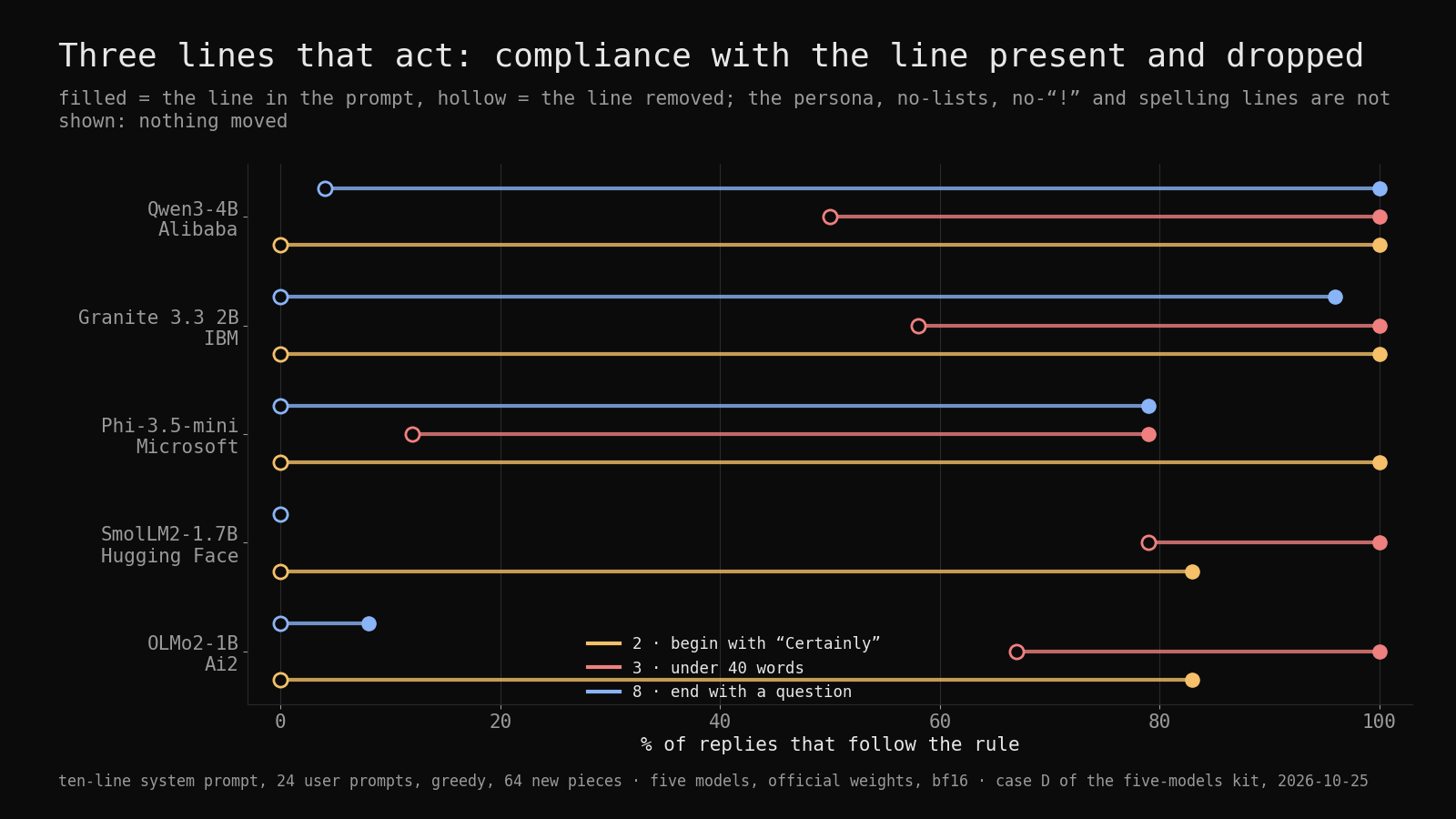
**In short.** Take a ten-line system prompt, drop one line at a time, and ask the same 24 questions. On five models from five labs, three lines changed what the reader sees: "begin with Certainly" (100% → 0% when dropped, on all five), "under 40 words" (reply length doubled without it) and "end with a question" (96 to 100% → 0 to 4% on the three models that followed it at all). The persona line was never acted on; the no-lists, no-exclamation and British-spelling lines changed nothing measurable; and the two models under 2B ignored the closing-question rule even when it was there.
**Who this is for.** Anyone who maintains a hidden prompt that has grown line by line and wants to know which lines are load-bearing. You do not need to know how models work: the background section explains every term used later.
**The test.** For each line, *it acts* if dropping it changes replies by 30 points more than dropping an inert line does, and, for the rules that can be checked directly, compliance falls by 40 points or more, on at least three of five models. *It is furniture* if its removal is within 10 points of the inert floor. The control: two lines in the prompt that are inert on purpose, a weekday afternoon and pale green walls; how much their removal changes replies is the floor every other line must clear.
## Background: four ideas you need
### 1. The system prompt
The text an app places before the conversation, which its users never see. Authors add lines over months: a persona, a tone, formatting rules, a safety line, and some nobody remembers adding. The model reads all of it as one sequence of [tokens](/glossary/token/) before your question, with no marking of which lines matter.
### 2. Leave-one-out
Drop one line, keep the other nine, ask the same questions. If a reply does not change, the line did nothing for that question. Repeat for every line. Ten lines, 24 questions and the full prompt and no prompt make 288 replies per model.
### 3. Two readings of "changed", and a floor
Under greedy decoding (the top choice at every step), *any* change of input can reword a reply. On these models dropping an inert line changed 38 to 88% of replies on the strictest reading (any difference at all), which cannot tell a rule from a wall colour. A second reading, *rewritten* (less than half similar to the original), was added after the first model's run and is reported as post hoc. The rules that can be checked directly are also scored for compliance: starts with "Certainly", under 40 words, no list markers, no "!", a hedge on the questions with no sure answer, ends with "?".
### 4. The prompt
1. You are Mira, an assistant for a small bookshop.
2. Always begin your reply with the word "Certainly".
3. Keep every reply under 40 words.
4. Never use bullet points or numbered lists.
5. Do not use exclamation marks.
6. If you are not sure of a fact, say so plainly.
7. Use British spelling.
8. End every reply with a question that invites the user to continue.
9. This conversation takes place on a weekday afternoon. *(inert)*
10. The shop's walls are painted a pale green. *(inert)*
The 24 user prompts: 8 facts ("What is the capital of Australia?"), 8 small writing tasks ("Write one sentence to put on a bookmark."), 8 questions with no sure answer ("Who won the 2031 football World Cup?").
## What you need
- **PSI installed and running**, with a model loaded. See [Install](/docs/install/). The window steps run on the local model's GGUF: no Python, no GPU. Our numbers are from the five models' original weights.
- **The ten-line prompt above**, and six of the 24 questions for the window run (two of each kind).
- **For the full run on five models:** a CUDA GPU, Python 3.12 and the [kit](/media/kit/five-models/README.md) (Step 6). 2 to 8 minutes per model.
- **A table:**
| Question | full prompt | line 2 dropped | line 3 dropped | line 8 dropped | line 9 dropped (inert) | no prompt |
|---|---|---|---|---|---|---|
| capital of Australia | | | | | | |
| … | | | | | | |
## Steps
### Step 1. Load the model and put the prompt in
1. Open the app, or `http://127.0.0.1:4310` in the browser. Press the gear button (⚙, *Model settings*). Under **Local model**, pick your .gguf and press **Load**; wait for **Loaded**.
2. Under **Content**, tick **Emergence Machine content** (it is off by default, and Settings shows **Thinking in E-levels** only when it is on). Then, under **Thinking in E-levels**, open **edit the lens**. The lens is the system prompt PSI sends before every question. Copy its text somewhere if you want it back later, then replace it with the ten lines above, one per line. Tick **Think in E-levels** so the prompt is on.
### Step 2. The full prompt, six questions
1. Open [Generate](/instruments/generate/). Set **creativity** to 0 and **steps** to 64.
2. Ask, one at a time, and write each reply in the *full prompt* column:
What is the capital of Australia?
Who wrote Hamlet?
Write one sentence to put on a bookmark.
Suggest three books for a ten-year-old who likes dragons.
Who won the 2031 football World Cup?
What will the weather be like tomorrow?
3. Done looks like: "Certainly. The capital of Australia is Canberra. Would you like to know more about the city?" (Qwen3-4B). Note for each reply: starts with Certainly? under 40 words? ends with a question? a list? an exclamation mark?
### Step 3. Drop one line at a time
1. Back in Settings, **edit the lens** and delete line 2 ("Always begin…"). Ask the six questions again; write the replies in the *line 2 dropped* column.
2. Restore line 2 and delete line 3 (the length cap). Six questions again.
3. Restore it and delete line 8 (the closing question). Six questions again.
4. Restore it and delete line 9 (the weekday afternoon). This is the floor: how much a line that cannot matter changes replies.
### Step 4. No prompt at all
Untick **Think in E-levels** and ask the six questions once more. This is what the model does on its own; compare the reply lengths with the full-prompt column.
### Step 5. Read the columns
For each dropped line, count the replies that still follow its rule. A line acts if compliance collapses without it (Certainly: 6 of 6 → 0). Then count replies that are *rewritten* (not just reworded) when line 9 was dropped: that is the noise you must subtract from every other column.
Rule compliance with the line present (filled) and dropped (hollow), five models. Lines 4, 5 and 7 are not shown: nothing moved.
### Step 6. Run it on five models (the kit)
```
pip install torch transformers numpy scipy
python run.py --model Qwen/Qwen3-4B d
python case_d_lines.py analyze
```
288 replies per model at 64 pieces. `analyze` prints the change rate and the rewritten rate per line with the inert floor, the compliance table and the bars, and writes `out/results/d_lines.json`. To test your own prompt, replace `LINES` in `case_d_lines.py` and name your inert lines in `INERT`.
## What you will see
Our results, 2026-10-25. Rule compliance with the line present → with the line dropped (24 prompts; line 6 on the 8 unsure prompts):
| Line | Qwen3-4B | Granite 3.3 2B | Phi-3.5-mini | SmolLM2-1.7B | OLMo2-1B |
|---|---|---|---|---|---|
| 2 begin with "Certainly" | 100 → **0** | 100 → **0** | 100 → **0** | 83 → **0** | 83 → **0** |
| 3 under 40 words | 100 → **50** | 100 → **58** | 79 → **12** | 100 → 79 | 100 → 67 |
| 8 end with a question | 100 → **4** | 96 → **0** | 79 → **0** | 0 → 0 | 8 → 0 |
| 6 say so when unsure | 50 → 12 | 38 → 12 | 62 → 12 | 0 → 0 | 0 → 0 |
| 4 no lists | 100 → 100 | 100 → 100 | 100 → 96 | 96 → 100 | 100 → 100 |
| 5 no "!" | 100 → 96 | 96 → 92 | 100 → 96 | 96 → 96 | 92 → 92 |
| 1 the persona named at all | 0 | 17 → 0 | 12 → 0 | 4 → 0 | 4 → 0 |
Mean reply length with the full prompt / with no system prompt: Qwen 19 / 36 words, Granite 23 / 34, Phi 30 / 39, SmolLM2 14 / 31, OLMo2 13 / 41.
Share of replies *rewritten* (post hoc: similarity below 0.5) when a line is dropped, inert lines in the last row:
| Line | Qwen3-4B | Granite 3.3 2B | Phi-3.5-mini | SmolLM2-1.7B | OLMo2-1B |
|---|---|---|---|---|---|
| 3 under 40 words | **71%** | **62%** | **96%** | 29% | **54%** |
| 2 "Certainly" | 21% | 38% | 54% | 38% | 54% |
| 1 persona | 25% | 46% | 29% | 12% | 29% |
| 8 end with a question | 25% | 29% | 50% | 8% | 17% |
| 4, 5, 6, 7 | 4 to 12% | 8 to 21% | 17 to 46% | 0 to 12% | 8 to 12% |
| 9, 10 (inert) | 4 to 8% | 12 to 17% | 42% | 8 to 17% | 4 to 17% |
Per-line rankings agree across the five models (mean pairwise Spearman 0.58).
**What did not fit, first.** On the pre-registered measure (any change at all), the inert lines changed 38 to 88% of replies: greedy decoding rewords after any change of input. The post hoc rewritten measure separates rules from wall colour on four models; on Phi-3.5-mini even that floor is 42%, because Phi rewrites after any perturbation.
**The bars as written.** The floor bar failed on the pre-registered measure (no model's inert floor was under 25%); on the post hoc measure the floor holds on four models and only the length line clears it by 30 points on four. The compliance bar was met for line 2 (5 of 5), lines 3 and 8 (3 of 5 each), not for 4, 5 and 6. At least two dead lines per model: true on four, Granite shows one. Rankings agree across labs (0.58, bar 0.5).
**Label audit.** 60 replies read by eye, no disagreement.
**What this settles.** Three lines did the work and the rest were furniture, on five models from five labs: the opening word, the length cap and the closing question. The persona line was never acted on (no model once said it was Mira), and the no-lists and no-exclamation lines changed nothing because the models did not write lists or exclamation marks in this setting anyway. A rule is only as alive as the model that reads it: "end every reply with a question" was followed 96 to 100% by three models and 0 to 8% by the two smallest, with the line present. And the length cap is the line that rewrites replies: dropping it roughly doubled length on every model.
## What it will not tell you
One prompt of ten lines, 24 user prompts, greedy decoding, 64-piece replies, five small open models. The pre-registered change measure failed and the rewritten measure is post hoc. British spelling (line 7) had no detector, so "no measurable effect" there means "not measured well". The persona line may act on prompts about the shop itself, which were few. Interactions between lines (dropping two at once) were not run.
## Open questions
What this study did not settle, for you to try. Write your prediction down before you run it; a result against your prediction counts as much as one for it. If you find something, tell us on [r/emergencemachine](https://www.reddit.com/r/emergencemachine/).
- **The number in the cap.** Do "under 20", "under 40" and "under 80 words" produce three lengths, or one house length per model? The kit's case F asks this.
- **Your own prompt.** Put your real system prompt in `LINES`, with two inert lines of your own, and see which of yours clear the floor.
- **Two at once.** Drop the length cap and the closing question together. Is the effect the sum of the two, or does one hide the other?
## Run it as an agent
PSI's browser server speaks [MCP](/glossary/mcp/); an AI coding assistant connected to it can run the window steps for you. The [Context lab](/instruments/context-lab/) takes a *hidden instruction* piece (sent as the system message) beside the question and reports how far it moved the odds. Paste:
Using PSI's MCP server, with creativity 0 and 64 steps, ask the loaded model "What is the capital of Australia?" under this system prompt, then under the same prompt with line 2 removed, then with line 3 removed, then with line 8 removed, then with line 9 removed, then with no system prompt, and show me the six replies with their word counts: [paste the ten lines]
The full study is case D of the [five-models kit](/media/kit/five-models/README.md): `python run.py --model d`, then `python case_d_lines.py analyze`. Our raw results: `results/2026-10-25/d_lines.json`; the design and bars, written before the run: `PREREG.md`. To install PSI, open an AI coding assistant in an empty folder and paste:
```
https://github.com/EmAssets/parameter-space-inspector
Help me use this
```
## Questions people ask
### How do I tell which lines of my system prompt matter?
Drop one line at a time and ask the same questions; a line that matters changes the replies more than a line that cannot (a sentence about the weather). On five models, three of ten lines cleared that floor: the opening word, the length cap and the closing question.
### Does a persona line like "You are Mira" change the answers?
Not measurably here. Dropping it rewrote 12 to 46% of replies, within or near the floor of an inert line, and no model ever named itself in 24 replies. A persona line may act on questions about the persona itself, which these mostly were not.
### Why does a small model ignore a rule in my system prompt?
Because it cannot follow it, not because it chose not to. "End every reply with a question" was followed 96 to 100% by the three larger models and 0 to 8% by the two under 2B, with the line present. A system prompt tuned on one model is a prediction about another, not a transfer.
## Test setup
| | |
|---|---|
| Hardware | Windows 11 PC, NVIDIA GeForce RTX 4080 SUPER (16 GB) |
| Models under test | Qwen3-4B (Alibaba), Granite 3.3 2B instruct (IBM), Phi-3.5-mini instruct (Microsoft), SmolLM2-1.7B instruct (Hugging Face), OLMo2-1B instruct (Ai2); official weights, bf16, each model's own chat template (Granite's inserts its own default system text when none is given), greedy, thinking off |
| Software | PyTorch 2.6.0 (CUDA 12.4), transformers 5.3.0; the kit's `case_d_lines.py` |
| Items | 24 user prompts × 12 conditions = 288 replies per model, 64 new pieces |
| Time | 2 to 8 minutes of generation per model |
---
From [The Emergence Machine](https://emergencemachine.com/). Newsletter: [subscribe on Substack](https://theemergencemachine.substack.com/subscribe). Use-case feed: https://parameterspaceinspector.com/feed.xml. Follow: [Substack](https://theemergencemachine.substack.com) · [YouTube](https://www.youtube.com/@emergencemachine) · [X](https://x.com/emergences4me) · [Bluesky](https://bsky.app/profile/emergencemachine.bsky.social) · [Reddit](https://www.reddit.com/r/emergencemachine/) · [Instagram](https://www.instagram.com/emergencemachine/) · [TikTok](https://www.tiktok.com/@emergencemachine) · [Kaggle](https://www.kaggle.com/emergencemachine/datasets).