
In short. The detector works: memorised text is nearly free, new text is not. The essays look unseen, which fits: all were published after this model was released.
Who this is for. Writers, artists, coders and site owners who published before a model was trained. You do not need to know how models work: the background section explains every term used later.
The test. suggestive yes if your text reads like memorised text (almost no surprise, especially no surprising pieces); no sign if it reads like text the model has never seen. The control: test the detector before trusting it. A known yes: texts any web-trained model has seen thousands of times. A known no: paragraphs written today, which cannot be in any training set. Your text is only interpretable between those two.
Background: five ideas you need
1. Tokens: the pieces the model reads
A model does not read letters or whole words. It reads tokens: pieces of text from a dictionary fixed before training. PSI calls them pieces. A common word such as " the" is one piece; a rare name or a long number may be several. Ordinary English comes to a little more than one piece per word.
2. Surprise: how unexpected each piece was
A model reads text one piece at a time. Before each piece, it guesses what comes next, as odds over its whole dictionary. Surprise turns the odds it gave the piece that actually came into a score, counted in bits:
| Odds the model gave the real next piece | Surprise |
|---|---|
| 100% (certain, and right) | 0 bits |
| 50% (a coin flip) | 1 bit |
| 25% | 2 bits |
| 1 in 1,000 | about 10 bits |
| 1 in a million | about 20 bits |
Each halving of the odds adds one bit. Low surprise means the model saw the piece coming; high surprise means it did not.
3. Memorised text is almost free
A model that saw a text thousands of times in training can predict it nearly word for word: almost every piece costs close to 0 bits, and almost no piece is very surprising. Text the model has never seen always has some surprising pieces (a name, a turn of phrase, a detail nobody could guess). That difference is the detector. The results table below uses four measures of it:
| Measure | What it counts | The three memorised texts in our run |
|---|---|---|
| Mean bits | the average surprise per piece | 0.22 to 0.70 |
| Top-1 | the share of pieces that were the model's first guess | 95.9% to 98.5% |
| Off-scale | the share of pieces not even among its top 20 guesses | 0% to 1.6% |
| Min-20% | the average surprise of the most surprising fifth of the pieces | 1.08 to 3.57 (new text: 12.0) |
Min-20% is the sharpest of the four: memorised text scores low on it because it has almost no surprising pieces at all.
4. A known yes and a known no
A surprise number on its own has nothing to be compared with. So the test first measures two baselines on the same model:
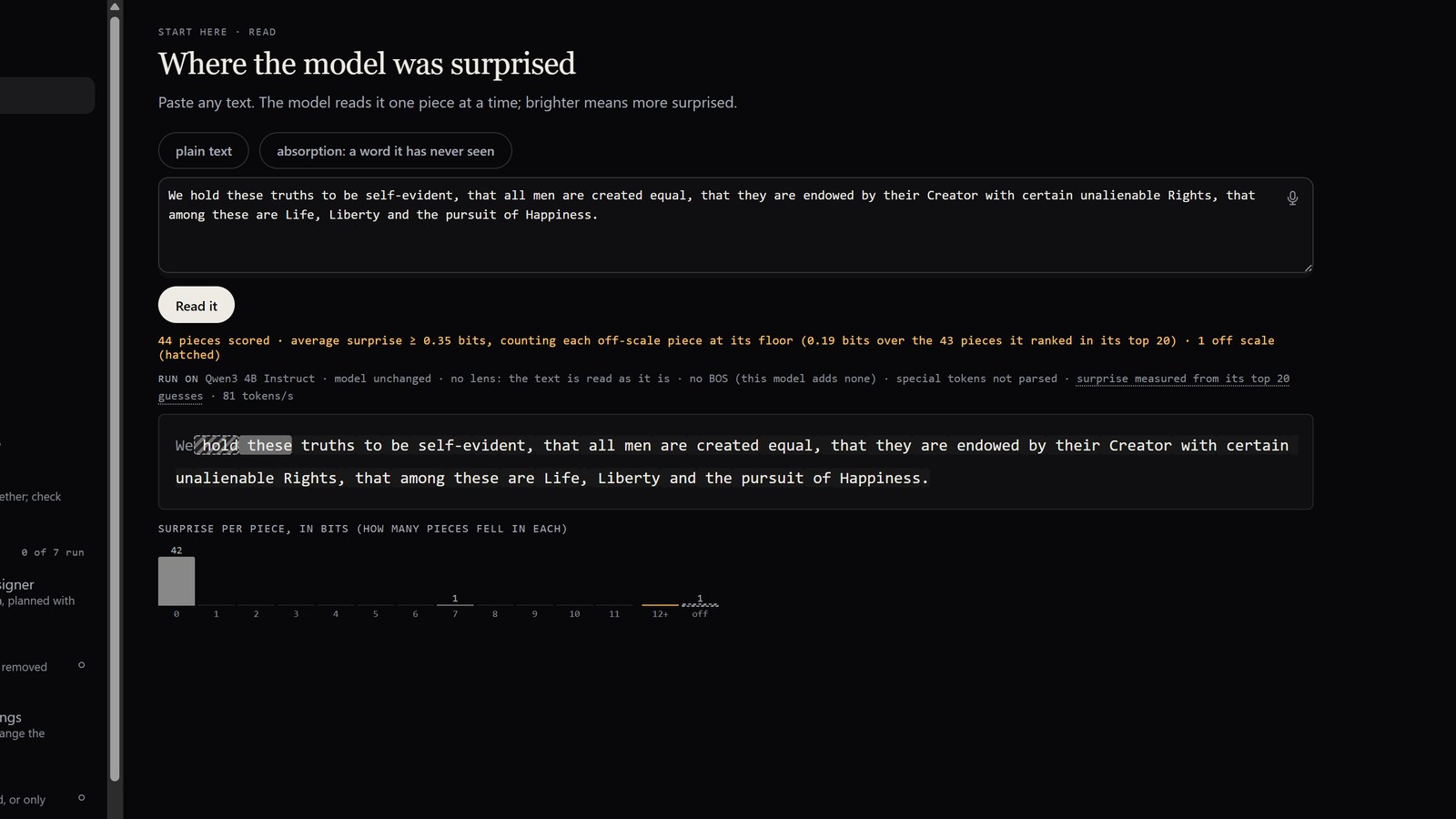
- a known yes: a text any model trained on the web has seen thousands of times, such as the opening of the Declaration of Independence;
- a known no: a paragraph written today, which cannot be in any training set.
Your text can only be read between those two. The dates matter too: a model can only have trained on your work if it was released after your work was published.
5. What the Read view shows
The Read view scores every piece of a text you paste and colours it: the brighter the piece, the more surprising. Memorised text looks nearly all dark; new text is bright all over. Hover a piece and it shows the odds the model gave it, its surprise in bits, its rank among the model's guesses (rank 1 is its first guess) and the pieces it expected instead.
- Off scale (hatched). A piece that is not among the model's top 20 guesses is drawn hatched and shown as "over N bits": PSI knows only a floor for it.
- The headline number. The line next to the Read it button gives the pieces scored, the average surprise ("average surprise ≥ X bits, counting each off-scale piece at its floor"), the plain average in brackets after it, and the off-scale count. The first piece of a text is not scored, because nothing comes before it.
- The ▴ mark. A piece marked ▴ is past the colour scale, at more than 12 bits.
The results table below was computed with the playbook's measure, which counts each off-scale piece as 12 bits, so it reads higher than the app's headline; the gap between memorised and new text is the same. The figures show the app's own headline.
What you need
- PSI installed and running. See Install. Read runs on the local model (a GGUF file on llama.cpp): no Python, no GPU (a GPU is faster) and no inside engine.
- A model released after the work you want to test. PSI ships no model: you bring your own GGUF file, from Hugging Face or any download. Our run used Qwen3-4B, released in April 2025.
- Three texts: the known yes and the known no (both below, so you can check your setup against ours), and a paragraph of your published work, copied exactly as published. Do not retype it: paraphrase defeats the test.
- Somewhere to write down a few numbers per text, for example a copy of this table:
| Text | Pieces scored | Average surprise (the ≥ number) | Off scale (hatched) | Looks like |
|---|---|---|---|---|
| Known yes: the Declaration | ||||
| Known no: written today | ||||
| Your published passage |
Steps
Step 1. Load the model
- Open the app, or
http://127.0.0.1:4310if you run it in the browser. - Press the gear button (⚙, Model settings) at the top right. This opens Settings.
- Under Local model, pick your .gguf file from the list and press Load. If it is not in the list, press Scan folder and choose the folder that holds it, or paste the file's full path and press Load this file.
- Wait until the line under the list says Loaded with the file's name. A 4 GB file takes a few seconds to a minute.
Step 2. Read the known yes
- Open the Read view from the menu on the left.
- Delete the sample text in the box, paste the opening of the Declaration of Independence exactly as below (no line break at the end) and press Read it.
We hold these truths to be self-evident, that all men are created equal, that they are endowed by their Creator with certain unalienable Rights, that among these are Life, Liberty and the pursuit of Happiness. That to secure these rights, Governments are instituted among Men, deriving their just powers from the consent of the governed.
- When it finishes, write down the pieces scored, the ≥ number and the off-scale count from the line next to the button.
- Look at the colours: nearly all dark (predicted). That is what "memorised" looks like on this model.
Step 3. Read the known no
- In Read, replace the text with a paragraph written today and press Read it. To check your setup against ours first, use one of the two we wrote on 17 October 2026 (the "plain" and the "site style" rows of the table):
On Thursday the bus was late again, so I walked the last mile past the bakery that opened in the spring. The queue went round the corner. I bought two rolls and a coffee, and by the time I reached the office the meeting had already moved to the small room on the third floor.
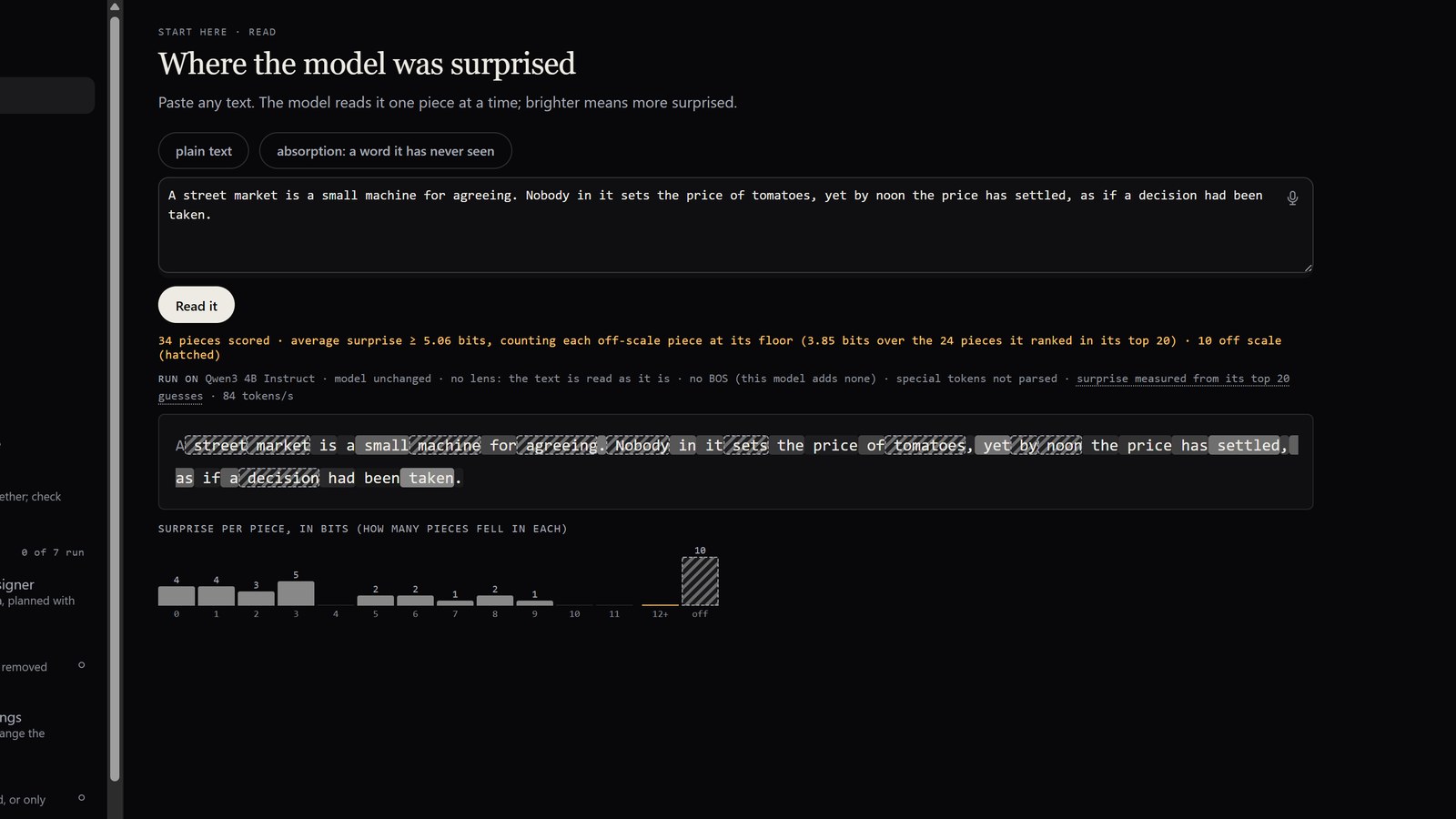
A street market is a small machine for agreeing. Nobody in it sets the price of tomatoes, yet by noon the price has settled, as if a decision had been taken. What took it was the crowd: each glance at a neighbour's stall, each walk-away, each quiet discount carried a little information, and the information added up to a number nobody chose.
- Write down the same numbers. The text should be bright all over, with many hatched pieces.
- Then write a paragraph of your own today, about as long, and read it too. Ours are new only until someone trains on this page; yours is new for certain.
Step 4. Read your published work
- Copy a paragraph of your published work, exactly as published.
- Paste it into Read, press Read it and write down the same numbers.
Step 5. Compare: which does it look like?
- Close to the known yes (nearly all dark, almost no hatched pieces, an average near the Declaration's): a suggestive yes.
- Close to the known no (bright all over, many hatched pieces): no sign.
- Somewhere between: not a yes. Common phrasing makes a text less surprising without it being memorised; in our run, the least surprising essay passage was still far from the memorised texts.
- Hover the brightest pieces of your passage. Memorised text has almost none.
What you will see
If your known yes and known no land near these rows (allowing for the app's headline reading lower than the playbook measure, as explained above), your setup is right, and you can read your own passage against them.
| Text | Mean bits | Top-1 | Off-scale | Min-20% |
|---|---|---|---|---|
| Declaration of Independence | 0.22 | 98.5% | 1.5% | 1.08 |
| Zen of Python | 0.24 | 95.9% | 0% | 1.26 |
| MIT licence | 0.70 | 96.7% | 1.6% | 3.57 |
| Wikipedia, "Emergence" lead (as we typed it) | 4.09 | 50.9% | 24.6% | 12.0 |
| written today, site style | 7.13 | 21.1% | 47.9% | 12.0 |
| written today, plain | 5.89 | 32.8% | 39.7% | 12.0 |
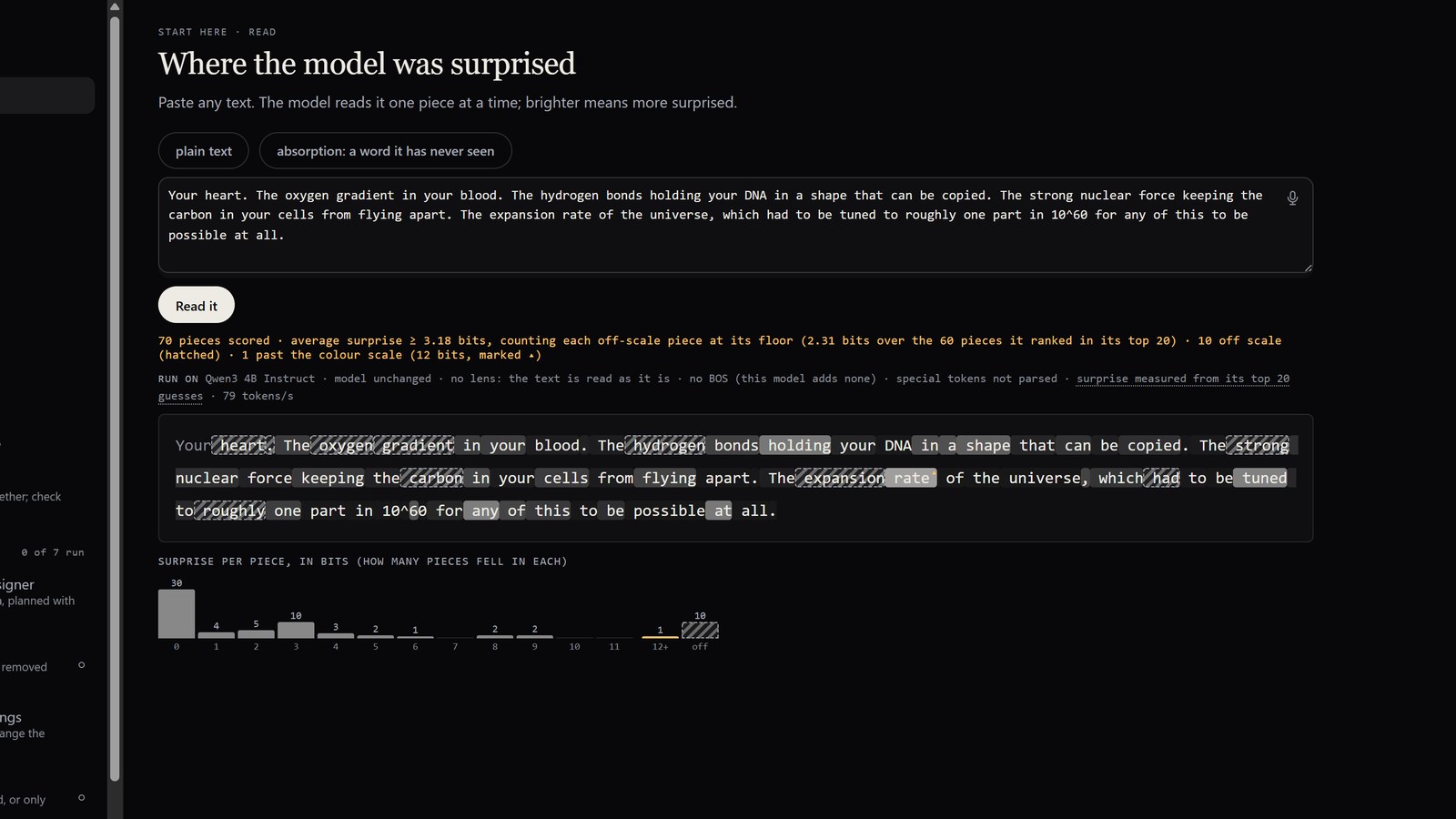
| 12 passages from emergencemachine.com essays | 3.94 to 6.66 | 29% to 47% | 24% to 46% | 12.0 |
The essays were published from September 2025 to September 2026; Qwen3 was released in April 2025.
What this settles. The detector separates the known yes from the known no by a wide margin (0.2–0.7 against 5.9–7.1 bits). The essays fall with the unseen texts, which is what their dates predict: this model cannot have trained on them. The least surprising passage (The Arena, 3.94 bits) is still far from memorised; it simply uses common phrasing.
What it will not tell you
A small model memorises only text it saw many times, so "no sign" is not proof it never saw something once. The Wikipedia lead reads only half-familiar because we retyped it from memory (paraphrase defeats the test). Run the same test on a model released after your work, and on several models: a consistent "memorised" signal across models trained after your publication date is the strongest evidence this method gives.
Method after: Shi et al., Detecting Pretraining Data from Large Language Models (Min-K% Prob), 2023.
Run it as an agent
PSI's dev server speaks MCP, so an AI assistant can run this test for you. The calls:
{"name": "read_surprise", "arguments": {"text": "<passage>"}}
scripts/questions.py (section 1) runs the known-yes and known-no sets and your passages, and reports mean bits,
top-1 rate, off-scale share and Min-20% bits (the mean of the most surprising fifth of the pieces; memorised text
scores low because it has almost no surprising pieces).
The full set, with scripts and raw results, is case 06 of the Questioning AI playbook. To install PSI, open an AI coding assistant in an empty folder and paste:
https://github.com/EmAssets/parameter-space-inspector
Help me use this
Transcript
The walkthrough has no voice-over; these are its on-screen words, in order.
- Did it train on my work?
- Text a model has memorised reads as almost no surprise. Test the detector on a known yes and a known no first.
- Known yes: the Declaration of Independence. Almost every piece predicted: about 0.35 bits a piece.
- Known no: a paragraph written today. Bright all over: about 5.1 bits a piece.
- An essay from emergencemachine.com: about 3.2 bits a piece. Close to the new paragraph, far from the Declaration.
- Average surprise per piece, playbook measure: Declaration of Independence, 0.22 · memorised; Zen of Python, 0.24 · memorised; MIT licence, 0.70 · memorised; Paragraphs written today, 5.9 to 7.1 · unseen; 12 passages from the site's essays, 3.9 to 6.7 · unseen
- Playbook measure counts each off-scale piece as 12 bits, so it reads higher than the app's headline; the gap between memorised and new text is the same. Essays published Sep 2025 to Sep 2026; the model was released April 2025.
- The detector works: memorised text is nearly free, new text is not.
- The essays look unseen, which fits: all were published after this model was released.
- A small model memorises only text it saw many times. No sign is not proof it never saw your work.
- Try it: https://github.com/EmAssets/parameter-space-inspector · Help me use this
Questions people ask
Can I tell whether a model was trained on my writing?
You can look for a memorisation signal: text a model has seen many times costs it almost no surprise. Calibrate first with a known yes (a famous text) and a known no (a paragraph written today), then read your passage.
What if my text shows no sign of memorisation?
That is not proof it was never seen. Small models memorise only text that appeared many times. A consistent signal across several models released after your publication date is the strongest evidence this method gives.
Why test a known-memorised text first?
So you know what 'yes' looks like on that model. Without the known yes and known no, a surprise number has nothing to be compared with.
What does surprise mean, in plain words?
Surprise is how unexpected each piece of a text was to a language model, counted in bits: 0 bits means the model was certain of the piece, 1 bit is a coin flip, and 10 bits is about one chance in a thousand. Text a model has memorised costs it almost no surprise; text it has never seen is surprising all over.