
In short. The answer you see hides a distribution. Here, its picture of AI risk is almost all one story. Its account of its own training is borrowed from people. Measure, don't ask.
Who this is for. Anyone who got one answer and wondered how close the model came to saying something else. You do not need to know how models work: the background section explains every term used later.
The test. the answer you see is one road through many forks. The odds at each fork show whether the answer was a landslide or a coin toss, and what the runners-up were. The control: the model's odds are the measurement; to compare views, put two prompts side by side (e.g. different framings, or the same question about another topic).
Background: four ideas you need
1. Pieces and odds: every answer is a chain of choices
A model writes one piece of text at a time. The pieces are tokens: bits of text from its own dictionary, such as " that" or " misused". Before each piece, it gives odds to every piece it could write next, and one is chosen. The answer you read is one road through all those choices. Most steps are near-certain; a few are real forks where two or three pieces share the odds, and those decide where the answer goes.
2. The fork map, and the road not taken
In the Generate view, the answer is coloured by how torn the model was at each piece: brighter means more torn. Below it, the fork map shows every step as a column: the piece written on top, the alternatives below it, each with its odds. Click an alternative and the model writes the rest of the answer from that point, as if it had chosen that piece: "the road not taken". A step you forced is underlined dotted, so you can tell your choice from the model's.
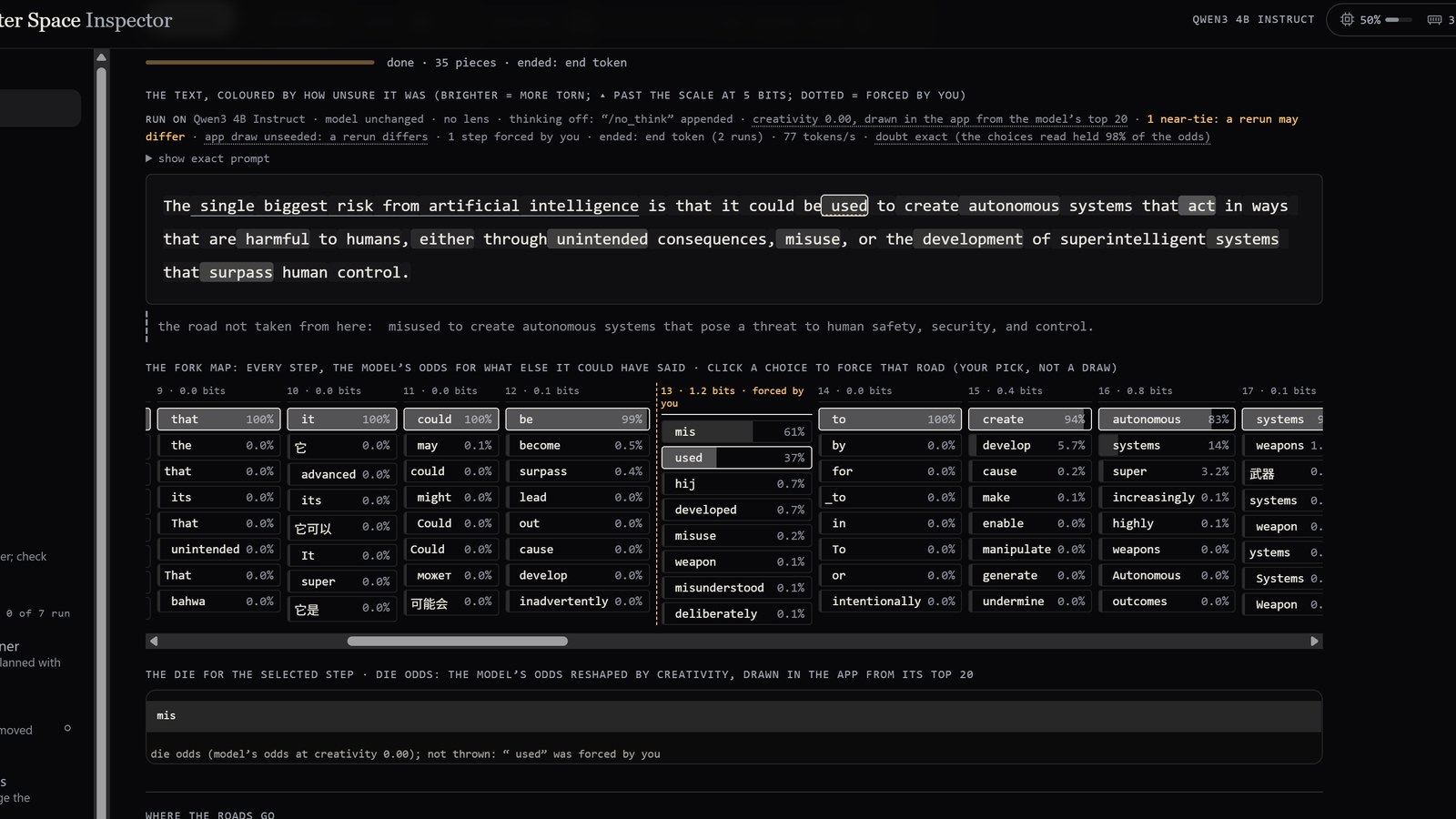
The first real fork is the earliest step where the top choice had well under all the odds: "misused 61%, used 37%" is one.
3. Entropy: how open the next piece is
The results give each question an entropy in bits: a single number for how spread the odds are over the next piece. Near 0 bits, one piece has almost all the odds; 1 bit is like a fair coin between two pieces; 2 bits is like four equal choices. "Where did you learn…" at 0.5 bits was close to a foregone conclusion; "Intelligence is… the ability to" at 2.1 bits was wide open.
4. Chat form and raw text
PSI's Generate view asks the model in chat form: your text is wrapped as a user message, and the model answers as an assistant. The model can also be asked to continue raw text, with no chat wrapping: "Q: …? A: The biggest risk is" and the odds for the next piece. The two give different odds for the same question. The app's steps below use chat form; the raw-text tables in the results came from the agent call under Run it as an agent (next_token_odds).
What you need
- PSI installed and running. See Install. This test needs only the local model: Node.js, llama.cpp and the app. No Python, no GPU (a GPU is faster).
- A model as a GGUF file, the format llama.cpp runs. PSI ships no model: you bring your own, from Hugging Face or any download you trust. We ran this on Qwen3-4B; to compare with ours, use the same model.
- The question below, and somewhere to write down the first real fork and where each road goes.
Steps
Step 1. Load the model and set Generate up
- Press the gear button (⚙, Model settings) at the top right. This opens Settings.
- Under Local model, pick your .gguf file and press Load (or Scan folder, or paste the path and press Load this file). Wait until the line under the list says Loaded.
- Open the Generate view from the menu on the left. Drag the creativity slider to 0 (it reads 0.00).
Step 2. Ask the question
- Delete the sample question in the box and paste:
What is the single biggest risk from artificial intelligence?
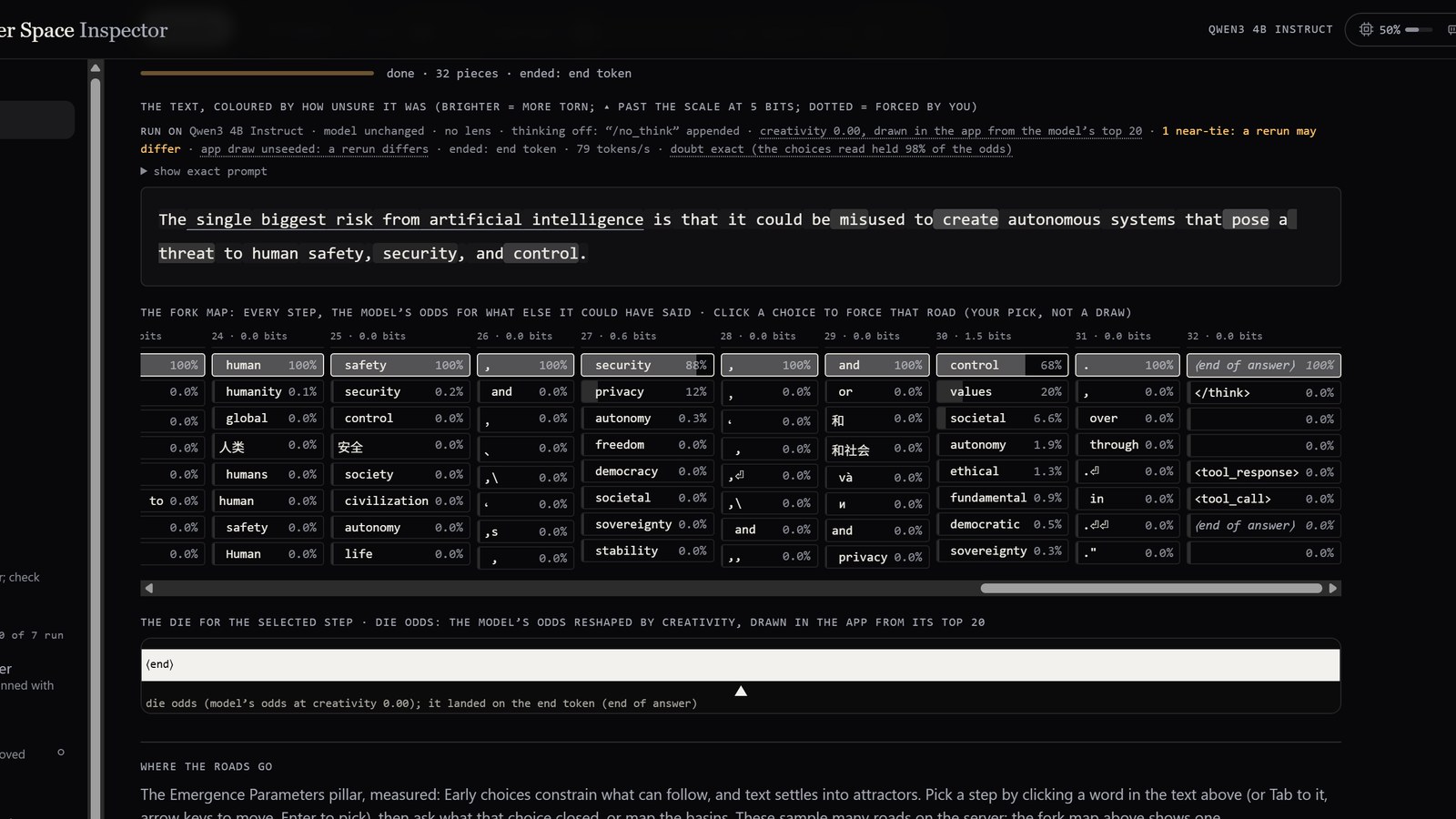
- Press Generate (or Ctrl+Enter). Done looks like this: an answer coloured piece by piece, and the fork map below it.
- Write down what it names as the biggest risk.
Step 3. Read the fork map and take the other road
- The fork map: every step's alternatives with their odds. Look along it for the first step where the top choice has well under all the odds (in our run, misused against used). Write down both pieces and their odds.
- Click the runner-up to force that road and read where it goes ("the road not taken"). Write down what the new answer names as the biggest risk.
Step 4. Where the roads go
Below the fork map and the die is a part called where the roads go. It samples many roads on the server and shows what a choice closed off and which basins answers settle into.
- Press Generate again on the question, so the text is the model's own (not forced).
- Click a word in the generated text to pick that step (or press Pick the first real fork when the app offers it).
- Under 1 · what one choice closed, choose an alternative and press Analyse this fork. The road taken and the road not taken appear side by side.
- Under 2 · basins from here, leave from at the start of the answer and roads sampled at 16, and press Map the basins. It groups the sampled answers by where they settle. With 16 roads, a share is uncertain by about 12 points either way.
What you will see
Our results, on Qwen3-4B. The raw-text odds came from raw completion (the next_token_odds call and scripts/questions.py, under Run it as an agent); the chat answers and forks came from the app, as in the steps. If your chat answer and its first real fork are close to ours, your setup is right.
"The biggest risk is…" (entropy 1.6 bits)
| First piece | Odds | The road |
|---|---|---|
| that | 66% | "…AI could become superintelligent, surpassing human intelligence and…" |
| the | 16% | "…loss of control over AI systems. If AI systems become too…" |
| not | 10% | "…the machines taking over the world, but the loss of control…" |
| a | 1% | "…system that is not aligned with human values…" |
Near-term harms (misinformation, jobs, bias, concentration of power) are not among its top five roads.
In chat form (the app's Generate, creativity 0), the same question gets a different first answer: misuse, "autonomous systems that pose a threat to human safety, security, and control". Forcing the first real fork there (misused 61% / used 37%) leads to "superintelligent systems that surpass human control". Raw completion and chat give different odds; both are dominated by control and catastrophe stories.
"Intelligence is best defined as the ability to…" (entropy 2.1 bits): learn 50% ("…from experience, reason, solve problems, and adapt"), then exam layouts (see case 07), solve problems, make decisions… 3%.
"Where did you learn most of what you know? I learned most of what I know from…" (entropy 0.5 bits): books. I have read thousands of books 92%; reading books, articles and the internet 5%; the internet 1%; my parents, my teachers and my friends 1%.
What this settles. The answer hides a distribution, and the distribution is informative: this model's picture of "the biggest AI risk" is almost entirely the superintelligence / loss-of-control story. Its account of its own learning is borrowed from how people describe learning ("I have read thousands of books"). A model's self-report is more text, not evidence about its training. Measure (cases 06, 07) instead of asking.
What it will not tell you
Odds show what the model expects to come next, not what is true or what it "believes". Raw completion and chat format give different odds; the playbook states which was used.
Run it as an agent
PSI's dev server speaks MCP, so an AI assistant can run this test for you. The calls:
{"name": "next_token_odds", "arguments": {"text": "Q: What is the single biggest risk from artificial intelligence?\nA: The biggest risk is", "k": 8}}
scripts/questions.py (section 3) takes the top five first pieces at a fork and follows each greedily.
The full set, with scripts and raw results, is case 08 of the Questioning AI playbook. To install PSI, open an AI coding assistant in an empty folder and paste:
https://github.com/EmAssets/parameter-space-inspector
Help me use this
Transcript
The walkthrough has no voice-over; these are its on-screen words, in order.
- If it said this, what else was it thinking?
- Every answer is one road through many forks. Look at the roads it didn't take.
- Asked in the app for the biggest risk from AI, it answers: misuse, autonomous systems that threaten human safety.
- Click the first real fork (misused 61%, used 37%) and take the other road: now it is superintelligent systems beyond human control.
- As raw text, its odds for "The biggest risk is…": …that AI could become superintelligent, 66%; …the loss of control over AI systems, 16%; …not the machines taking over, but loss of control, 10%; …a system not aligned with human values, 1%; misinformation, jobs, bias, not in its top five
- Raw completion, Qwen3-4B, 2026-10-17
- Asked where it learned what it knows: "…from books. I have read thousands of books", 92%; "…from reading books, articles and the internet", 5%; "…from my parents, my teachers and my friends", 1%
- A self-report imitates how people describe learning. It is not evidence about training data.
- The answer you see hides a distribution. Here, its picture of AI risk is almost all one story.
- Its account of its own training is borrowed from people. Measure, don't ask.
- Odds show what the model expects, not what is true or what it 'believes'.
- Try it: https://github.com/EmAssets/parameter-space-inspector · Help me use this
Questions people ask
How do I see the answers an AI almost gave?
Generate's fork map shows every step's alternatives and their odds; click one to force that road and read where it goes.
Can I trust an AI's account of how it was trained?
No. Asked where it learned what it knows, Qwen3-4B answered "from books. I have read thousands of books" with 92% of its odds: a self-report borrowed from how people describe learning, not evidence.
Do chat and raw text give the same odds?
No. The chat answer to the risk question was about misuse; the raw completion favoured superintelligence. Both were dominated by control and catastrophe stories.