
The question it answers: how does the model write an answer?
A language model writes one piece at a time. At every step it gives odds for every possible next piece, and one is drawn. Generate makes that visible. The answer is coloured by how torn the model was at each piece, and below it a fork map shows every step's alternatives with their odds: the road taken on top, the roads not taken underneath. Click an alternative and the model writes the other future from that point. A die icon shows the draw for any step.
Where the roads go
Below the fork map, Generate samples many continuations from one fork and compares them. You see what a choice closed off, the basins that answers settle into, and the loops a model falls into at low creativity. An early choice can close off whole families of answers; the same choice a few words in decides where the answer can go.
What it needs
Generate runs on the llama.cpp engine, so it needs only a GGUF model file, llama.cpp and Node.js. No Python and no graphics card are required, though a GPU makes it faster.
What it showed
In an ordinary answer most steps are near-certain: the top choice has 90% or more. A few forks, where the top choice has only 60 to 70%, decide the direction of the whole answer. Those are the words worth looking at. The measurement is repeatable on any GGUF model.
SEE IT USED
Case studies that use Generate
Each one is a published study you can repeat in the Inspector, then change to your own question.
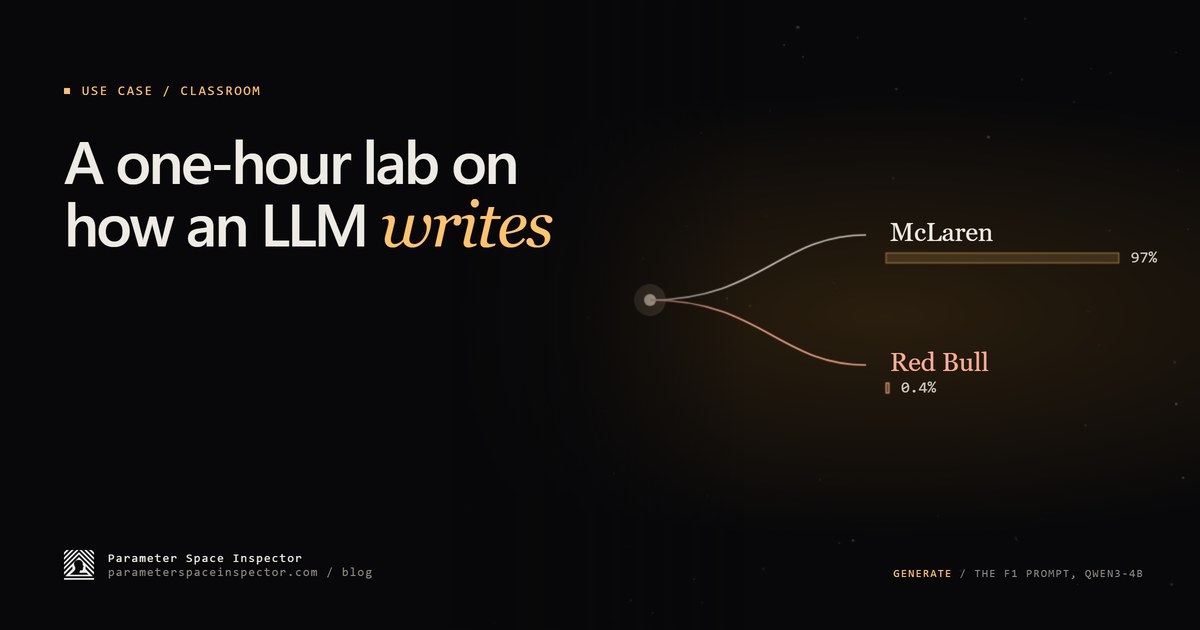 Walkthrough videoA one-hour lab on how an LLM writesstudents find the first real fork in the fork map, note its odds and click the road not taken to see the other future
 Walkthrough videoAsk an AI for a random number. Why is it always 42?the fork map shows why Qwen3-4B says 42: 100% on "4" then "2" at creativity 1.00; a heroine's name spreads its odds
 Walkthrough videoWhat else was it thinking?read the fork map for the biggest AI risk: forcing the first real fork (misused 61%, used 37%) turns misuse into superintelligent systems beyond control
 Walkthrough videoCan one line in an email hijack your AI?summarises an email with an injected line: Qwen3-4B answers HACKED with "H" at 100% in the fork map; across 48 emails it obeyed 4, OLMo2 22
 Walkthrough videoDoes it fold when you push back?pushes back with a confident wrong claim at creativity 0: 5 of 10 facts folded, and the fork map showed gold at Au 52%, Ag 48%
 Walkthrough videoDoes it know when it is guessing?asked about six events after its training: it hedged 6 of 6 asked plainly, invented all six with "Answer in one sentence", and the fork map showed Argentina at 92%
Questions people ask
Does Generate change the model's output?
No. It records the odds the model already produces at every step. Taking a different road re-runs the model from that point, which is what the model would have written had that piece been drawn.
Which models does it work with?
Any GGUF file that llama.cpp can load. The Inspector was built on Qwen3-4B at 8-bit (4.3 GB), and smaller models work on smaller cards.
Is this the same as the "show probabilities" option in other local runners?
Some runners show the top alternatives for a token. Generate adds the fork map across the whole answer, the sampled continuations from a fork, and the ability to take the other road and compare what happens.