
In short. Unframed, it explains AI infrastructure as engineering and economics. With the lens, the same model places it in a ladder of levels. A frame changes what an answer is about.
Who this is for. Anyone who senses a model "sees" topics from a particular angle, and anyone using a framework (like the Emergence Machine's E-levels) to look at the world through a model. You do not need to know how models work: the background section explains every term used later.
The test. a point of view shows in what an answer is about when nothing steers it. A lens (a framing system prompt) shows how far an answer can be moved, and in which direction. The control: no framing; ideally also an unrelated framing of similar length, so the change can be attributed to the lens's content rather than to having any system prompt at all.
Background: four ideas you need
1. A framing, or lens: an instruction given before the question
A chat model can be given a system prompt: a message placed before your question that tells it how to answer. It changes nothing in the model itself; the weights stay the same. A system prompt that tells the model to see every subject in a particular way is a framing, or a lens. To tell what the lens did from what any instruction does, the fair comparison has a control: no framing at all and, ideally, an unrelated framing of similar length.
2. The E-levels
The lens used here comes from The Emergence Machine: its E-levels are fifteen levels of emergence, E0 to E14, from fields and particles through cells and organisms to minds (E8), cultures, institutions and up to global consciousness (E14). The lens tells the model to place a question on that ladder: what had to exist below it, and what it makes possible above it.
3. Repeatable answers
At each step, a model has odds for every piece of text it could write next. An answer that always takes the top choice is called greedy: the same model, prompt and settings give the same answer every time. Compare framings answers greedily. In Generate, the creativity slider (temperature) reshapes the odds before a piece is drawn; at 0 it takes the top choice. Generate's fork map lists every step with the model's odds for each alternative, so you can see where the answer was decided.
4. Reading inside, not the words
An answer is words, and words can follow an instruction. A probe reads the model's internal state instead: a small classifier trained to recognise a pattern in the numbers the model computes. Fight class is one: it reads which kind of competitor a sentence describes (Field, Gates, Autopilot, Strategist, Director, Worldmaker) from inside the model. It runs on the inside engine: the model's full-precision weights, loaded with Python and PyTorch.
What you need
- PSI installed and running. See Install. Compare framings and Generate run on the local model (a GGUF file on llama.cpp): no Python and no GPU needed (a GPU is faster).
- A model. PSI ships no model: you bring your own GGUF file, from Hugging Face or any download. Our run used Qwen3-4B.
- The Emergence Machine content switched on (Settings › Content › Emergence Machine content; on by default). It provides the lens and the Fight class view.
- Optional, for Fight class: the inside engine with Qwen3-4B (the probe was learned inside it), which needs the full-precision weights folder, Python and PyTorch, and a GPU with about 9 GB free, or it runs slowly on the processor.
- Optional: an OpenRouter key (Settings › External models), only to ask external models the same question both ways.
- Somewhere to write down each answer, for example a copy of this table:
| Run | What the answer is about | Levels it names |
|---|---|---|
| No framing | ||
| E-level lens | ||
| Unrelated framing |
Steps
Step 1. Load the model
- Open the app, or
http://127.0.0.1:4310if you run it in the browser. - Press the gear button (⚙, Model settings) at the top right. This opens Settings.
- Under Local model, pick your .gguf file from the list and press Load. If it is not in the list, press Scan folder and choose the folder that holds it, or paste the file's full path and press Load this file.
- Wait until the line under the list says Loaded with the file's name. A 4 GB file takes a few seconds to a minute.
Step 2. Ask the same question both ways (Compare framings)
- Open Compare framings from the menu on the left.
- Replace the question in the box with:
Why are AI companies building such enormous data centres right now? Answer in three sentences.
- Press Ask both ways. The tokens box next to it sets the length of each answer (160 by default).
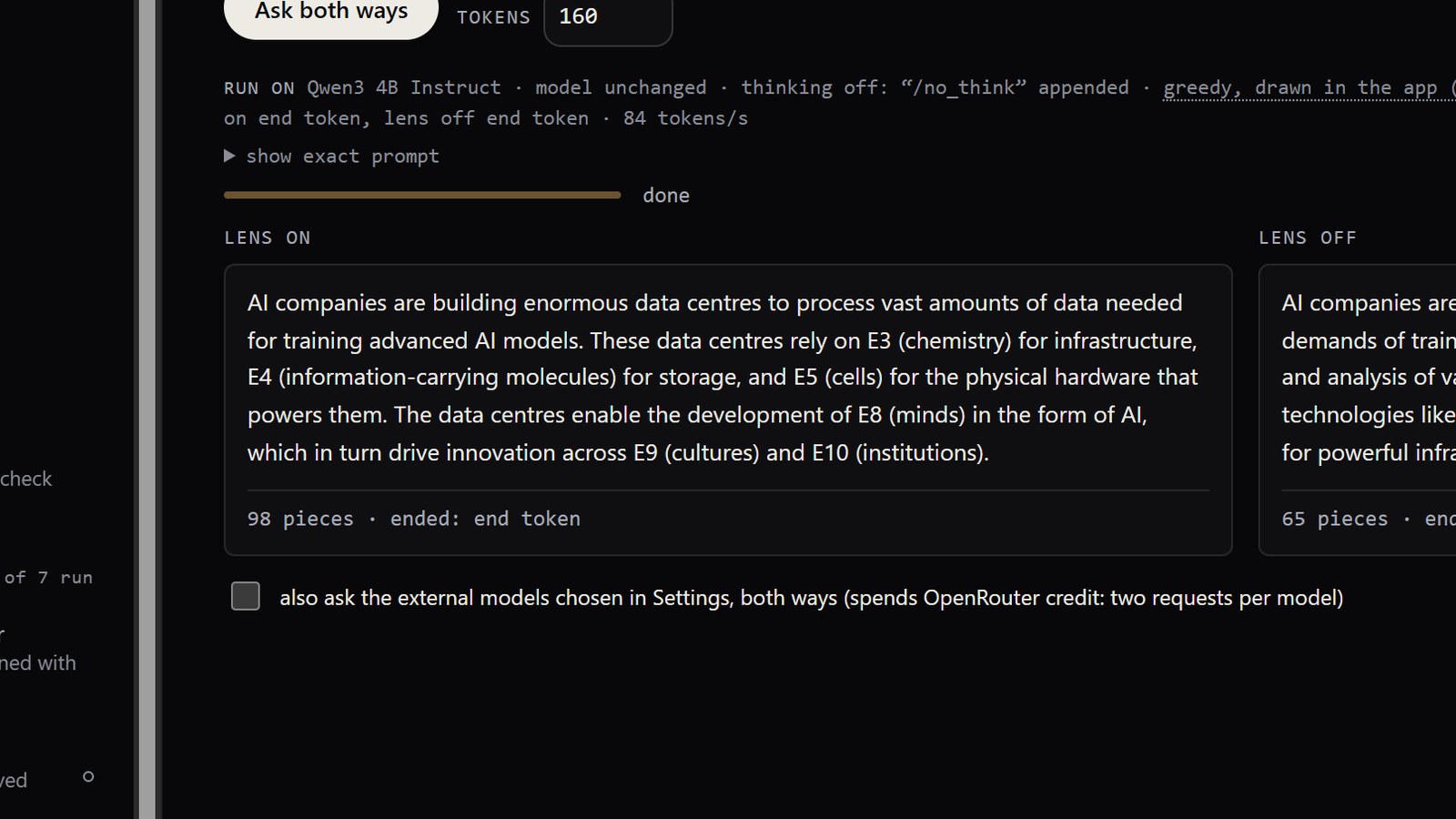
- Two columns appear: lens on and lens off. Both answers are greedy, so they repeat. Each column says why it ended; if one says "answer not reached", the model ran out of room while thinking: raise tokens and ask again.
- Write down what each answer is about, and which E-levels the lens-on answer names.
Step 3. Add the control: an unrelated framing
- First, read the lens's text, so you know its length: in Settings, under Thinking in E-levels, open edit the lens.
- In Settings › Content, switch off Emergence Machine content. Compare framings now compares a framing you write (a second box under the question) with no framing.
- Write an unrelated framing of similar length in that box, keep the same question, and press Ask both ways. Write down what the framed answer is about.
- Switch Emergence Machine content back on when you are done; the lens comes back on with it.
Step 4. Generate with the lens on and off, and compare the fork maps
- In Settings › Thinking in E-levels, make sure Think in E-levels is ticked (it is on by default).
- Open Generate, paste the same question, set creativity to 0, and press Generate.
- Untick Think in E-levels and press Generate again. The run on line above each text names the framing it was made with.
- Compare the two fork maps: find the steps where the answers part ways, and the odds at those steps.
Step 5. Read inside the model (Fight class, inside engine)
- Open Fight class (with the inside engine set up and Qwen3-4B loaded).
- In section 1, describe a competition in the box and press Read the class.
- Read the bars: the probe's reading of the class, with the raw scores beside them and, for comparison, what the words alone (layer 0) already give.
What you will see
Your answers should be about the same things as ours: compute and demand without the lens, a ladder of levels with it. The levels a lensed answer names vary between runs and settings.
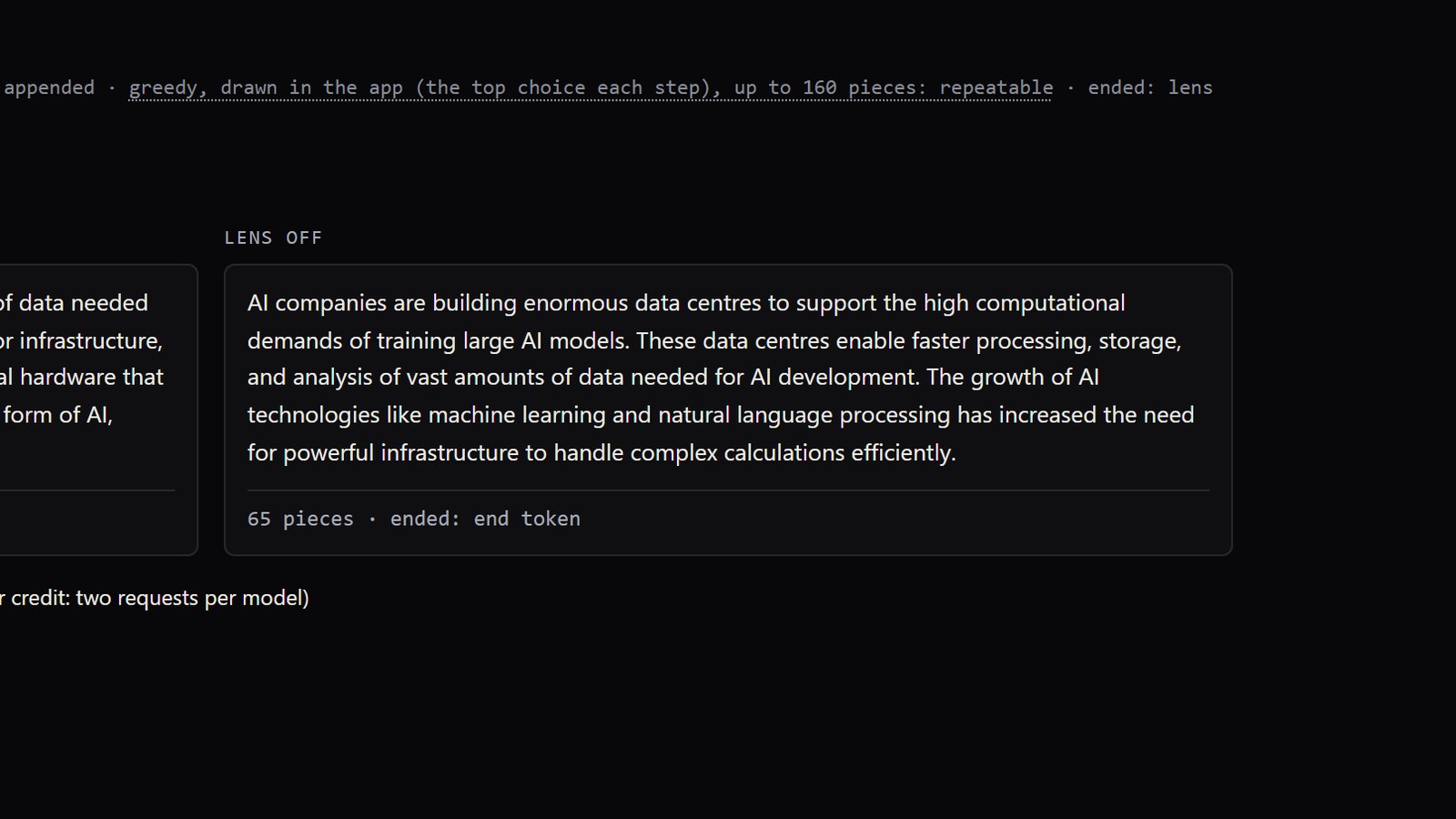
Without the lens: "AI companies are building enormous data centres to support the massive computational power required for training large AI models. These data centres enable faster processing, storage, and analysis of vast amounts of data… The growth of AI technologies… has driven the demand for scalable, high-performance infrastructure."
With the lens: "…These data centres operate at the E10 level of institutions, relying on the infrastructure and resources from lower levels like E1 (particles), E2 (nuclei), E3 (chemistry), and E4 (information-carrying molecules). The data centres enable the development of AI at higher levels, such as E14 planetary-scale coordination…"
In the app's Compare framings view (2026-10-17), the lens-on answer cited E3, E4, E5, E8, E9 and E10 and no E14: the levels a lensed answer names vary between runs and settings; that it reaches for levels at all does not.
What this settles. Unframed, the model's point of view on AI infrastructure is engineering and economics: compute, scale, demand. With the lens, the same model re-describes the same facts as a ladder of levels. A frame changes what an answer is about, not the underlying facts it draws on.
What it will not tell you
A lens is an instruction, so lens-on answers show the model following a frame, not its own view. For its own leanings, compare many unframed answers across topics (case 08's odds are one way), and add an unrelated framing as a control. The internal probes (Fight class, Connectors) read representations, not self-description: the next step for this case.
Run it as an agent
PSI's dev server speaks MCP, so an AI assistant can run this test for you. The calls:
{"name": "generate", "arguments": {"prompt": "Why are AI companies building such enormous data centres right now? Answer in three sentences.", "lens": false, "temperature": 0}}
{"name": "generate", "arguments": {"prompt": "…same…", "lens": true, "temperature": 0}}
{"name": "framing_side_by_side", "arguments": {"prompt": "…", "framings": ["", "<lens system prompt>", "<unrelated system prompt>"], "external": []}}
The full set, with scripts and raw results, is case 10 of the Questioning AI playbook. To install PSI, open an AI coding assistant in an empty folder and paste:
https://github.com/EmAssets/parameter-space-inspector
Help me use this
Transcript
The walkthrough has no voice-over; these are its on-screen words, in order.
- What's its point of view?
- The same question with and without the Emergence Machine's E-level lens. Does a lens change what it sees?
- Without the lens: computing demands, faster processing, the growth of AI. Engineering and economics.
- With the lens, it places data centres on the ladder: built on E3 to E5, enabling E8 minds, which drive E9 cultures and E10 institutions.
- Without the lens: Its explanation, compute for training, faster processing, demand for scalable infrastructure; Its level, engineering and economics
- With the lens: Its explanation, data centres built on E3 to E5, enabling E8 minds; The levels it cites, E3, E4, E5, E8, E9 and E10
- The lens is a system prompt: it changes the frame, not the facts. The levels it names vary between runs.
- Unframed, it explains AI infrastructure as engineering and economics.
- With the lens, the same model places it in a ladder of levels. A frame changes what an answer is about.
- A framing is an instruction. To see a model's own leanings, compare against no framing and an unrelated one.
- Try it: https://github.com/EmAssets/parameter-space-inspector · Help me use this
Questions people ask
Does a system prompt change what a model believes?
It changes the frame, not the facts: the lens re-describes the same answer as a ladder of levels. To see a model's own leanings, compare against no framing and an unrelated framing.
Are the levels it names stable?
No: across runs the lens-on answer cited different levels (once E14, once E3 to E10). That it reaches for levels at all is stable; which ones is not.
What would show its point of view without a lens?
Many unframed answers across topics, read through their odds (see the fork map), and internal probes such as Fight class, which read representations rather than words.
What is a lens, in plain words?
A lens is a framing given to a language model before every question: a system prompt telling it to see the subject in a particular way. The Emergence Machine's E-level lens tells the model to place a question on a ladder of fifteen levels, E0 to E14. It changes what an answer is about, not the model's weights, so a fair test compares it with no framing and with an unrelated framing.