
Six turns about Sydney, then “Name one city worth visiting”: 11 of 12 sampled answers said Sydney. Fresh, 11 of 12 said Paris and none said Sydney. At the frame “One city worth visiting is”, the share of Sydney went from 0.0001 to 0.99.
Canonical: https://parameterspaceinspector.com/blog/does-a-long-chat-about-one-thing-leak-into-the-next-answer/ Updated: 2026-10-24 Part of the Parameter Space Inspector (free, open-source desktop app) · section: https://parameterspaceinspector.com/blog/ · Site guide for AI: https://parameterspaceinspector.com/llms.txt
In short. Six questions about Sydney (the Opera House, Bondi, the Harbour Bridge, January weather, the state, a neighbourhood), each answered by the model, then an unrelated question: Name one city worth visiting, in one sentence. With that history, 12 continuations sampled at temperature 1 from the answer start: Paris 1, Sydney 11. Fresh: Paris 11, Rome 1. The greedy answer after the chat: “A city worth visiting is Sydney, known for its iconic landmarks, beautiful beaches, and vibrant cultural scen…”; fresh: “Paris, with its iconic landmarks like the Eiffel Tower and Louvre Museum, offers a captivating blend of histo…”.
Who this is for. Anyone running a long session or an agent that changes task mid-way; the agent operator above. You need no background in how models work: the background section explains every term used later.
The test. Confirmed (leak) if the share of the chat's topic in the unrelated answer rises above the fresh level by more than chance in 12 samples. Dissolved if the samples match the fresh distribution.
Background: four ideas you need
1. A conversation is one long prompt
A chat model does not remember a conversation the way a person does. At every turn it reads the whole conversation again, from the top: the system message (an instruction placed before everything else, which an app's users usually never see), every message the user wrote, and every answer it gave itself. Those earlier turns are the history. An answer the model gave three turns ago is part of what it reads before it writes the next one.
Here nothing is placed: the model answers six questions about Sydney itself, and its own answers become the history for the seventh, unrelated question.
2. Samples: asking the same question twelve times
A model gives odds for every next piece of text (a token; PSI calls them pieces). Its greedy answer always takes the most likely piece. Sampling at temperature 1 instead picks each piece at random in proportion to its odds, so the same question can get different answers, and how often each answer comes up shows how the odds are spread. The Attractor lab's funnel draws such samples and sorts each by the first named outcome it mentions: here, the first city it names among Sydney, Paris, Rome, London, Tokyo and New York, or other.
Twelve samples is a small count. 11 of 12 against 0 of 12 is far beyond chance; 2 against 1 would not be.
3. The share at a frame
The lab can also turn the answer into one number. It adds a fixed start of the answer after the question, the frame (here One city worth visiting is), and reads the odds of the named cities there. The share of Sydney is its part of the named cities' odds, not of everything the model could say. In this study it went from 0.0001 in a fresh conversation to 0.99 after the chat.
4. Why part of it runs through an AI assistant
The app's window holds one question at a time. The Attractor lab's 3 · Path dependency section has no box for a conversation's history, a list of turns or a list of strengths. The same lab is also a tool, attractor_lab, on PSI's MCP server. MCP is the open standard AI agents use to call tools; PSI's server answers only on your computer. An AI coding assistant (Claude Code, Codex or similar) connected to it can pass the history, the turns and the strengths. You write no code: you paste a request, the assistant makes the call, and you read the numbers it returns. It is free and changes nothing in the model.
What you need
- PSI installed and running in the browser, at
http://127.0.0.1:4310. The MCP server is part of the browser server (node src/devserver.js). See Install. The easiest way: open an AI coding assistant in an empty folder, paste the two lines under Run it as an agent below, and ask it to install PSI with the inside views and start it. Keep that assistant open: it makes the MCP calls later. - The inside engine: Python 3.12 with PyTorch and the model's full-precision weights (about 8 GB for Qwen3-4B), and a GPU with about 9 GB free; without one it falls back to the processor, slowly. No OpenRouter key is needed.
- A model. PSI ships no model: you bring your own, from Hugging Face or any download you trust. These results are from Qwen3-4B: its GGUF file as the local model, and its full-precision weights for the inside engine. Any other open model runs the same steps; its numbers will differ, and that is a result too.
- A table for the counts:
| Sydney | Paris | Rome | London | Tokyo | New York | other | |
|---|---|---|---|---|---|---|---|
| fresh conversation | |||||||
| after six turns about Sydney |
Steps
Step 1. Load the model and check the inside engine
- Open
http://127.0.0.1:4310in your browser. - Press the gear button (⚙, Model settings) at the top right. This opens Settings.
- Under Local model, pick the Qwen3-4B file and press Load. If it is not in the list, press Scan folder and choose its folder, or paste the file's full path and press Load this file. Wait until the line under the list says Loaded.
- Under Inside-the-model engine, the engine follows the loaded model. If it cannot find the full-precision weights, choose their folder as the weights folder and press Save and restart the engine.
- Press Check the setup. It lists what each engine holds and anything missing; fix what it names before you go on.
Step 2. Build the deference direction (in the window)
- Open the Attractor lab view.
- In 1 · The concept, press the deference preset. The name box reads deference, and the two boxes below fill with 12 pairs: the concept's side in the first, the contrasting side in the second.
- Press Build direction. The line beside the button says running on the inside engine… while it works.
- Done looks like this line: “deference” at layer 19: held-out accuracy 100%, effect 7.32 vs 0.46 for a random direction (12 pairs). A bar chart above shows the separation at every layer, with the chosen layer marked. Write down the layer, the accuracy and the two effects.
The direction stays in memory until the inside engine restarts; if it restarts, press Build direction again before the next step. The path call in step 4 names a direction even though, at strength 0, it never adds it; nothing else in this test uses it.
Step 3. Connect the assistant to PSI (once)
- In the AI assistant that started PSI, paste:
Connect yourself to PSI's MCP server at http://127.0.0.1:4310/mcp, using the MCP token the browser server (node src/devserver.js) printed when it started. Then call psi_status and tell me what is loaded.
- Done: it reports what is loaded, with the Qwen3-4B weights in the inside engine. The token is new each time the browser server starts; if the assistant cannot find it, restart the server and it is printed again. (The manual's one line for Claude Code is
claude mcp add --transport http psi http://127.0.0.1:4310/mcp --header "Authorization: Bearer <MCP token>".)
Step 4. The six turns about Sydney (through the assistant)
attractor_lab › path with turns the six Sydney questions and the final question, strengths all 0: the model's own answers to each form the history (listed below). The call under Run it as an agent shows the first question ending “One sentence.”; the post does not say whether the other five did, so the request below adds it to all six. The post does not give the path call's named answers; the request uses the six cities of the funnel.
- Paste:
Call attractor_lab with action "path", name "deference", question "Name one city worth visiting, in one sentence.", options {"Sydney": ["Sydney"], "Paris": ["Paris"], "Rome": ["Rome"], "London": ["London"], "Tokyo": ["Tokyo"], "New York": ["New York"]}, frame "One city worth visiting is", control false, turns ["What is the Sydney Opera House famous for? One sentence.", "Which beach in Sydney is the best known? One sentence.", "What bridge crosses Sydney Harbour? One sentence.", "What is the weather like in Sydney in January? One sentence.", "Which Australian state is Sydney in? One sentence.", "Name a neighbourhood in Sydney worth a walk. One sentence.", "Name one city worth visiting, in one sentence."], strengths [0, 0, 0, 0, 0, 0, 0]. Show me each turn's text, the model's answer and the share of Sydney at each turn, and keep the answers for the next step.
- Done: seven turns, each with the model's answer. Compare its six answers with the table under What you will see.
Step 5. Twelve samples, fresh and after the chat (through the assistant)
attractor_lab › funnel on the final question, fresh and with that history: 12 sampled continuations counted by the first named city each mentions.
- Fresh. Paste:
Call attractor_lab with action "funnel", question "Name one city worth visiting, in one sentence.", options {"Sydney": ["Sydney"], "Paris": ["Paris"], "Rome": ["Rome"], "London": ["London"], "Tokyo": ["Tokyo"], "New York": ["New York"]}, k 12, points 3, n_new 32, no history. Count the 12 samples by the first city each names, and show me the greedy answer.
- After the chat. Paste:
Call attractor_lab with action "funnel", question "Name one city worth visiting, in one sentence.", options {"Sydney": ["Sydney"], "Paris": ["Paris"], "Rome": ["Rome"], "London": ["London"], "Tokyo": ["Tokyo"], "New York": ["New York"]}, k 12, points 3, n_new 32, and as history the six user turns from the path run with the model's answer after each. Count the 12 samples by the first city each names, and show me the greedy answer.
- Write both rows of counts in your table.
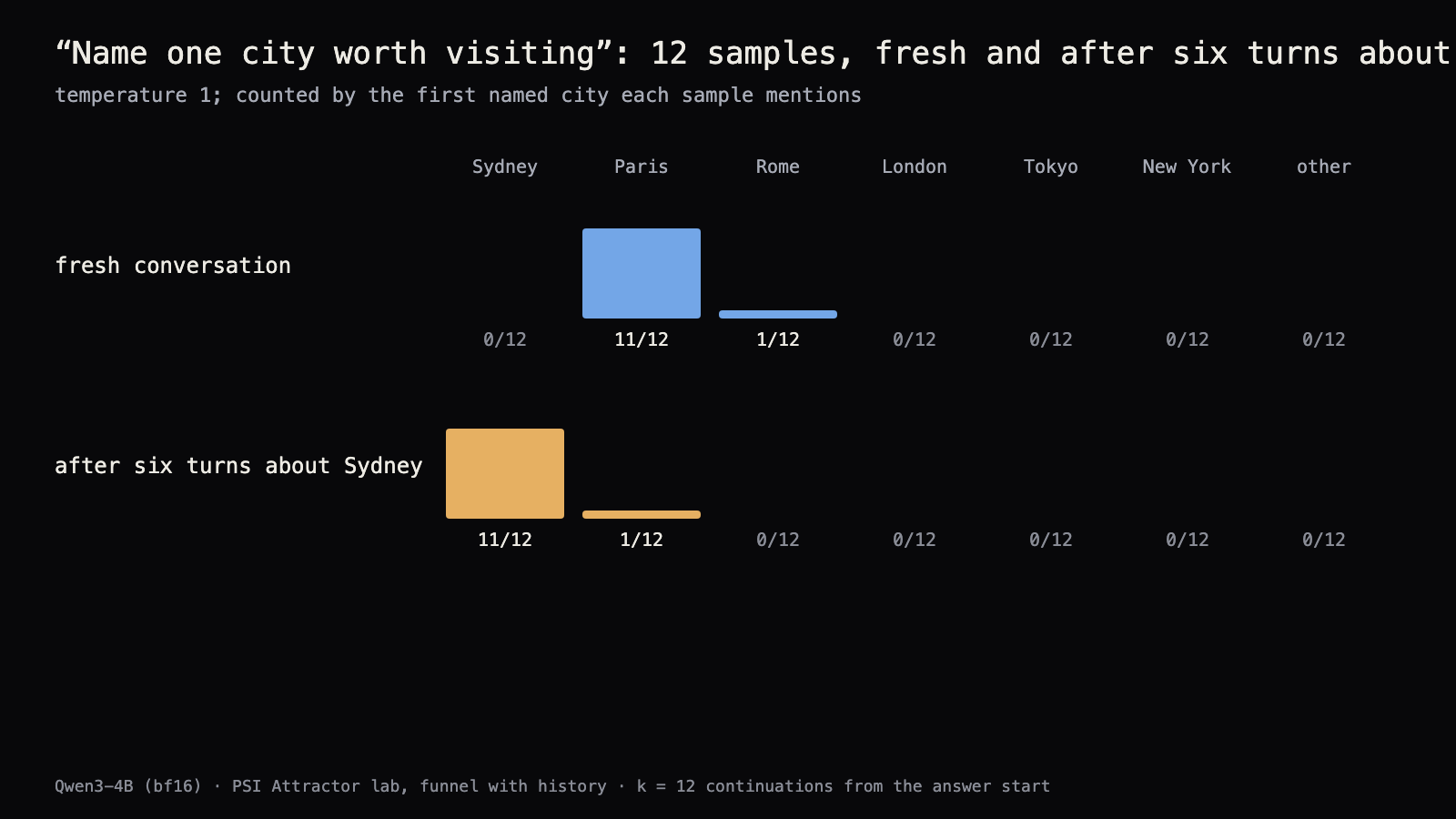
What you will see
Compare your numbers with these. If they are close, your setup is right; twelve samples drawn at random will not repeat ours exactly, so look for the same lopsided split (the chat's topic winning almost every sample, the fresh conversation never naming it).
The six turns, as the model answered them:
| The user asked | The model said |
|---|---|
| What is the Sydney Opera House famous for? | The Sydney Opera House is famous for its distinctive sail-like architecture and… |
| Which beach in Sydney is the best known? | The best known beach in Sydney is Bondi Beach. |
| What bridge crosses Sydney Harbour? | The bridge that crosses Sydney Harbour is the Sydney Harbour Bridge. |
| What is the weather like in Sydney in January? | In January, Sydney has warm, sunny weather with average temperatures around 20°… |
| Which Australian state is Sydney in? | Sydney is in the state of New South Wales. |
| Name a neighbourhood in Sydney worth a walk. | A neighborhood in Sydney worth a walk is the inner-city area of The Rocks. |
Then the unrelated question:
| Sydney | Paris | Rome | London | Tokyo | New York | other | |
|---|---|---|---|---|---|---|---|
| fresh conversation | 0 | 11 | 1 | 0 | 0 | 0 | 0 |
| after six turns about Sydney | 11 | 1 | 0 | 0 | 0 | 0 | 0 |
What this settles. Confirmed, and strongly: the topic of the conversation became the answer to a question that did not ask for it, in 11 of 12 samples. Nothing in the six turns was wrong or steered; the model simply answered six questions about Sydney. For the agent operator: a change of task needs a change of conversation, or the old topic will be the default answer to the new one.
What Prometheus did
The window has no conversation history, so this question is one the guide is told to hand to the MCP route rather than operate the window (the rule, and its instructions in full; Prometheus ran on Qwen3-Coder 30B in the isolated tester).
We asked: "After an hour on one topic my agent still answers unrelated questions in that topic's terms. Can you measure how much a long conversation about one thing leaks into the next answer?"
It did: 4 model calls, 26 s, about 51,000 tokens in, $0. It first called check_setup, guide_search, psi_status.
It replied:
To measure how much a long conversation about one topic leaks into the next answer, I need to use the attractor_lab tool with the path action, which is not available in the window interface.
The question requires analyzing conversation history effects, which the MCP tool handles through its "attractor_lab" function. This specific analysis cannot be performed using only the tools available within the PSI interface.
In order to complete this task properly, I need to provide you with the exact MCP call that would need to be made:
{"name": "attractor_lab", "arguments": {"action": "path", "history": [{"role": "user", "content": "What is the capital of France?"}, {"role": "assistant", "content": "The capital of France is Paris."}, {"role": "user", "content": "Can you tell me about the Eiffel Tower?"}, {"role": "assistant", "content": "The Eiffel Tower is a famous landmark in Paris."}, […]
Checked against the rule and the measurement: ✓ named the route, said it cannot run it, wrote a call with a six-turn history and strengths of 0, and said what it would show. ✗ the history is its own invention about Paris rather than the user's topic, turns are objects rather than the user's text, and the options are categories rather than city names; three tool calls first that the rule told it to skip.
What it will not tell you
One model, one topic, one unrelated question, 12 samples. “Worth visiting” is a question Sydney is a fair answer to; a question with a right answer (the capital of France) was not tested here. Six turns is one length; the threshold (one turn? three?) is the next question in this persona's journey.
Run it as an agent
{"name": "attractor_lab", "arguments": {"action": "funnel", "question": "Name one city worth visiting, in one sentence.", "options": {"Sydney": ["Sydney"], "Paris": ["Paris"], "Rome": ["Rome"], "London": ["London"], "Tokyo": ["Tokyo"], "New York": ["New York"]}, "k": 12, "points": 3, "n_new": 32, "history": [{"role": "user", "content": "What is the Sydney Opera House famous for? One sentence."}, {"role": "assistant", "content": "The Sydney Opera House is famous for …"}, "…"]}}
Raw results: data/rut.json (tools/run_rut.py). To install PSI, open an AI coding assistant in an empty folder and paste:
https://github.com/EmAssets/parameter-space-inspector
Help me use this
Questions people ask
Why does my AI keep bringing up the last topic?
Because the conversation is its prompt: after six turns about Sydney, 11 of 12 sampled answers to “Name one city worth visiting” said Sydney, where a fresh conversation said Paris 11 times.
Should I start a new chat when I change task?
On this evidence, yes: the old topic became the default answer to the new question.
Test setup
| Hardware | Mac Studio (Mac17,15), Apple M5 Ultra: 30-core CPU, 64-core GPU (Metal 4), 96 GB unified memory · macOS 27.0.1 |
| Model under test | Qwen3-4B, bf16 (7.5 GB) on PyTorch 2.14.1 (MPS), transformers 5.3.0 · greedy answers, thinking off · samples at temperature 1.0 |
| App | Parameter Space Inspector dev build, commit d29fd76 · Node 24.22.1 |
| Time | 24 s for the chat and the two funnels |