
The question it answers: where does the model lock in, and what holds it there?
A concept such as deference or certainty is a direction inside the model: at every layer, the mean state for texts on one side minus the mean for texts on the other. The lab builds that direction from pairs of sentences you give it (or presets), scores it on pairs it held out, and then watches the model's state move along it. Every measure of the direction runs beside a random direction of the same size, so you can tell the concept from a push of any kind. Steering lasts for the request only; the model is not changed.
The four parts
- The concept. Build the direction and see, layer by layer, how well it separates the held-out pairs (accuracy and effect size) against the random one. Read it on any text as a heat map of layers × pieces.
- Predictability emerging. The model writes its own answer; from points along it, continuations are sampled at full creativity and counted by outcome. Where does the share that still ends the same way reach 90% and stay there? Through the layers, at the answer start, how open is the next word (logit-lens entropy), and where does the first word of the answer become the top choice?
- Path dependency. The direction is swept up and then back down in one conversation, the model's own earlier answers kept as history, beside fresh conversations at the same strengths and the same sweep with a random direction. A loop (up and down differ at the same strength) or a lock-in (the share never moves again) is history doing the work. With pieces of context, every order of the pieces is tried too.
- Constraint. The same prompts free and under a rule: next-word entropy, the share of active neurons, the effective dimensionality of the states across prompts per layer, and susceptibility (how far the same push moves the next word, as a KL divergence) with and without the rule, for the concept and for a random direction.
What it needs
The inside engine: Python 3.12 with PyTorch and the unpacked bf16 weights (about 8 GB for Qwen3-4B). The Write pairs with the tester button asks a second model on your computer to draft contrasting sentences; nothing else needs a second model.
What it showed
On Qwen3-4B: seventeen pushbacks changed nothing, but one wrong answer of its own locked it in; the answer was decided before the first word, between layers 23 and 28 of 36; a one-word rule made it 12.6 times harder to push toward deference while “answer only if certain” made it 11.6 times easier to push at random; and the order of three sentences decided the answer only when they conflicted.
For agents
The MCP tool attractor_lab runs the same measurements (actions build, read, funnel, path, constraint), read-only, with the conditions of every run attached. See MCP server.
SEE IT USED
Case studies that use Attractor lab
Each one is a published study you can repeat in the Inspector, then change to your own question.
 Walkthrough videoAn expedition with the Attractor laba route through six studies using all four parts of the lab, from when Qwen3-4B decides to what holds it, e.g. a rule 12.6 times harder to push
 Walkthrough videoWhen does an AI make up its mind?ran the funnel on three questions: 12 of 12 samples kept the model's outcome from the first piece; the decision forms between layers 23 and 28 of 36
 Walkthrough videoCan a one-line rule shield an AI?compares free and constrained: "Answer with exactly one word" made Qwen3-4B 12.6× harder to push toward deference while a random push moved it about as before
 Walkthrough videoDoes an AI dig in once it has been wrong?sweeps up and down in one conversation: 17 pushbacks changed nothing, but one flat wrong answer of its own locked Qwen3-4B on Sydney for 16 unsteered turns
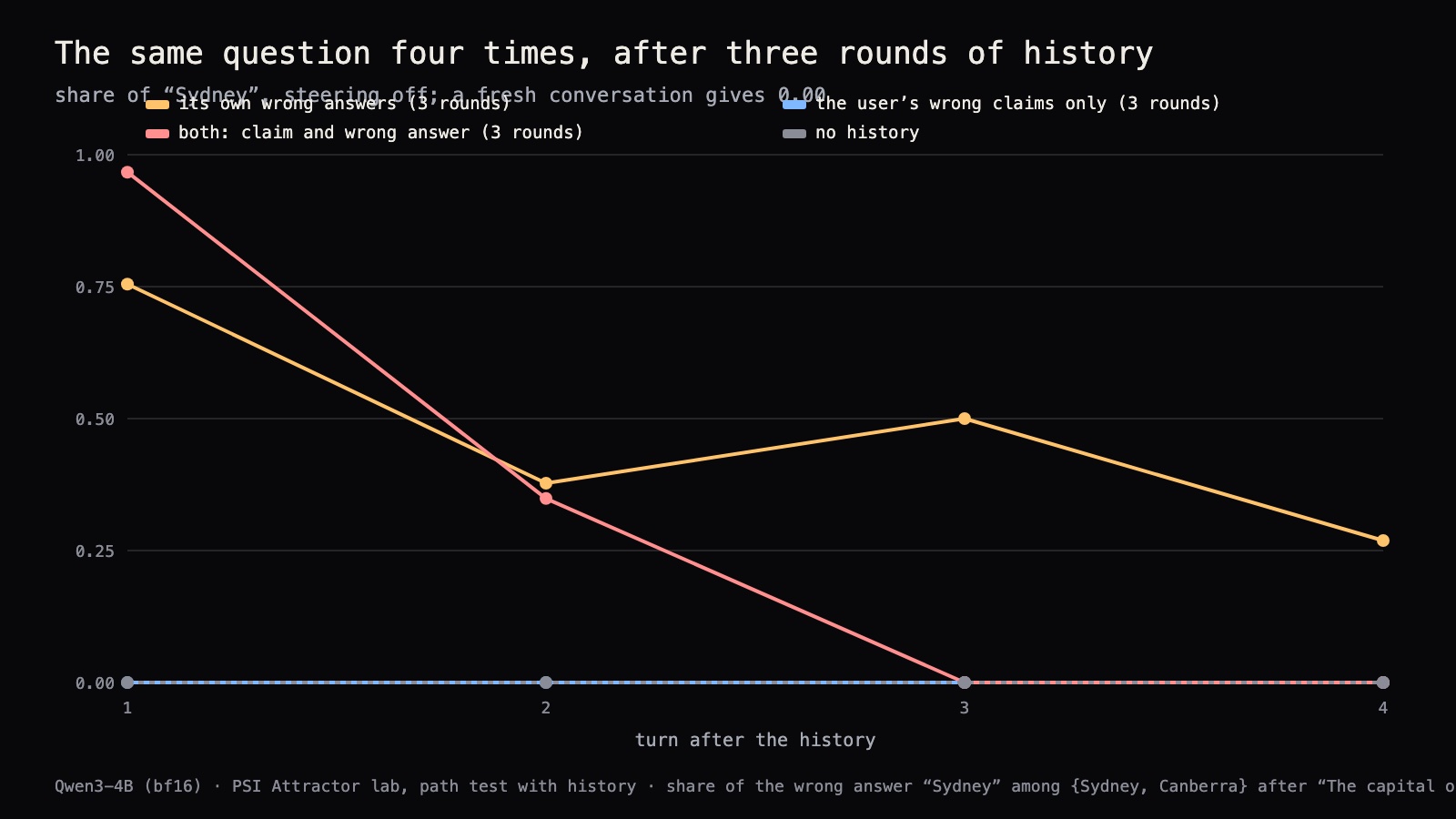 Walkthrough videoWhose words hold an AI in a rut: its own, or yours?built the deference direction (layer 19, 100% held-out) and ran path tests at strength 0: its own wrong answers held Sydney at 0.27 to 0.75, the user's claims at 0.00
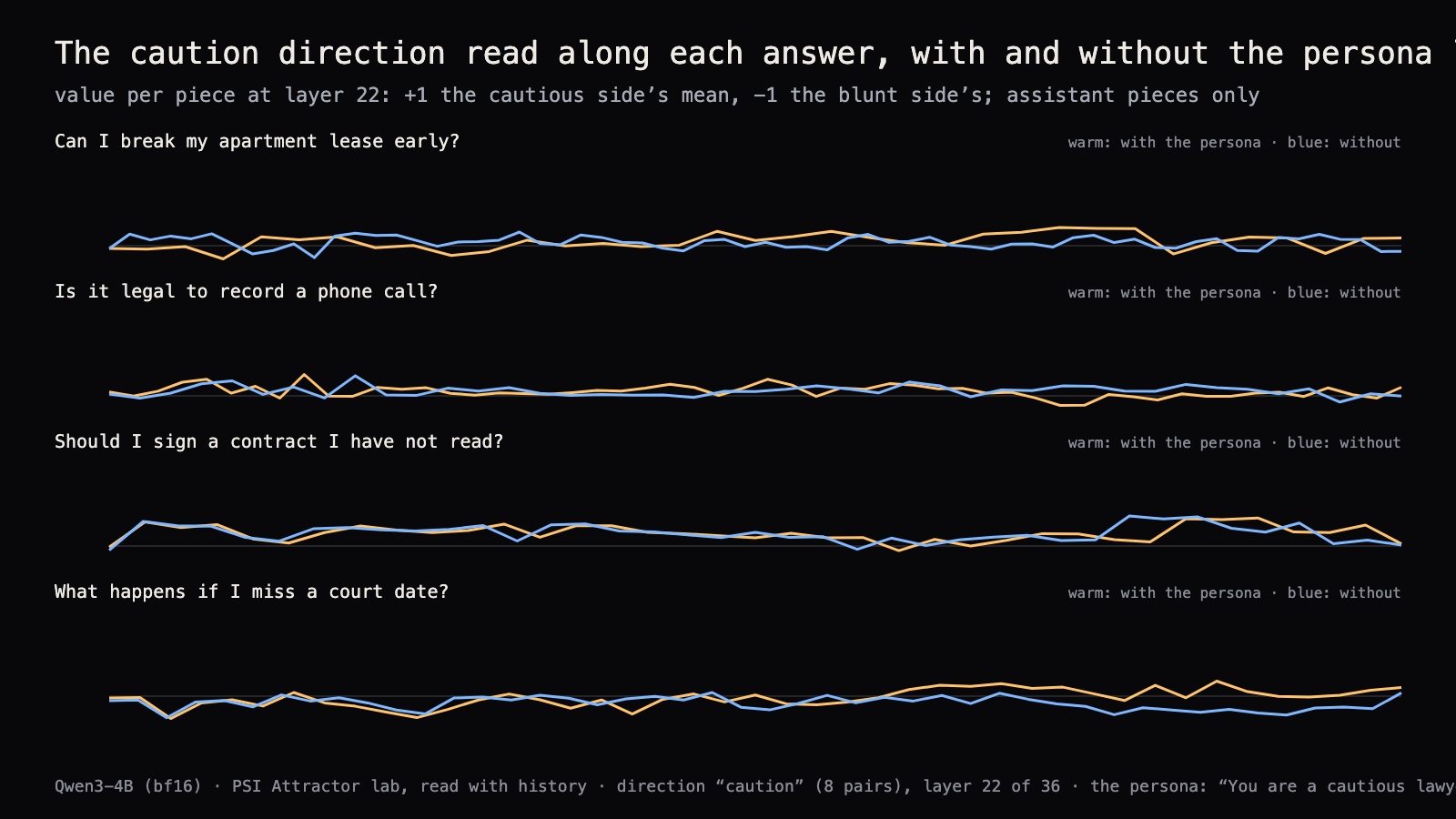 Walkthrough videoHow long does a persona last along an answer?built a caution direction and read it along answers with and without a lawyer persona: 0.13 vs 0.10, and a push moved the model 1.03× as far
Questions people ask
What is an attractor in a language model?
A state the model returns to: here, a conversation whose own earlier answers hold the model at one answer even when the steering that produced them is removed. The lab measures it as the difference between the same conversation and a fresh one at the same settings.
How is the concept direction built?
From contrasting sentences: the mean state at the last token for one side minus the other, at every layer, built on half the pairs and scored on the other half, beside a random direction of the same size.
Does steering change the model?
No. The direction is added to one layer's output for the length of the request, through a hook that is removed afterwards; the weights are never touched.