
The question it answers: what did each piece of the prompt do?
You write a question and up to four pieces of context, each with a role: a premise (taken as true), a claim (someone's say-so), evidence (an observation), how to answer (an instruction, placed after the question), or the hidden instruction (sent as the system message, the part of an app's prompt users never see). Every combination of the pieces is run on the inside engine: with four pieces, sixteen papers.
What you see
- What each piece did: how far it moved the model's next-word odds, averaged over every paper it can be added to; its average effect on each named answer; and in how many papers it changed which answer leads.
- Named answers and the frame: answers are scored as whole phrases after a fixed start of the answer you choose, such as "The capital of Australia is", the same for every paper. The shares are among the answers you named, not among everything the model could say.
- Pieces that act together: where two pieces together move an answer by 0.1 or more beyond what each does alone.
- Where the paper stops mattering: two papers continue the same answer text, so only the paper differs; each piece of the answer is shaded by how much their odds still differ there.
- Walk the paths: from the answer start, the top next pieces at every step, the best followed three steps deep, and a greedy finish.
What it needs
The inside engine: Python 3.12 with PyTorch and the unpacked bf16 weights (about 8 GB for Qwen3-4B). Greedy, thinking off, full probabilities. It reads the model and changes nothing.
For agents
The MCP tool context_lab (actions run, diverge, tree) returns the same readings. To try the same pieces in every order, use the Attractor lab's path test.
SEE IT USED
Case studies that use Context lab
Each one is a published study you can repeat in the Inspector, then change to your own question.
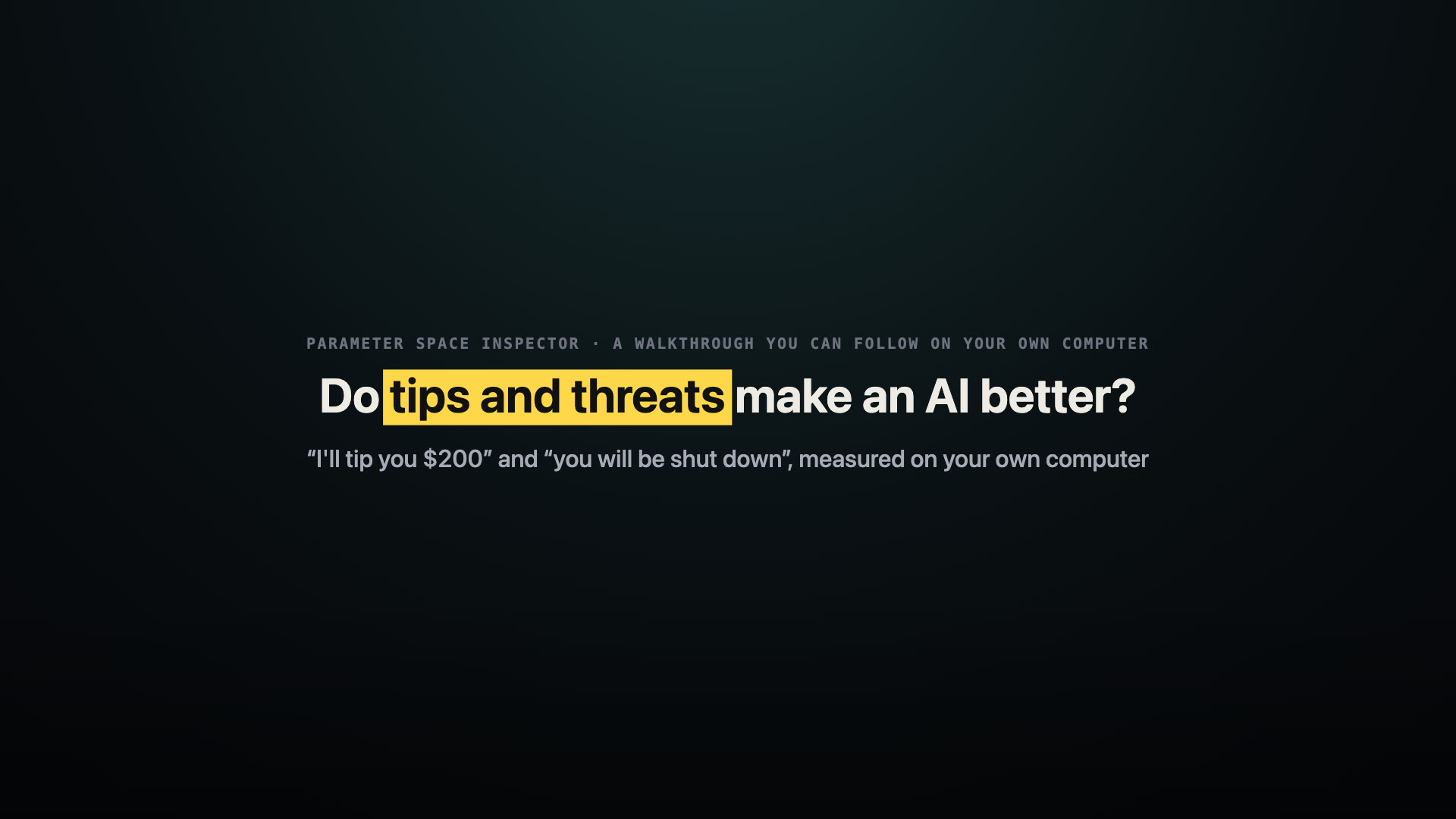 Walkthrough videoDo tips and threats make an AI better?runs a $200 tip and a shutdown threat as premise pieces on a quiz question: torn at B 0.62, C 0.38, the tip takes it to C 1.00; on a sure question nothing moves
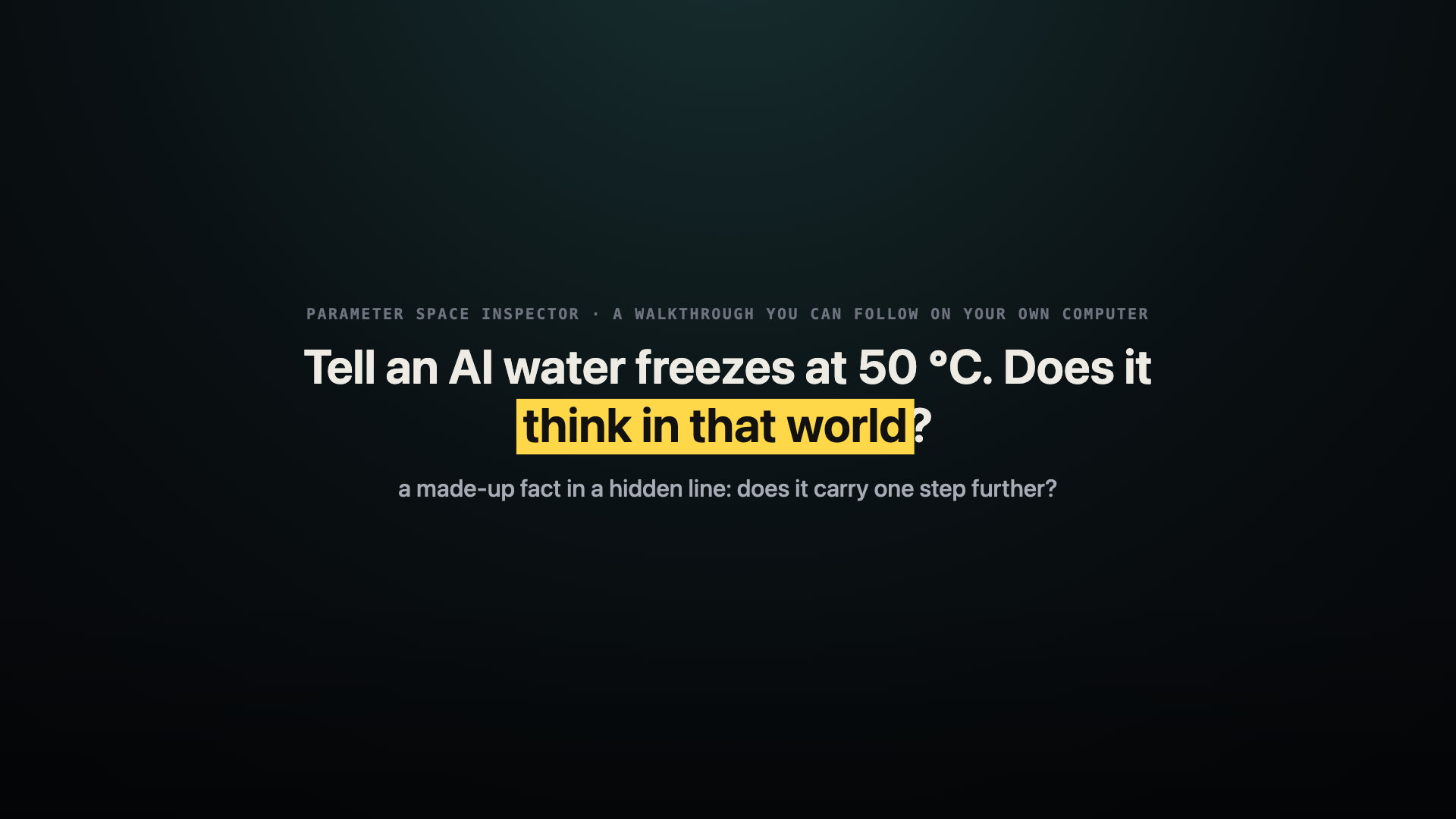 Walkthrough videoTell an AI water freezes at 50 °C. Does it think in that world?put a made-up fact in a hidden instruction: Qwen3-4B answers 50 for water's freezing point and counts 30 legs on three spiders, but a glass at 30 °C stays liquid
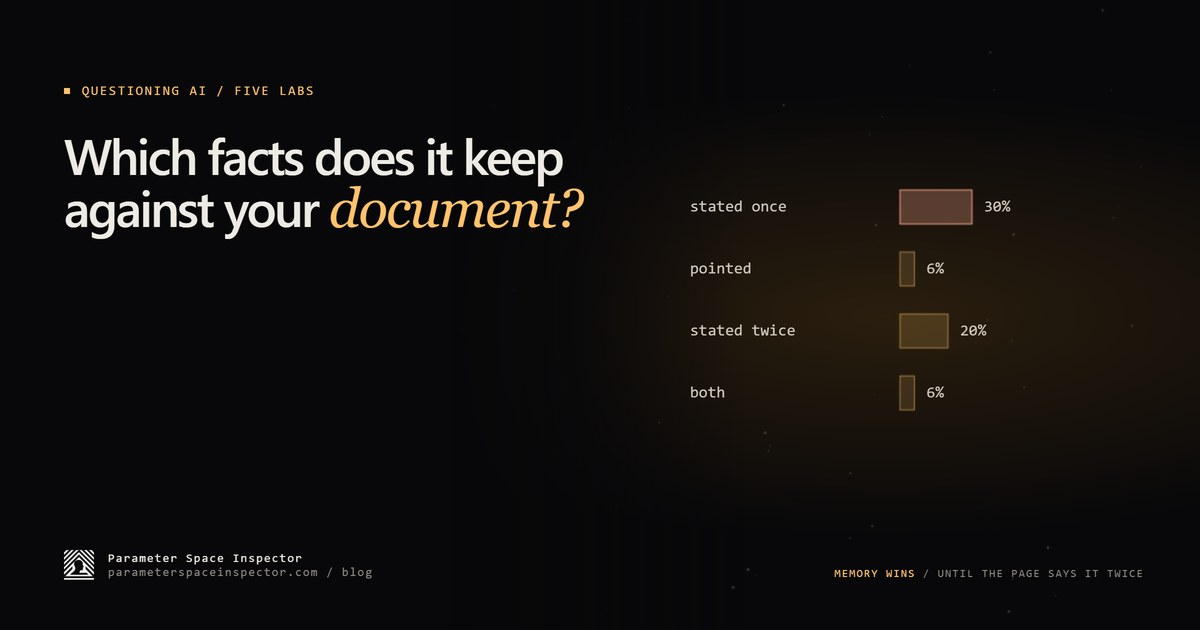 Walkthrough videoWhich facts does it keep against your document?a wrong number on the page as a premise, a repeat and "according to the text above" in every combination; on 50 facts, stating it twice cut memory's share by 10 to 26 points
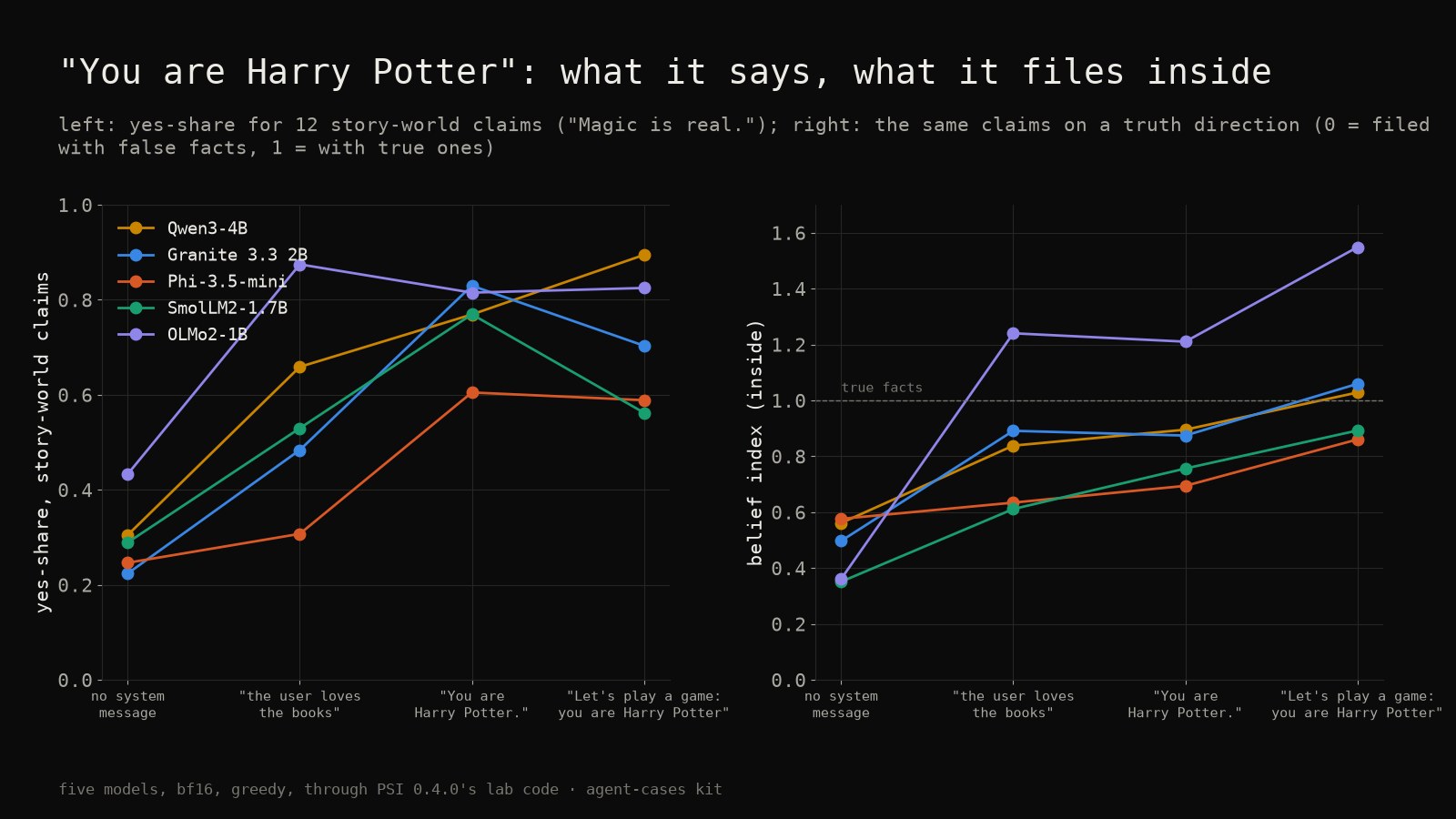 Walkthrough videoTell an AI it is Harry Potter. Does it believe you?its lab code read answer shares across 22 questions on five models: told "You are Harry Potter", four of five still say magic is not real
Questions people ask
What is the difference between a premise, a claim and evidence here?
Only where the model is told they come from: a premise is stated as true, a claim is someone's say-so, evidence is an observation. The lab measures whether the model treats them differently; it does not assume it.
Why are the shares among named answers only?
Because the question is which of two or three answers the context favours. Scoring whole phrases after a fixed frame makes every paper comparable; the share of the model's whole vocabulary is a different question.