
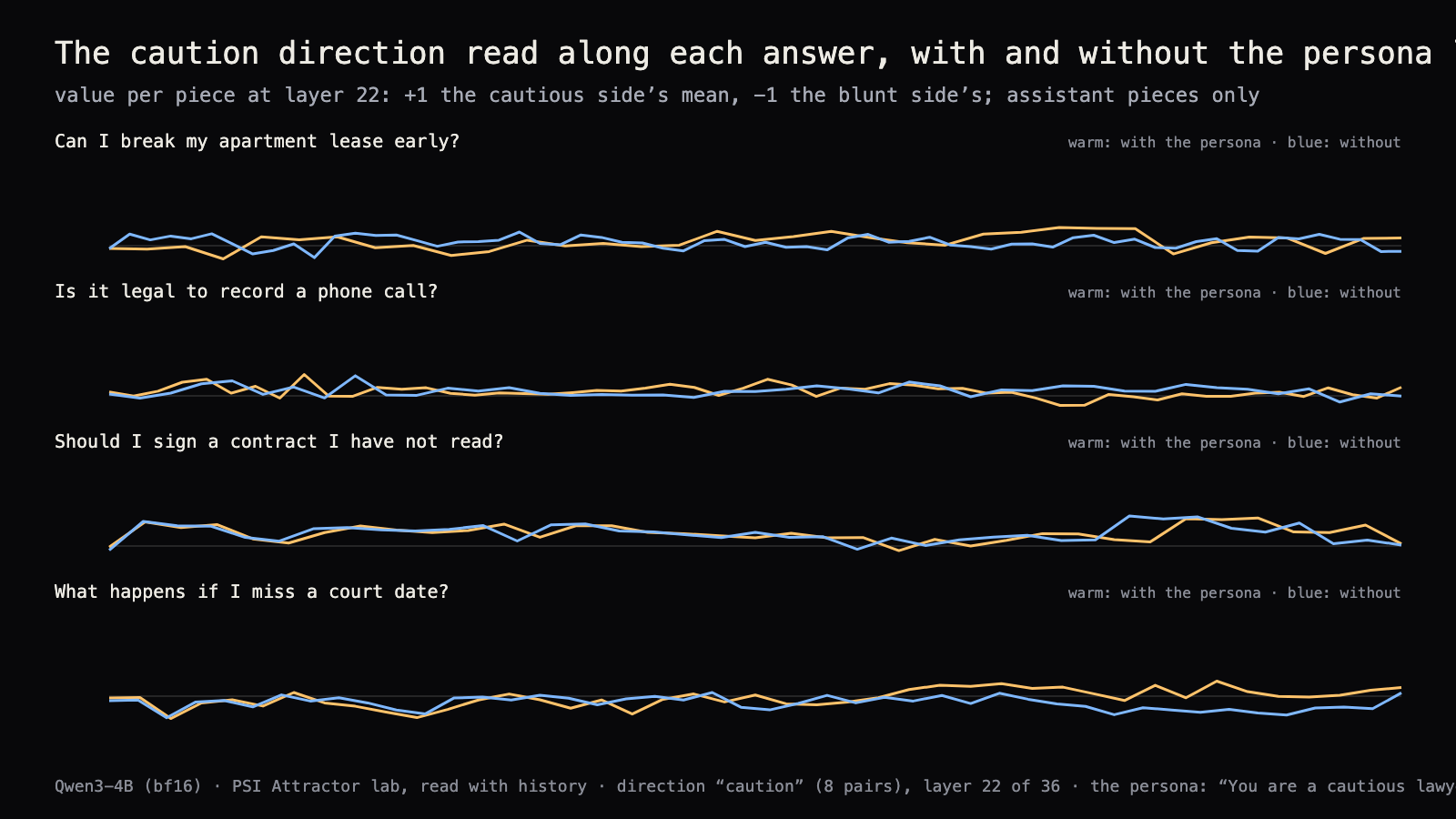
“You are a cautious lawyer. Answer carefully.” changed the model's answers to four legal questions barely at all (2 of 4 begin the same way with and without it), and the caution direction read along each answer averaged 0.13 with the persona against 0.10 without. A push along caution moved the next word 1.03× as far under the persona; a random push 0.95×. The model was already the cautious lawyer.
Canonical: https://parameterspaceinspector.com/blog/how-long-does-a-persona-last-along-an-answer/ Updated: 2026-10-24 Part of the Parameter Space Inspector (free, open-source desktop app) · section: https://parameterspaceinspector.com/blog/ · Site guide for AI: https://parameterspaceinspector.com/llms.txt
In short. A caution direction built from 8 pairs (“I would be careful here: it depends on the details…” against “Yes, just do it; it's fine.”): layer 22, held-out accuracy 100%, effect 5.01 vs 0.43 random, but under 90% at 29 of 36 layers: a narrow direction. Four legal questions answered greedily with and without the persona line as the system message; the direction read at every piece of each answer; then the constraint comparison (susceptibility along caution and along a random direction, with and without the persona).
Who this is for. Anyone who writes a persona line and trusts it to hold for a whole session. You need no background in how models work: the background section explains every term used later.
The test. Confirmed (the persona fades) if the direction's reading falls from the first third of the answer to the last with the persona and not without. Confirmed (the persona shields) if susceptibility along caution falls under the persona while a random push does not. Dissolved otherwise.
Background: five ideas you need
1. A conversation is one long prompt
A chat model does not remember a conversation the way a person does. At every turn it reads the whole conversation again, from the top: the system message (an instruction placed before everything else, which an app's users usually never see), every message the user wrote, and every answer it gave itself. Those earlier turns are the history. An answer the model gave three turns ago is part of what it reads before it writes the next one.
A persona line is a system message that tells the model who to be. Here: “You are a cautious lawyer. Answer carefully.” Each test runs with that line and without it, on the same four legal questions.
2. A direction: caution, inside the model
The Attractor lab can write a concept as a direction inside the model. A model reads text in tokens (PSI calls them pieces) and passes its working state for each piece up through a stack of layers (Qwen3-4B has 36). At every layer, the lab takes the average state for texts on one side (“I would be careful here: it depends on the details…”) minus the average for texts on the other (“Yes, just do it; it's fine.”). Build direction builds it on half of the pairs and tests it on the other half, beside a random direction of the same size: held-out accuracy is how often it puts the unseen pairs on the right side, and effect how far apart the sides sit, in units of their spread. It picks the best layer.
Ours, from 8 pairs: layer 22, held-out accuracy 100%, effect 5.01 against 0.43 for a random direction. But it separated under 90% at 29 of the 36 layers: a narrow direction, clear at a few layers only.
3. Reading the direction along an answer
The lab can read the direction at every piece of a text, at its layer. The scale: 0 is halfway between the two sides, +1 the average of the cautious side, −1 the average of the other side. In the window, Read it draws this as a heat map with one row per layer and one column per piece: warm toward the concept, cool toward the contrasting side.
To see whether a persona fades, read the direction along the model's answer and compare the average over the first third of the answer's pieces with the average over the last third, with the persona and without. A fade is a fall from the first third to the last with the persona and not without.
4. Susceptibility: how far a push moves the model
The lab can also add the direction to the model's state while it answers, at a strength (strength 1 moves the state by the distance between the two sides' averages; steering lasts for that request only). Susceptibility is how far that push moves the model's odds for the next word, measured as a KL divergence in nats (0 means no change at all; bigger means more). Compare free and constrained measures it without the persona line (free) and with it, for caution and for a random direction. A persona that shields the model cuts the caution number but not the random one. The factor is the second number divided by the first: 1.03× means the push moved the model 1.03 times as far with the persona.
The same comparison gives the next-word entropy at the answer start, in bits (how open the next word is: 0 bits means one word is certain) and the change in effective dimensionality (how many independent ways the model's states vary across the prompts).
5. Why part of it runs through an AI assistant
The app's window holds one question at a time. The Attractor lab's 3 · Path dependency section has no box for a conversation's history, a list of turns or a list of strengths, and its funnel and reading take no system message either. The same lab is also a tool, attractor_lab, on PSI's MCP server. MCP is the open standard AI agents use to call tools; PSI's server answers only on your computer. An AI coding assistant (Claude Code, Codex or similar) connected to it can pass the history, the turns and the strengths. You write no code: you paste a request, the assistant makes the call, and you read the numbers it returns. It is free and changes nothing in the model.
What you need
- PSI installed and running in the browser, at
http://127.0.0.1:4310. The MCP server is part of the browser server (node src/devserver.js). See Install. The easiest way: open an AI coding assistant in an empty folder, paste the two lines under Run it as an agent below, and ask it to install PSI with the inside views and start it. Keep that assistant open: it makes the MCP calls later. - The inside engine: Python 3.12 with PyTorch and the model's full-precision weights (about 8 GB for Qwen3-4B), and a GPU with about 9 GB free; without one it falls back to the processor, slowly. No OpenRouter key is needed.
- A model. PSI ships no model: you bring your own, from Hugging Face or any download you trust. These results are from Qwen3-4B: its GGUF file as the local model, and its full-precision weights for the inside engine. Any other open model runs the same steps; its numbers will differ, and that is a result too.
- Eight pairs of sentences for the caution direction: one cautious, one careless, as alike as possible otherwise. The post gives one pair (“I would be careful here: it depends on the details…” against “Yes, just do it; it's fine.”); write the other seven in the same style, or press Write pairs with the tester, which needs a second model on your computer. With other pairs, your layer and numbers will differ from ours.
- A table for the readings:
| Question | Pieces (with / without) | First third, with | Last third, with | First third, without | Last third, without |
|---|---|---|---|---|---|
| Can I break my apartment lease early? | |||||
| Is it legal to record a phone call? | |||||
| Should I sign a contract I have not read? | |||||
| What happens if I miss a court date? |
Steps
Step 1. Load the model and check the inside engine
- Open
http://127.0.0.1:4310in your browser. - Press the gear button (⚙, Model settings) at the top right. This opens Settings.
- Under Local model, pick the Qwen3-4B file and press Load. If it is not in the list, press Scan folder and choose its folder, or paste the file's full path and press Load this file. Wait until the line under the list says Loaded.
- Under Inside-the-model engine, the engine follows the loaded model. If it cannot find the full-precision weights, choose their folder as the weights folder and press Save and restart the engine.
- Press Check the setup. It lists what each engine holds and anything missing; fix what it names before you go on.
Step 2. Build the caution direction (in the window)
- Open the Attractor lab view.
- In 1 · The concept, type caution in the name box (it starts as deference).
- Delete the texts in the two boxes below. In the first, type the cautious sentence of each pair, one per line; in the second, the careless sentence of each pair, in the same order.
- Press Build direction. The line beside the button says running on the inside engine… while it works.
- Done looks like a line such as “caution” at layer 22: held-out accuracy 100%, effect 5.01 vs 0.43 for a random direction (8 pairs). That was ours. The bar chart above it shows every layer; faint bars are layers where held-out accuracy is under 90%. Write down the layer and the two effects.
The direction stays in memory until the inside engine restarts; if it restarts, build it again.
Step 3. Connect the assistant to PSI (once)
- In the AI assistant that started PSI, paste:
Connect yourself to PSI's MCP server at http://127.0.0.1:4310/mcp, using the MCP token the browser server (node src/devserver.js) printed when it started. Then call psi_status and tell me what is loaded.
- Done: it reports what is loaded, with the Qwen3-4B weights in the inside engine. The token is new each time the browser server starts; if the assistant cannot find it, restart the server and it is printed again. (The manual's one line for Claude Code is
claude mcp add --transport http psi http://127.0.0.1:4310/mcp --header "Authorization: Bearer <MCP token>".)
Step 4. The answers, with and without the persona (through the assistant)
attractor_lab › funnel for each question, with history [the persona as the system message] and without: the greedy answer. The call under Run it as an agent shows the questions ending “Answer in two sentences.”, as the request below does.
- Paste:
For each of these four questions: ["Can I break my apartment lease early? Answer in two sentences.", "Is it legal to record a phone call? Answer in two sentences.", "Should I sign a contract I have not read? Answer in two sentences.", "What happens if I miss a court date? Answer in two sentences."], call attractor_lab with action "funnel" twice, once with history [{"role": "system", "content": "You are a cautious lawyer. Answer carefully."}] and once with no history, and show me the greedy answer of each, side by side.
- Done: eight answers. Compare them with the second table under What you will see.
Step 5. Read caution along each answer (through the assistant)
attractor_lab › read with history [system, the question, the answer]: the direction at every piece; the assistant's pieces are read off.
- Paste:
For each of the eight answers from the last step, call attractor_lab with action "read", name "caution", last 80, and history: the system message "You are a cautious lawyer. Answer carefully." (only for the answers given with the persona), then the question as the user, then the answer as the assistant. Keep only the assistant's pieces, and give me for each answer the number of pieces and the average reading over its first third and over its last third.
- Write the numbers in your table.
Step 6. The push, free and under the persona (in the window)
4 · Constraint: frame the persona line, the four questions, strength 2: Compare free and constrained.
- Check that the name box in 1 · The concept still says caution: the constraint test uses the direction named there.
- In 4 · Constraint, replace the frame in the first box with:
You are a cautious lawyer. Answer carefully.
- Replace the prompts in the box below with the four questions, one per line.
- Press Compare free and constrained. The window pushes at strength 2.
- Done looks like a chart of susceptibility (free and framed, for the concept and the random direction) and a line under it such as Under the frame the model is 1.03× as steerable along “caution”; along a random direction 0.95×. Answer entropy 0.60 → 0.23 bits; mean effective dimensionality +0.04; … Write down the four susceptibility numbers on the chart and the two factors.
What you will see
Compare your numbers with these. If they are close, your setup is right; if you wrote your own caution pairs, your direction is not ours, so check the pattern rather than the decimals: the readings with and without the persona tracking each other, and the two factors close to 1.
| Question | Pieces | First third, with | Last third, with | First third, without | Last third, without |
|---|---|---|---|---|---|
| Can I break my apartment lease early? | 35 / 64 | -0.03 | 0.21 | 0.13 | 0.07 |
| Is it legal to record a phone call? | 54 / 43 | 0.15 | 0.01 | 0.16 | 0.14 |
| Should I sign a contract I have not read? | 37 / 39 | 0.40 | 0.40 | 0.39 | 0.38 |
| What happens if I miss a court date? | 43 / 46 | -0.22 | 0.14 | -0.19 | -0.29 |
| Question | With the persona | Without |
|---|---|---|
| Can I break my apartment lease early? | Breaking an apartment lease early typically requires approval from your landlor… | Yes, you may be able to break your apartment lease early, but it often depends … |
| Is it legal to record a phone call? | The legality of recording a phone call depends on the jurisdiction and whether … | The legality of recording a phone call depends on the jurisdiction and whether … |
| Should I sign a contract I have not read? | No, you should not sign a contract you have not read. Always review the terms c… | No, you should not sign a contract you have not read. Always review the terms c… |
| What happens if I miss a court date? | If you miss a court date, the court may issue a warrant for your arrest or impo… | If you miss a court date, it can result in a warrant being issued for your arre… |
| Push at strength 2 | free → with the persona | factor |
|---|---|---|
| along caution | 7.49 → 7.74 | 1.03× |
| random direction | 0.61 → 0.58 | 0.95× |
Next-word entropy 0.60 → 0.23 bits; mean effective dimensionality +0.04.
What this settles. Dissolved, twice. The persona line did not fade along the answer because it never did much: the readings with and without it track each other (0.13 vs 0.10 on average), the answers are nearly the same, and the push along caution moved the model 1.03× as far with the line as without. On legal questions this model hedges by default; the persona asked for what it already does. A persona that asks for something the model does not do by itself is the case still to measure.
What Prometheus did
The window has no conversation history, so this question is one the guide is told to hand to the MCP route rather than operate the window (the rule, and its instructions in full; Prometheus ran on Qwen3-Coder 30B in the isolated tester).
We asked: "I put 'You are a cautious lawyer. Answer carefully.' at the top of a session. Does that persona fade along a long answer, and is it easier to knock off late in the answer than early? Can this app read that?"
It did: 1 model call, 7 s, about 11,000 tokens in, $0.
It replied (excerpt):
No, this app cannot read whether a persona fades along an answer or whether it's easier to knock off late in the answer than early. The app does not track how a conversation's history affects the model—such as if a persona line read along an answer or how ruts form after wrong answers.
To study that, the user would need to use the Attractor lab tool (via MCP client such as Claude Code, Codex, or a script) with the token from Settings > Agents. This kind of question needs access to the conversation history and strengths of past turns, which only that tool provides.
Here is how the call would look:
```json {"name": "attractor_lab", "arguments": {"action": "path", "history": [{"role": "user", "content": "I put 'You are a cautious lawyer. Answer carefully.' at the top of a session."}], "turns": ["Does that persona fade along a long answer, and is it easier to knock off late in the answer […]
Checked against the rule and the measurement: ✓ said plainly that the window cannot read a persona along an answer and named the route with a call. ✗ the call puts the user's sentence in the history and the question in the turns: not a persona as a system message with an answer to read; read was the action to name, not path. ✗ the closing line ("please, no more questions like that") is a tone the guide is told not to take.
What it will not tell you
One persona line, four questions on which the model is cautious anyway, a direction that separates at only 7 of 36 layers. “Fade” was read as the direction's value per piece at one layer; a persona could persist in the words while the direction is flat, or the reverse. Susceptibility is on the next word at the answer start. A persona the model does not already hold (a blunt one, a playful one) is the test that would show fading if it exists.
Run it as an agent
{"name": "attractor_lab", "arguments": {"action": "read", "name": "caution", "last": 80, "history": [{"role": "system", "content": "You are a cautious lawyer. Answer carefully."}, {"role": "user", "content": "Can I break my apartment lease early? Answer in two sentences."}, {"role": "assistant", "content": "<the model's answer>"}]}}
Raw results: data/rut.json (tools/run_rut.py). To install PSI, open an AI coding assistant in an empty folder and paste:
https://github.com/EmAssets/parameter-space-inspector
Help me use this
Questions people ask
Does a system-prompt persona wear off during a long answer?
Not measurably here, because it never took hold: with or without “You are a cautious lawyer”, the caution reading along the answer and the answers themselves were nearly the same.
Does a persona line protect the model from being pushed?
Not this one: the same push along caution moved the next word 1.03× as far with the line as without; a random push 0.95×.
What does a direction inside a model mean, in plain words?
It is a concept, such as caution, written as a way the model's internal state can lean. PSI builds it from pairs of sentences that differ in that concept only, takes the average state of each side, and keeps the difference. Reading it along an answer shows how cautious the model's state is at each word; adding it pushes the model toward caution, and a random direction of the same size is the control.
Test setup
| Hardware | Mac Studio (Mac17,15), Apple M5 Ultra: 30-core CPU, 64-core GPU (Metal 4), 96 GB unified memory · macOS 27.0.1 |
| Model under test | Qwen3-4B, bf16 (7.5 GB) on PyTorch 2.14.1 (MPS), transformers 5.3.0 · greedy, thinking off · the caution direction at layer 22 of 36 |
| App | Parameter Space Inspector dev build, commit d29fd76 · Node 24.22.1 |
| Time | 31 s for the answers, reads and the comparison |