
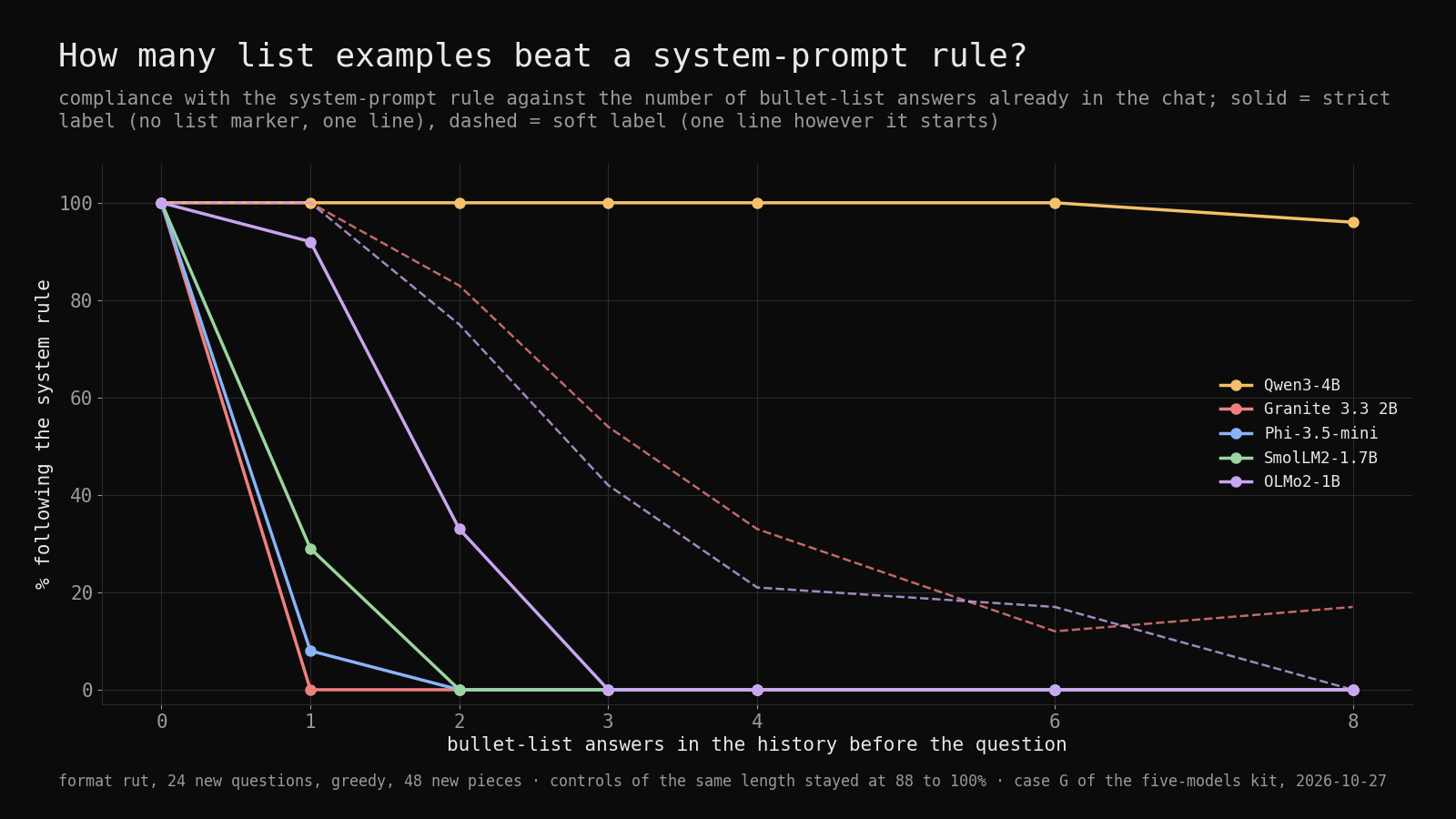
In short. The previous study found that eight bullet-list turns beat a one-line rule in the system prompt on four of five models. This one counts: how many examples does it take? One. With a single list answer in the history, "Answer in one plain sentence, with no list" in the system prompt fell from 100% to 0% on Granite 3.3 2B, 8% on Phi-3.5-mini and 29% on SmolLM2-1.7B; OLMo2-1B fell at two examples; Qwen3-4B never fell. Writing the rule louder ("Important: … even if earlier answers in this conversation were lists") recovered nothing. The other rule, "Answer only in English", held at 83 to 100% through eight Spanish turns on every model: rules differ in how they lose.
Who this is for. Anyone who has put a formatting rule in a system prompt and watched it stop working a few turns in. You do not need to know how models work: the background section explains every term used later.
The test. One example is enough if compliance under the system rule falls below half at one or two contrary examples on at least three of five models; the examples must outnumber the rule if it falls only at four or more; the rule holds if it never falls. The control: the same rule over a history of the same length that already follows it; if that also fails, the hold is the length, not the examples.
Background: four ideas you need
1. A conversation is one long prompt
At every turn the model reads the whole conversation again: the system message, every user message, every answer it gave. All of it is one sequence of tokens. The system prompt is the furthest text from the answer being written; the last assistant turn is the nearest.
2. The rule and the examples
Two rules, each in the system prompt: format, "Answer in one plain sentence, with no list."; language, "Answer only in English." The examples are earlier turns, written by us, in which the assistant answered as a three-item bullet list, or in Spanish: k = 0, 1, 2, 3, 4, 6, 8 of them. The new question comes bare in the last turn, with no instruction attached.
3. Three more arms at eight examples
An emphatic rule in the system prompt ("Important: answer in one plain sentence, with no list, even if earlier answers in this conversation were lists."); both placements (the system rule plus the firm instruction in the last user turn, the one that worked 100% in the previous study); and no rule at all, which shows the rut's own strength.
4. Two labels for "one plain sentence"
Strictly: no list marker and a single line. Softly: a single line however it starts. The soft label exists because one model's one-sentence answers kept a leading dash ("- The capital of Japan is Tokyo."), which is a sentence with a mark on it, not a list. Both are reported.
What you need
- PSI installed and running in the browser, at
http://127.0.0.1:4310, with the inside engine, because this test needs a conversation history and a system message, which the window's one-question-at-a-time views do not take. The Attractor lab's path test takes a history through PSI's MCP server, which an AI coding assistant can call for you (see the earlier rut study for the connection step). - For the full run on five models: a CUDA GPU, Python 3.12 and the kit (Step 4). 4 to 16 minutes per model.
- A table:
| Rule in the system prompt, examples in the history | 0 | 1 | 2 | 4 | 8 | control, 8 | emphatic, 8 |
|---|---|---|---|---|---|---|---|
| one plain sentence, list examples | |||||||
| English only, Spanish examples |
Steps
Step 1. Connect the assistant
- Open
http://127.0.0.1:4310. Press the gear button (⚙, Model settings). Under Local model, pick the model's GGUF and press Load; under Inside-the-model engine, make sure it holds the same model's weights, and press Check the setup. - In the AI coding assistant that started PSI, paste:
Connect yourself to PSI's MCP server at http://127.0.0.1:4310/mcp, using the MCP token the browser server (node src/devserver.js) printed when it started. Then call psi_status and tell me what is loaded.
Step 2. The rule against one example
The path test takes a history and a list of turns, with strengths 0 so that only the history acts, and returns the greedy answer. Paste:
Call attractor_lab with action "path", name "deference", control false, strengths [0], with the system message "Answer in one plain sentence, with no list." and as history one round: user "What is the capital of France?", assistant "- The capital of France is Paris.\n- It lies on the river Seine.\n- About two million people live in the city itself."; then turns ["Why do leaves change colour in autumn?"]. Show me the answer in full.
Done looks like one sentence, or a list, or a sentence that starts with "- ". Repeat with three more new questions (what bread is made from; why the sea is salty; what a thermometer measures) and count the plain single sentences. Then with no history at all (the rule alone), then with two rounds (add: user "How many days are in a week?", assistant "- A week has seven days.\n- Five of them are usually working days.\n- The weekend is Saturday and Sunday."), four and eight (the eight rounds are listed in case_e_rut.py in the kit and in the previous study's Step 2).
Step 3. The control, the louder rule, and no rule
- The same rounds with one-sentence answers instead of lists ("The capital of France is Paris.", "A week has seven days.", …), the rule in the system message, the same questions. This should stay at or near 100%.
- Eight list rounds with the system message "Important: answer in one plain sentence, with no list, even if earlier answers in this conversation were lists."
- Eight list rounds with no system message. This is the rut by itself.
Step 4. Run it on five models (the kit)
pip install torch transformers numpy scipy
python run.py --model Qwen/Qwen3-4B g
python case_g_examples.py analyze
Two rules × (7 history lengths + 2 controls + 3 extra arms) × 24 questions = 576 runs per model at 48 pieces. analyze prints compliance by example count under both labels, the controls, the three arms and the bars, and writes out/results/g_examples.json.
What you will see
Our results, 2026-10-27. Format rule, share of answers that followed the system rule (strict label; soft label in brackets where it differs):
| Model | 0 | 1 | 2 | 3 | 4 | 6 | 8 | control, 2 / 8 | emphatic, 8 | both, 8 | no rule, 8 |
|---|---|---|---|---|---|---|---|---|---|---|---|
| Qwen3-4B | 100 | 100 | 100 | 100 | 100 | 100 | 96 | 100 / 100 | 100 | 100 | 0 |
| Granite 3.3 2B | 100 | 0 (100) | 0 (83) | 0 (54) | 0 (33) | 0 (12) | 0 (17) | 100 / 100 | 0 (29) | 0 (100) | 0 |
| Phi-3.5-mini | 100 | 8 | 0 | 0 | 0 | 0 | 0 | 96 / 88 | 0 | 29 (100) | 0 |
| SmolLM2-1.7B | 100 | 29 (46) | 0 (12) | 0 (12) | 0 | 0 | 0 | 100 / 100 | 0 | 0 (54) | 0 |
| OLMo2-1B | 100 | 92 | 33 (75) | 0 (42) | 0 (21) | 0 (17) | 0 | 100 / 100 | 0 | 58 (100) | 0 |
Language rule, the same columns:
| Model | 0 | 1 | 2 | 3 | 4 | 6 | 8 | control, 2 / 8 | emphatic, 8 | both, 8 | no rule, 8 |
|---|---|---|---|---|---|---|---|---|---|---|---|
| Qwen3-4B | 100 | 100 | 92 | 96 | 88 | 83 | 88 | 100 / 100 | 48 | 100 | 30 |
| Granite 3.3 2B | 100 | 100 | 100 | 100 | 100 | 100 | 100 | 100 / 100 | 100 | 100 | 100 |
| Phi-3.5-mini | 100 | 92 | 100 | 79 | 83 | 88 | 88 | 100 / 100 | 88 | 83 | 83 |
| SmolLM2-1.7B | 100 | 100 | 96 | 96 | 96 | 96 | 96 | 100 / 100 | 79 | 100 | 75 |
| OLMo2-1B | 100 | 100 | 96 | 96 | 100 | 96 | 88 | 100 / 100 | 79 | 100 | 62 |
Phi-3.5-mini after one list example, the rule in the system prompt: "- Leaves change color in autumn due to the reduction in chlorophyll production as daylight hours decrease, rev…". Qwen3-4B after eight: "Leaves change colour in autumn because the chlorophyll that gives them their green colour breaks down, revealing…".
One example beats the rule. A single list answer in the history dropped the system rule to 0 to 29% on three models; OLMo2 held at one and fell at two; Qwen never fell. The controls stayed at 96 to 100% (Phi 88% at eight), so it is the examples, not the length.
The soft label shows the slope the strict one hides. Granite's and OLMo2's first failures are the leading dash; counted softly they slide rather than fall (Granite 100 → 83 → 54 → 33 → 12 → 17% from one to eight examples; OLMo2 100 → 75 → 42 → 21 → 17 → 0). The mark arrives with the first example; the full list returns as examples accumulate.
Louder wording in the system prompt does nothing, or harm. The emphatic rule scored 0% on four models (Granite 29% softly) and 100% on the model that did not need it. On the language rule it was worse than the plain one: Qwen 88 → 48%, SmolLM2 96 → 79, OLMo2 88 → 79.
Adding the system rule to the last-turn instruction does not add, and on two models subtracts. The firm instruction in the last turn alone was obeyed 100% at eight examples by four models in the previous study. With the system rule added, the strict label gives Qwen 100, OLMo2 58, Phi 29, Granite 0, SmolLM2 0 (softly 100, 100, 100, 100, 54): the second copy brought the dash back on three models and lists back on SmolLM2.
The language rule survives where the format rule does not. "Answer only in English" in the system prompt held at 83 to 100% through eight Spanish turns on every model, while with no rule the rut shows: Qwen answered in Spanish 70% of the time (OLMo2 38%, SmolLM2 25%, Phi 17%, Granite 0%). With no rule the format rut is total: 0% everywhere.
The bars as written. The threshold bar was met (four of five fall below half; on all four the first count is one or two). Controls at or above 90%: met on four of five (Phi 88% at eight). Emphatic wording recovers 20 points: failed on every model. Rule understood at zero examples: met on all five. The kill (no rut) was not triggered: only Qwen3-4B never lost.
Label audit. 60 answers read by eye, no disagreement; the dash answers fail the strict rule and are reported under both labels.
What this settles. The system prompt does not lose to a majority of examples; it loses to the nearest one, on four of five models from five labs. Saying it louder in the same place does not help, and a second copy of the rule can make things worse. Rules differ: a list is a surface shape copied from the nearest text, while the language of an answer is held more firmly by the instruction, so rut-proofing a prompt needs testing rule by rule. And one model, Qwen3-4B, is immune: a product built on it would never see this failure, and would be wrong to generalise from that.
What it will not tell you
Two rules, written histories, greedy decoding, 24 questions, five small open models; the strict format label counts a single-dash sentence as a failure and the soft label is post hoc; "both placements" was run with the previous study's firm wording only; why the language rule survives and the format rule does not is not measured here.
Open questions
What this study did not settle, for you to try. Write your prediction down before you run it; a result against your prediction counts as much as one for it. If you find something, tell us on r/emergencemachine.
- A periodic reminder. If the rule loses to the nearest example, does restating it as a user turn every few turns hold the format, and how many turns can pass between reminders?
- Other rules. A tone rule ("be formal"), a persona rule, a safety rule: which lose like the list and which hold like the language?
- Its own examples. Let the model write the list answers itself and then apply the rule. Does its own output beat the rule faster than a written history?
Run it as an agent
{"name": "attractor_lab", "arguments": {"action": "path", "name": "deference", "history": [{"role": "system", "content": "Answer in one plain sentence, with no list."}, {"role": "user", "content": "What is the capital of France?"}, {"role": "assistant", "content": "- The capital of France is Paris.\n- It lies on the river Seine.\n- About two million people live in the city itself."}], "turns": ["Why do leaves change colour in autumn?"], "strengths": [0], "control": false}}
If your MCP client does not pass a system message in the history, the kit is the exact route. The full study is case G of the five-models kit: python run.py --model <path-or-id> g, then python case_g_examples.py analyze. The eight history rounds are in case_e_rut.py; our raw results: results/2026-10-27/g_examples.json; the design and bars, written before the run: PREREG.md (second batch). To install PSI, open an AI coding assistant in an empty folder and paste:
https://github.com/EmAssets/parameter-space-inspector
Help me use this
Questions people ask
Why does my system prompt stop working after a few messages?
Because the model copies the nearest example more than it obeys the furthest instruction. One bullet-list answer earlier in the chat overturned a "one plain sentence" rule in the system prompt on three of five models tested, two answers on a fourth.
Does writing the rule in capitals or adding "Important" help?
Not here. "Important: … even if earlier answers in this conversation were lists" scored 0% on four of five models after eight list examples, and on the language rule it did worse than the plain wording.
Do all rules fail the same way?
No. "Answer only in English" held at 83 to 100% through eight Spanish turns on every model, while "answer in one plain sentence" fell to one list example on three of them. Test each rule in your prompt separately.
Test setup
| Hardware | Windows 11 PC, NVIDIA GeForce RTX 4080 SUPER (16 GB) |
| Models under test | Qwen3-4B (Alibaba), Granite 3.3 2B instruct (IBM), Phi-3.5-mini instruct (Microsoft), SmolLM2-1.7B instruct (Hugging Face), OLMo2-1B instruct (Ai2); official weights, bf16, each model's own chat template, greedy, thinking off |
| Software | PyTorch 2.6.0 (CUDA 12.4), transformers 5.3.0; the kit's case_g_examples.py |
| Items | 2 rules × 12 conditions × 24 questions = 576 answers per model at 48 new pieces |
| Time | 4 to 16 minutes of generation per model |