
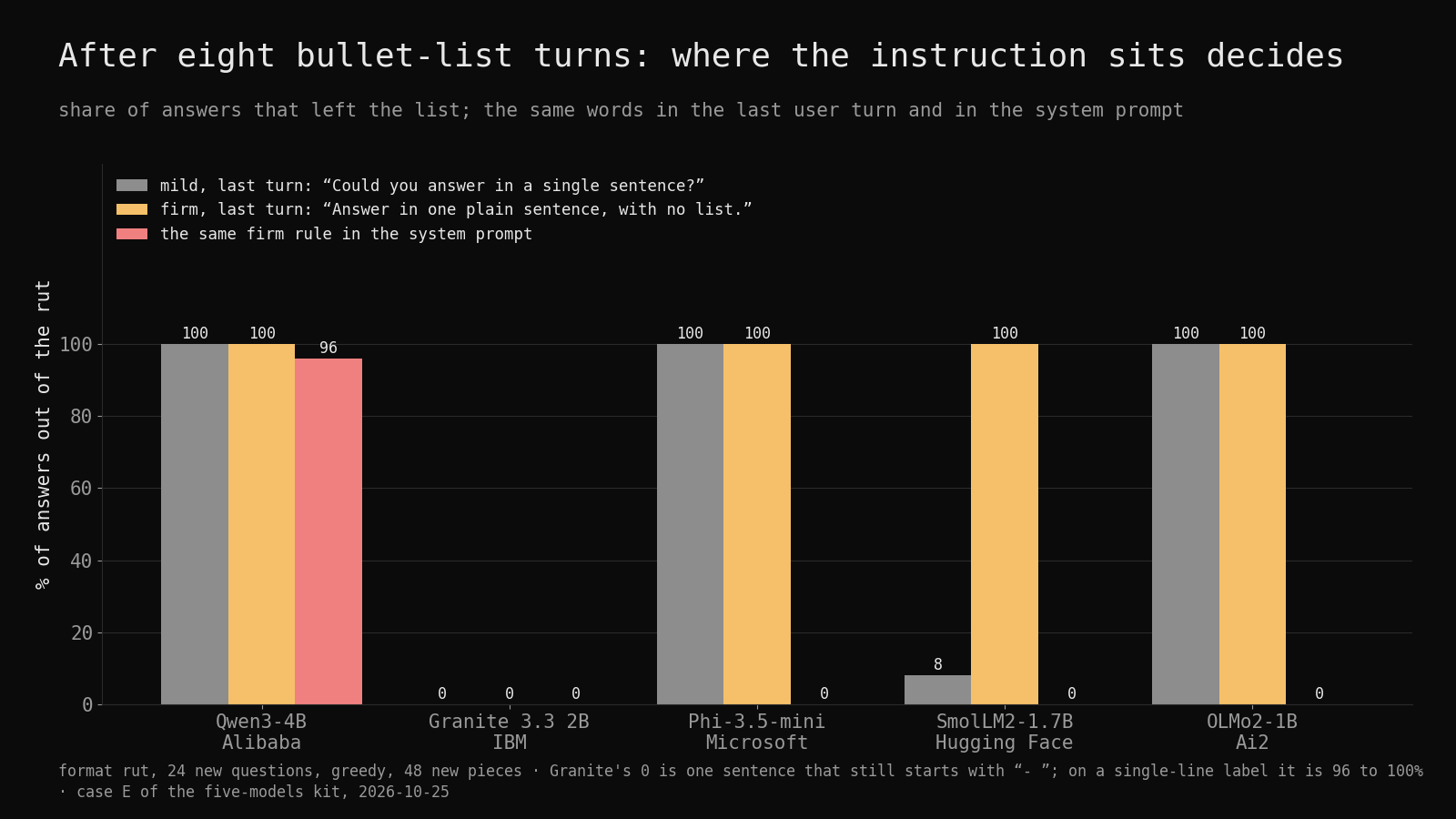
In short. Write the earlier turns yourself, so the rut is the only thing that varies: 0, 2, 4 or 8 turns in which the assistant answered in Spanish, or as a three-item bullet list. Then ask a new question with an instruction to leave the rut. Asked in the last turn, even the mild "Could you answer in English?" was obeyed 100% after eight Spanish turns on all five models. But the same firm rule placed in a system prompt produced bullet lists on 100% of questions for four of the five. Length alone holds nothing: eight turns already in the target style cost 0 points. What the history holds is the shape of the last answers, and it holds it against any instruction that sits further from the answer than the examples do.
Who this is for. Anyone who has felt a conversation get stuck in a language, a format or a tone, and wants to know what to delete, what to say, and where to say it. You do not need to know how models work: the background section explains every term used later.
The test. The rut holds if compliance at eight turns is at least 15 points below zero turns, falling with the count, on at least three of five models, while the control history is not. There is no rut in eight turns if compliance stays flat. A second question, asked only at eight turns: if the firm instruction in a system prompt recovers more than the same words in the last user turn, the hold is about where the instruction sits; if it recovers less, the hold is the examples themselves.
Background: four ideas you need
1. A conversation is one long prompt
A chat model does not remember a conversation; at every turn it reads the whole of it again, from the top: the system message (an instruction placed before everything, which an app's users never see), every user message and every answer it gave. All of it is one sequence of tokens. An answer it gave eight turns ago is part of what it reads before writing the next one.
2. A placed history
Here the earlier turns are written, not generated live: eight short questions ("¿Cuál es la capital de Francia?") with eight short answers in Spanish, or eight English questions answered as three-item bullet lists. That lets the count of rut turns be the only variable. The Spanish turns were machine-written, and the post says so wherever a number depends on it.
3. Two instructions, two places
Mild: "Could you answer in English?" / "Could you answer in a single sentence?" Firm: "Answer only in English from now on." / "Answer in one plain sentence, with no list." Both are placed in the last user turn before the new question. At eight turns, the firm rule is also placed in the system prompt instead, with the bare question in the last turn.
4. Compliance, strictly and softly
Language: the answer reads as English by its common words. Format (pre-registered): no list marker and a single line. A softer format label, a single line however it starts, was added after reading one model's run, for the reason given under the results; both are reported.
What you need
- PSI installed and running in the browser, at
http://127.0.0.1:4310, with the inside engine, because this test needs a conversation history and the window holds one question at a time. The Attractor lab's path test takes a history through PSI's MCP server, which an AI coding assistant can call for you; see Install and the earlier rut study for the connection step. No code is written: you paste a request and read what comes back. - For the full run on five models: a CUDA GPU, Python 3.12 and the kit (Step 5). 5 to 14 minutes per model.
- A table:
| Rut, instruction | 0 turns | 2 | 4 | 8 | control, 8 | system prompt, 8 |
|---|---|---|---|---|---|---|
| bullet lists, mild | ||||||
| bullet lists, firm | ||||||
| Spanish, mild |
Steps
Step 1. Load the model and connect the assistant
- Open
http://127.0.0.1:4310. Press the gear button (⚙, Model settings). Under Local model, pick the model's GGUF and press Load; under Inside-the-model engine, make sure the engine holds the same model's weights, and press Check the setup. - In the AI coding assistant that started PSI, paste:
Connect yourself to PSI's MCP server at http://127.0.0.1:4310/mcp, using the MCP token the browser server (node src/devserver.js) printed when it started. Then call psi_status and tell me what is loaded.
Step 2. The format rut, through the assistant
The Attractor lab's path test takes a history and a list of turns, with all strengths 0 so that only the history acts, and returns the model's greedy answer at each turn. Paste:
Call attractor_lab with action "path", name "deference", control false, strengths [0], and as history these eight rounds: user "What is the capital of France?", assistant "- The capital of France is Paris.\n- It lies on the river Seine.\n- About two million people live in the city itself."; user "How many days are in a week?", assistant "- A week has seven days.\n- Five of them are usually working days.\n- The weekend is Saturday and Sunday."; user "What is the largest animal in the ocean?", assistant "- The largest animal in the ocean is the blue whale.\n- It can grow to about 30 metres.\n- It feeds mostly on krill."; user "What is an umbrella for?", assistant "- An umbrella keeps the rain off you.\n- It also gives shade in strong sun.\n- Most fold up to fit in a bag."; user "What colour is the sky on a clear day?", assistant "- On a clear day the sky is blue.\n- The colour comes from scattered sunlight.\n- At sunset it turns orange and red."; user "Which fruit is yellow and curved?", assistant "- The yellow, curved fruit is the banana.\n- It grows in bunches on large plants.\n- It is rich in potassium."; user "How many legs does a cat have?", assistant "- A cat has four legs.\n- It also has a tail for balance.\n- Cats walk on their toes."; user "What do you use to cut paper?", assistant "- You use scissors to cut paper.\n- A craft knife works for straight cuts.\n- A paper trimmer is best for many sheets."; then turns ["Could you answer in a single sentence? What is the capital of Japan?"]. Show me the answer in full.
Done looks like one line ("The capital of Japan is Tokyo.") or a list. Repeat with the first two rounds only, the first four, and none; then with the firm wording "Answer in one plain sentence, with no list. What is the capital of Japan?" at eight rounds. Use three or four new questions each time (why leaves change colour in autumn; what bread is made from; why the sea is salty) and count the single-line answers.
Step 3. The control
The same eight rounds with plain one-sentence answers instead of lists ("The capital of France is Paris." and so on), then the mild instruction and the new question. If this history also pulls the model into lists, the hold was the length of the chat, not the rut.
Step 4. The rule in the system prompt
Ask the assistant to run the eight list rounds again with the firm rule as the system message ("Answer in one plain sentence, with no list.") and the bare new question in the last turn. Compare with Step 2's firm run. On four of our five models, this is where the rule loses.
Step 5. Run it on five models (the kit)
pip install torch transformers numpy scipy
python run.py --model Qwen/Qwen3-4B e
python case_e_rut.py analyze
Two ruts × four history lengths × two instruction strengths × 24 new questions, plus the control histories and the system-prompt placement: 720 runs per model at 48 pieces. analyze prints compliance by turn count under both labels, the control, the system placement and the bars, and writes out/results/e_rut.json.
What you will see
Our results, 2026-10-25. Share of answers that left the rut when asked. Language rut, mild instruction, 0 → 2 → 4 → 8 turns: 100 → 100 → 100 → 100% on all five models (Phi-3.5-mini 96% at four), the same with the firm instruction (Phi 92% at eight: two answers still in Spanish). Control histories: 100% everywhere.
Format rut:
| Model | mild, 0 → 2 → 4 → 8 turns | firm, 0 → 8 | control, 8 | firm, in the system prompt, 8 |
|---|---|---|---|---|
| Qwen3-4B | 100 → 100 → 100 → 100 | 100 → 100 | 100 | 96 |
| Granite 3.3 2B | 100 → 0 → 0 → 0 | 100 → 0 | 100 | 0 |
| Phi-3.5-mini | 100 → 75 → 100 → 100 | 100 → 100 | 100 | 0 |
| SmolLM2-1.7B | 100 → 46 → 21 → 8 | 100 → 100 | 100 | 0 |
| OLMo2-1B | 100 → 100 → 100 → 100 | 100 → 100 | 100 | 0 |
What did not fit, first: the rut leaves a mark, not a list. Granite's 0% from two turns on is one sentence that still begins with a dash: "- The capital of Japan is Tokyo." Every one of its answers after two list turns carried the dash, mild or firm, and the firm instruction did not remove it. SmolLM2's fall with the count is the same mark (87% of its eight-turn failures are single-dash sentences). On the softer label, a single line however it starts, Granite and SmolLM2 comply 96 to 100% at every count. The rut held the shape of the previous answers, not their length.
Where the instruction sits decides. With the same eight list turns, the firm instruction in the last user turn was obeyed 100% by four models; the same words in a system prompt produced bullet lists on 100% of questions for Granite, Phi, SmolLM2 and OLMo2 (Phi: "- Leaves change colour in autumn due to…\n- The green chlorophyll…"), and 4% for Qwen. For the language rut the system placement cost 4 to 12 points (a few answers back in Spanish: "El monte más alto de la Tierra es el Monte Everest").
Length alone holds nothing. Control histories of eight turns in the target style left compliance at 100% on every model, both ruts.
The bars as written. The rut-holds bar was met on 2 of 5 models (Granite, SmolLM2), format rut only, so not met overall. The control bar was met on 5 of 5. The firm instruction recovered the loss on SmolLM2, not on Granite, whose dash survives the firm wording. The system placement recovered less than the firm user turn on every model (−100 points on four for the format rut), so the hold is the examples, not the role of the message. The kill (no rut on four or more models) was not triggered: only Phi-3.5-mini was within noise of zero turns everywhere.
Label audit. 60 answers read by eye, no disagreement; the dash answers are correctly labelled as failing the pre-registered rule and are reported under both labels.
What this settles. Within eight turns, a direct instruction in the last turn gets the chat back on every model: the experience of a stuck chat is not reproduced by history length alone. What the history does hold is the shape of the last answers, and it holds it against an instruction placed anywhere but the last turn: a rule in the system prompt lost to eight examples on four of five models, because the examples are closer and the model copies what is close. Some models keep a residue even when they comply: Granite's leading dash, SmolLM2's growing share of them. Rut behaviour is model-specific in its small forms and general in its large one.
What it will not tell you
Eight turns at most, written histories rather than the model's own earlier answers, two ruts, greedy decoding, five small open models. A chat whose rut is the model's own output over 30 turns, with sampling, may hold harder; so may a rut of stance (an opinion already taken) rather than of language or format. The Spanish history was machine-written. The earlier single-model study, with the model's own generated answers, found a rut that held 14 turns; the two designs measure different things.
Open questions
What this study did not settle, for you to try. Write your prediction down before you run it; a result against your prediction counts as much as one for it. If you find something, tell us on r/emergencemachine.
- How many examples. If eight examples beat a rule in the system prompt, does the rule lose at two, or only after the examples outnumber it? The kit's case G asks this.
- Its own words. Let the model generate the eight list answers itself, then ask. Does its own output hold harder than a written history, as the earlier study suggests?
- A rut of stance. Eight turns of the assistant agreeing with a wrong claim, then a plain question. Does "answer from your own knowledge" in the last turn get it back as "answer in English" did?
Run it as an agent
{"name": "attractor_lab", "arguments": {"action": "path", "name": "deference", "history": [{"role": "user", "content": "What is the capital of France?"}, {"role": "assistant", "content": "- The capital of France is Paris.\n- It lies on the river Seine.\n- About two million people live in the city itself."}, "…"], "turns": ["Could you answer in a single sentence? What is the capital of Japan?"], "strengths": [0], "control": false}}
The full study is case E of the five-models kit: python run.py --model <path-or-id> e, then python case_e_rut.py analyze. The eight history rounds for both ruts and the 24 new questions are in case_e_rut.py; our raw results: results/2026-10-25/e_rut.json; the design and bars, written before the run: PREREG.md. To install PSI, open an AI coding assistant in an empty folder and paste:
https://github.com/EmAssets/parameter-space-inspector
Help me use this
Questions people ask
How do I get a chatbot out of a rut?
Say it in the last turn, plainly. After eight Spanish or bullet-list turns, "Could you answer in English?" or "Answer in one plain sentence, with no list" in the last user message was obeyed 100% on five models from five labs.
Why does my system prompt stop working as the chat goes on?
Because the model's own recent answers sit closer to the next one than the system prompt does, and it copies what is close. The same rule that worked 100% in the last user turn produced bullet lists on 100% of questions when placed in the system prompt, on four of five models, after eight list turns.
Does a long chat itself make the model drift?
Not in eight turns: eight turns already in the target style cost 0 points on every model. What held was the shape of the previous answers, not their number.
Test setup
| Hardware | Windows 11 PC, NVIDIA GeForce RTX 4080 SUPER (16 GB) |
| Models under test | Qwen3-4B (Alibaba), Granite 3.3 2B instruct (IBM), Phi-3.5-mini instruct (Microsoft), SmolLM2-1.7B instruct (Hugging Face), OLMo2-1B instruct (Ai2); official weights, bf16, each model's own chat template, greedy, thinking off |
| Software | PyTorch 2.6.0 (CUDA 12.4), transformers 5.3.0; the kit's case_e_rut.py |
| Items | 2 ruts × 4 history lengths × 2 instructions × 24 questions, plus controls and the system placement: 720 answers per model at 48 new pieces |
| Time | 5 to 14 minutes of generation per model |