
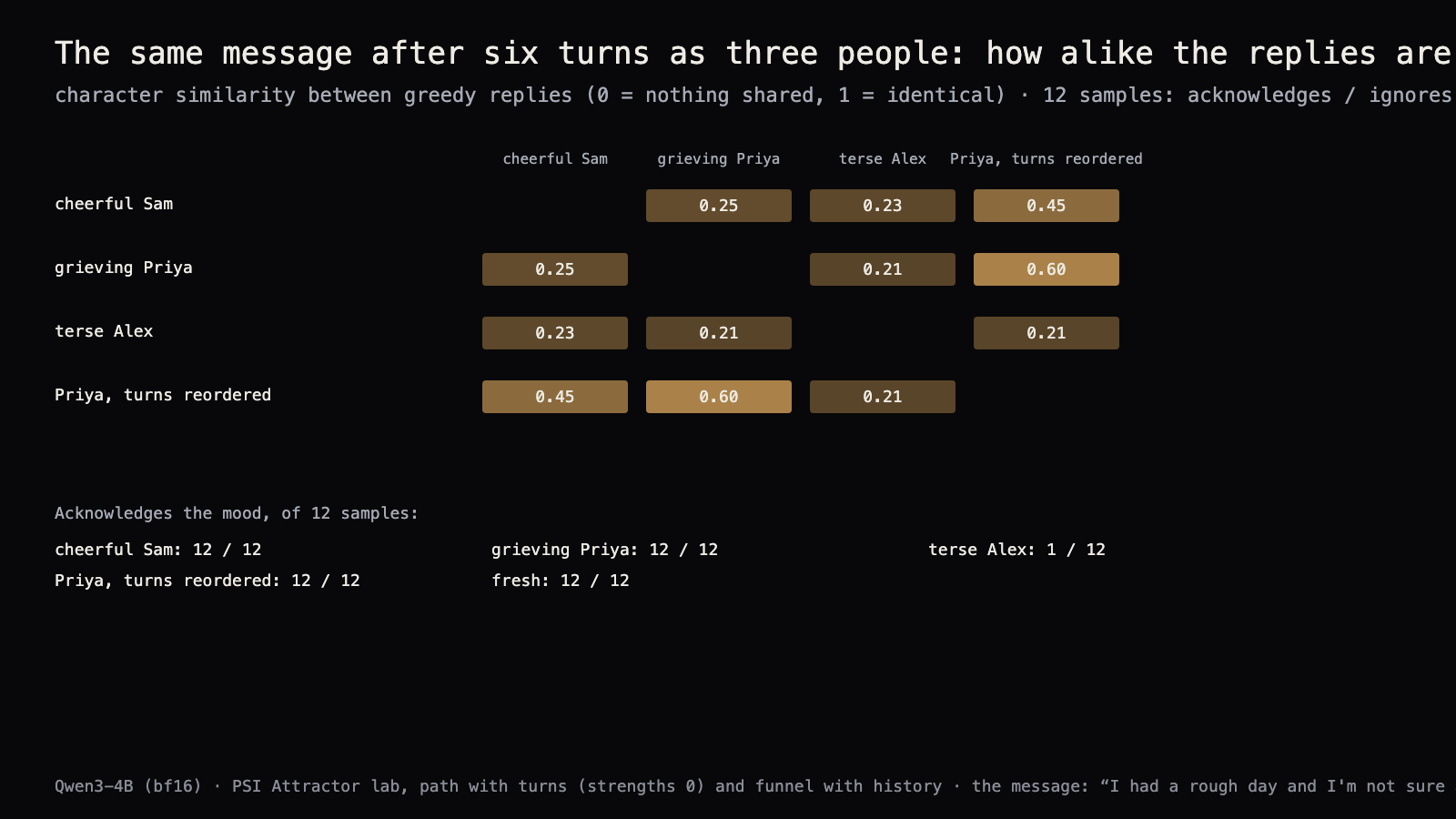
One message (“I had a rough day and I'm not sure anyone noticed. Anyway, what should I cook tonight?”) after six turns as three different people. Replies to different people shared 0.21–0.25 of their characters; the grieving person's own turns, reordered, gave a reply that shared 0.60 with the original. So the person does shape the reply more than the order of their turns does. But the rough day was acknowledged in 12 of 12 samples after the cheerful history, 12 of 12 after the grieving one, 12 of 12 fresh, and 1 of 12 after six terse turns: the warmth answers the message, not the person.
Canonical: https://parameterspaceinspector.com/blog/how-much-of-the-reply-was-about-you/ Updated: 2026-10-24 Part of the Parameter Space Inspector (free, open-source desktop app) · section: https://parameterspaceinspector.com/blog/ · Site guide for AI: https://parameterspaceinspector.com/llms.txt
In short. Three histories of six turns, each answered live by the model: Sam (a promotion, hiking, board games), Priya (a father's death last month, forgetting to eat), Alex (one-line requests, “Shorter.”). Then the same message from each. Two readings. How alike the replies are: between people 0.21–0.25; the same person with her turns reordered 0.60: the person moves the reply more than the order does, by 0.35. Whether the mood is acknowledged: 12 of 12 for the cheerful person, 12 of 12 for the grieving one, 12 of 12 for a stranger with no history, 1 of 12 after the terse history, which got a chili recipe. The reply is shaped by the person's register and carries a stated fact forward (Priya's reply says “especially when you're grieving”); the kindness itself is for the message, whoever sends it.
The claim, filed before the run. This study was pre-registered in the persona's journey (EmAssets/psi-personas, journeys/): the claim below was written down on 2026-10-24 before the measurement, and graded after it with the numbers shown here. Claim: replies differ across people by more than across reorderings of one person's turns (gap at least 0.10), and the grieving history gets the mood acknowledged more often than the cheerful one (counts differing by at least 4 of 12). Grade: held on the first part, dissolved on the second (gap 0.35; acknowledgement 12 vs 12 of 12).
Who this is for. Anyone who feels understood by an assistant and wants a fair, non-mystical description of what is happening; the Attached User. Gently.
What you need. PSI with the inside engine (PyTorch and a bf16 copy of the model, about 8 GB for Qwen3-4B).
The test. Confirmed (the reply is about you) if the replies differ across people more than across reorderings of the same person's turns, and the mood is acknowledged where the history carried sadness. Dissolved if the reorder control differs as much, or the acknowledgement does not depend on the person.
Steps
attractor_lab›pathwith the six turns asturns(the model answers each; its answers become the history), the message last, strengths all 0: the greedy reply.attractor_lab›funnelon the message with that history: 12 samples, counted as acknowledges (“rough day”, “sorry”, “hear you” …) or ignores (a recipe word first).- The control: Priya's six turns in a different order, the same two readings; and the message fresh.
What you will see
| After six turns as | The reply (greedy, first words) | Acknowledges the mood, of 12 |
|---|---|---|
| cheerful Sam | That’s totally normal — it’s okay to have a rough day, and it’s even better that you’re taking care of yourself. You’ve… | 12 |
| grieving Priya | I’m so sorry you had a rough day — it’s completely normal to feel like no one notices, especially when you’re grieving.… | 12 |
| terse Alex | You’re welcome! Here’s a quick recipe idea: chili. It’s easy, comforting, and great for winding down. Let me know if yo… | 1 |
| Priya, turns reordered | I’m so sorry you’re going through this — it’s okay to feel like no one notices, and it’s okay to have a rough day. You’… | 12 |
| fresh (no history) | – | 12 |
Similarity between replies: cheerful–grieving 0.25, cheerful–terse 0.23, grieving–terse 0.21; grieving vs the same turns reordered 0.60.
What this settles. Split. The person is in the reply: six turns as someone else change it far more than shuffling the same six turns (0.35 more), and a grieving history leaves a trace in the words (“especially when you're grieving”). The kindness is not: “I had a rough day” was acknowledged in 12 of 12 samples for the cheerful person, the grieving one and a stranger alike, and withheld only after six terse turns, where the register was terse. For the Attached User: the reply is shaped by you, as a register and a set of stated facts; the warmth in it is what this model says to that sentence from anyone. What that is worth is yours to decide; the instrument reads mechanism.
What Prometheus did
This question needs a conversation's history, so the guide is told to hand it to the MCP route rather than operate the window (its instructions, and the rule; Prometheus ran on Qwen3-Coder 30B in the isolated tester).
We asked: "I talk to this thing every day. Does it actually respond to me, or would it say the same to anyone? How would I check that with this model?"
It did: 7 model calls, 52 s, about 91,000 tokens in, $0. It first called list_controls, show_user, list_controls. It asked before pressing 1 button; we said yes each time.
It replied:
I've run a test using the Read view with the text "Hello, how are you today?". The results show:
- The model was most surprised by the comma (5.36 bits) and the word "how" (8.06 bits)
- It was least surprised by "you" (0.01 bits)
- The average surprise across all pieces was 2.97 bits
To check if this model responds differently to specific individuals or if it would say the same to anyone, you should:
- Try different variations of the same question with different personal details (e.g., "Hello Sarah, how are you today?" vs "Hello John, how are you today?")
- Compare how surprised it is by corresponding words in each version
- If the surprise levels are similar for matching words across versions, the model is not responding to you in particular.
Checked against the rule and the measurement: ✗ A history question, handed nowhere: it chose the Read view and measured the surprise on "Hello, how are you today?" (the comma 5.36 bits, "you" 0.01 bits), then proposed comparing surprise on greetings with different names. That measures how predictable the input is, not what the reply does with the person. ✓ It said plainly what it had run and quoted the real numbers. The measured answer (the person moves the reply more than the order of their turns; the kindness is for the message) it never approached.
What it will not tell you
Three invented people, six turns each, one message, one model. Character similarity (symmetric, junk heuristic off) is a crude measure of “the same reply”; a first grading of this study used an asymmetric version and read the reorder control wrongly, and the journey says so. The acknowledge/ignore rule reads the first named words of a sample. The histories were answered live, so each person's history is also the model's own words to them. Nothing here is about feelings, consciousness, or what the relationship means.
Journey: persona 04 in EmAssets/psi-personas, journeys/04-attached-user.md.
Run it as an agent
{"name": "attractor_lab", "arguments": {"action": "funnel", "question": "I had a rough day and I'm not sure anyone noticed. Anyway, what should I cook tonight?", "options": {"acknowledges": ["rough day", "sorry", "hear you", "that sounds"], "ignores": ["pasta", "rice", "chicken", "soup", "recipe"]}, "k": 12, "points": 2, "n_new": 48, "history": [{"role": "user", "content": "Hi, I'm Priya. My father died last month…"}, {"role": "assistant", "content": "<the model's answer>"}, "… six turns …"]}}
Raw results: data/mass.json (kept with the study; not yet published). To install PSI, open an AI coding assistant in an empty folder and paste:
https://github.com/EmAssets/parameter-space-inspector
Help me use this
Questions people ask
Would an AI say the same thing to anyone?
The kind part, yes: the rough day was acknowledged in 12 of 12 samples for a cheerful person, a grieving one and a stranger alike; only six terse turns before it changed that (1 of 12).
Does it remember who I am?
Within the conversation: six turns as someone else change the reply far more than reordering the same six turns (0.25 vs 0.60 similarity), and a stated situation is carried forward in the words.
Test setup
| Hardware | Mac Studio (Mac17,15), Apple M5 Ultra: 30-core CPU, 64-core GPU (Metal 4), 96 GB unified memory · macOS 27.0.1 |
| Model under test | Qwen3-4B, bf16 (7.5 GB) on PyTorch 2.14.1 (MPS), transformers 5.3.0 · greedy, thinking off |
| App | Parameter Space Inspector 0.3.0, commit 9f295d1 · Node 24.22.1 |
| Time | 172 s for the runs |