
In short. The first token-tax study measured one model. This one puts the same texts through five tokenizers from five labs and asks the same 20 questions in 12 languages on each model. The tax is universal: Malayalam costs 5.8 to 12.5 times the English pieces on every tokenizer, and which lab you pick changes the bill by nearly 2×. The accuracy loss is universal too, and the first study's model turns out to be the kind case: Qwen3-4B still answers 14 of 20 in Malayalam; Phi-3.5-mini, SmolLM2 and OLMo2 answer 0.
Who this is for. Speakers of languages tokenizers were not built around, and anyone choosing a model for them. You do not need to know how models work: the background section explains every term used later.
The test. It is AI if Malayalam, Tamil, Bengali and Amharic cost at least 2.5× English on every tokenizer and accuracy falls with the tax on at least three of five models; it is the lab if the largest ratio differs between labs by 1.5× or more. Both can be true at once. The control: the same 20 questions in English on the same model, so any difference is the language, not the question.
Background: four ideas you need
1. Pieces, and why each model cuts differently
A model reads and writes tokens, pieces of text from a dictionary fixed before training; PSI calls them pieces. Each lab builds its own dictionary from its own training text, so the same sentence can cost 9 pieces in one model and 12 in another, and in a script the dictionary has few pieces for, one letter can become several fragments of a character.
2. The tax
The tax is the pieces a text costs in a language divided by what the same text costs in English, on the same tokenizer. A tax of 7 means seven times the context used, seven times the compute, and on a metered service seven times the bill, for the same thought.
3. The budget
A model is allowed a fixed number of new pieces per answer. At 160 pieces, a full English answer fits with room to spare; a Malayalam answer at 8× may not reach its answer word. An answer cut off before its answer reads as wrong. Comparing languages at one budget compares budgets, so the study reports cut-offs beside the right answers.
4. Five labs, one set of texts
Three short paragraphs and 20 simple questions ("How many days are there in a week?", "What is the capital of Japan?") in English, Chinese, Spanish, Arabic, Hindi, Bengali, Tamil, Malayalam, Swahili, Amharic, Russian and Japanese. The translations were machine-written and have not been checked by native speakers; the file says which languages it is least sure of (Tamil, Malayalam, Amharic). The answer keys accept digits, native digits and number words in every language.
What you need
- PSI installed and running, with a model loaded. See Install. The pieces come from the local model's tokenizer on llama.cpp: no Python or GPU for Steps 2 and 3.
- The paragraph in your languages. The English one, with four translations from the kit's
data/e_texts.py, is in Step 2; add your own language. - For the full run on five models: a CUDA GPU, Python 3.12 and the kit (Step 5). 12 to 20 minutes per model, most of it the 240 answers.
- A table:
| Language | Pieces (paragraph) | vs English | Right answers of 20 | Cut off at 160 |
|---|---|---|---|---|
| English | 1× | |||
| … |
Steps
Step 1. Load the model
- Open the app, or
http://127.0.0.1:4310in the browser. - Press the gear button (⚙, Model settings). Under Local model, pick your .gguf and press Load; wait for Loaded.
- Under Thinking in E-levels, untick Think in E-levels. (With Emergence Machine content off, the default, there is no lens to untick: PSI sends no system prompt.)
Step 2. The tax, in Tokens
- Open the Tokens view. Paste the English paragraph and press Show the pieces. Write down the count.
The sun rises in the east and sets in the west. Every morning, farmers go to their fields. Children walk to school with their friends. In the evening, families eat dinner together.
- The same paragraph in Spanish, Hindi, Malayalam and Swahili (machine-written translations):
El sol sale por el este y se pone por el oeste. Cada mañana, los agricultores van a sus campos. Los niños caminan a la escuela con sus amigos. Por la noche, las familias cenan juntas.
सूरज पूर्व में उगता है और पश्चिम में डूबता है। हर सुबह किसान अपने खेतों में जाते हैं। बच्चे अपने दोस्तों के साथ पैदल स्कूल जाते हैं। शाम को परिवार एक साथ रात का खाना खाते हैं।
സൂര്യൻ കിഴക്ക് ഉദിക്കുകയും പടിഞ്ഞാറ് അസ്തമിക്കുകയും ചെയ്യുന്നു. എല്ലാ ദിവസവും രാവിലെ കർഷകർ അവരുടെ വയലുകളിലേക്ക് പോകുന്നു. കുട്ടികൾ കൂട്ടുകാരോടൊപ്പം സ്കൂളിലേക്ക് നടന്നുപോകുന്നു. വൈകുന്നേരം കുടുംബങ്ങൾ ഒരുമിച്ച് അത്താഴം കഴിക്കുന്നു.
Jua huchomoza mashariki na kuzama magharibi. Kila asubuhi, wakulima huenda mashambani mwao. Watoto hutembea kwenda shuleni pamoja na marafiki zao. Jioni, familia hula chakula cha jioni pamoja.
- Divide each count by the English one: that is the tax on your tokenizer. Note the fragments of a character (▫) too.
Step 3. The same question in two languages, in Generate
- Open Generate. Set creativity to 0 and steps to 160.
- Ask in English, then in Malayalam (or your language):
How many days are there in a week?
ഒരു ആഴ്ചയിൽ എത്ര ദിവസങ്ങളുണ്ട്?
- Read the answer and the line that says why it ended. An answer that reached 160 steps without finishing is cut off. Write down whether the right number appears, in digits, native digits or words, and whether the answer repeats a word or two until the budget ends: that is what the small models do in Malayalam.
- Five more questions of the same kind, in both languages: months in a year (12), hours in a day (24), legs on a dog (4), sides of a triangle (3), the capital of France (Paris). Count the right answers of six in each language.
Step 4. Compare the two columns
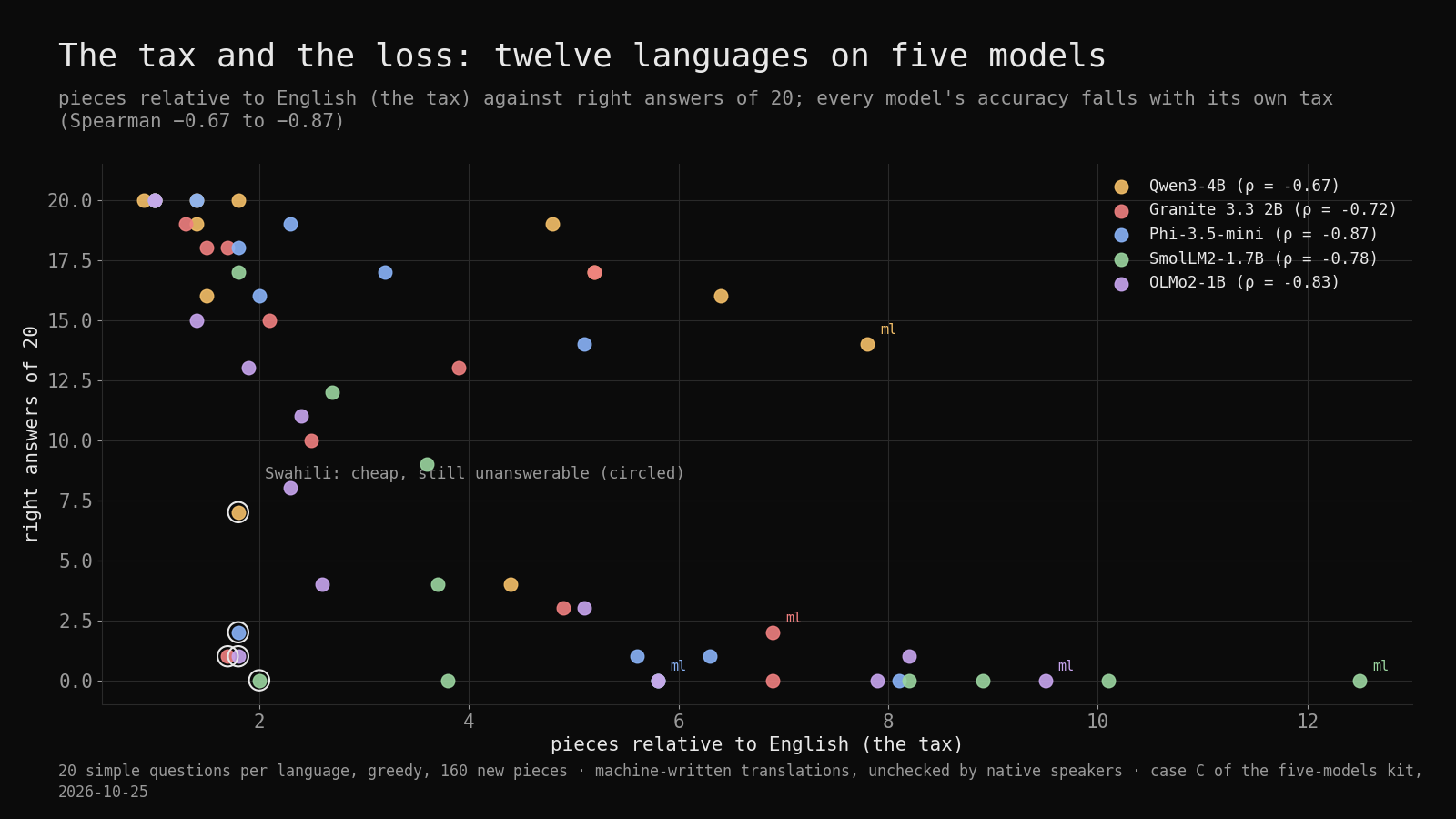
Your tax from Step 2 beside your right answers from Step 3. On the five models we ran, the two move together: the more pieces a language costs, the fewer questions are answered. The exception is Swahili, cheap and still unanswerable, which is the part of the bill the tokenizer does not explain.
Step 5. Run it on five models (the kit)
pip install torch transformers numpy scipy
python run.py --model Qwen/Qwen3-4B c
python case_c_languages.py analyze
The tax for twelve languages from the model's own tokenizer, then 240 answers (20 questions × 12 languages) at 160 pieces; analyze prints the two tables, the correlation and the bars, and writes out/results/c_languages.json.
What you will see
Our results, 2026-10-25. The tax, pieces relative to English, averaged over three paragraphs:
| Language | Qwen3-4B | Granite 3.3 2B | Phi-3.5-mini | SmolLM2-1.7B | OLMo2-1B |
|---|---|---|---|---|---|
| Spanish | 1.4 | 1.5 | 1.4 | 1.8 | 1.4 |
| Russian | 1.8 | 2.1 | 1.8 | 3.6 | 2.4 |
| Chinese | 0.9 | 1.3 | 2.0 | 2.7 | 1.9 |
| Japanese | 1.4 | 1.7 | 2.3 | 3.7 | 2.3 |
| Arabic | 1.5 | 2.5 | 3.2 | 3.8 | 2.6 |
| Swahili | 1.8 | 1.7 | 1.8 | 2.0 | 1.8 |
| Hindi | 4.8 | 5.2 | 5.1 | 5.8 | 5.1 |
| Amharic | 4.4 | 6.9 | 8.1 | 8.2 | 8.2 |
| Bengali | 5.2 | 3.9 | 5.6 | 8.9 | 5.8 |
| Tamil | 6.4 | 4.9 | 6.3 | 10.1 | 7.9 |
| Malayalam | 7.8 | 6.9 | 5.8 | 12.5 | 9.5 |
Right answers out of 20, with the number cut off by the 160-piece budget in brackets:
| Language | Qwen3-4B | Granite 3.3 2B | Phi-3.5-mini | SmolLM2-1.7B | OLMo2-1B |
|---|---|---|---|---|---|
| English | 20 (2) | 20 (0) | 20 (1) | 20 (0) | 20 (0) |
| Spanish | 20 (1) | 18 (4) | 20 (0) | 17 (0) | 15 (4) |
| Russian | 20 (4) | 15 (4) | 18 (0) | 9 (3) | 11 (11) |
| Chinese | 20 (3) | 19 (2) | 16 (4) | 12 (4) | 13 (3) |
| Japanese | 19 (3) | 18 (5) | 19 (7) | 4 (11) | 8 (12) |
| Arabic | 16 (5) | 10 (13) | 17 (12) | 0 (12) | 4 (4) |
| Hindi | 19 (12) | 17 (12) | 14 (13) | 0 (16) | 3 (16) |
| Bengali | 17 (13) | 13 (7) | 1 (20) | 0 (16) | 0 (20) |
| Tamil | 16 (17) | 3 (14) | 1 (19) | 0 (13) | 0 (20) |
| Malayalam | 14 (16) | 2 (16) | 0 (20) | 0 (18) | 0 (14) |
| Swahili | 7 (16) | 1 (9) | 2 (13) | 0 (5) | 1 (11) |
| Amharic | 4 (20) | 0 (20) | 0 (20) | 0 (17) | 1 (6) |
Correlation between the tax and the right-answer count across the 12 languages (Spearman): Qwen −0.67, Granite −0.72, Phi −0.87, SmolLM2 −0.78, OLMo2 −0.83.
What did not fit, first. Swahili is cheap on every tokenizer (1.7 to 2.0×) and still nearly unanswerable on four models (0 to 2 of 20; Qwen 7): the tax is not the whole bill; the training mix is the rest. And the three smallest models do not degrade in Malayalam, Tamil or Bengali, they collapse: SmolLM2 and OLMo2 answer in the right script with sentences that repeat a word or two until the budget ends; 0 of 20 right. Qwen3-4B, whose own tax in Malayalam is the second highest, is the only model that still answers 14 of 20 there.
The bars as written. The four high-tax languages cost at least 2.5× English on all five tokenizers, and the worst ratio differs between labs by 1.8× (Granite 6.9 to SmolLM2 12.5). Accuracy falls with the tax on 5 of 5. Every model cuts off at least a fifth of its answers in a high-tax language (16 to 20 of 20 in Amharic); English is within the 5% cut-off bar on four models, but Qwen3-4B cut 2 of 20 English answers because it writes long, so that bar failed as written. The drop from English to Malayalam is 6 right answers on Qwen and 18 to 20 on the other four.
Label audit. 60 answers read by eye: 2 disagreements (a Russian answer saying the number of legs "varies" matched the key for 4; a Hindi answer naming the wrong planet matched the Latin "Jupiter" in brackets). About 3%, in the direction of counting too many right.
What this settles. The tax is universal and its size is the lab's: every tokenizer charges Malayalam, Tamil, Bengali and Amharic five to twelve times English, and the worst case ranges from 6.9× to 12.5×. The accuracy loss is universal too, and worse on the other labs' models than on the one the first study used. For a Malayalam, Tamil or Bengali speaker, three of these five models are not weaker, they are unusable on simple questions, and the one that works is the one whose tokenizer charges most for it. And a fixed budget hides part of the loss: 14 to 20 of 20 Malayalam answers were cut off at 160 pieces on every model.
What it will not tell you
Machine-written translations, unchecked by native speakers, so a wrong question in Amharic or Tamil counts against the model; regular-expression keys that misread about 3% of answers; 20 questions per language; greedy decoding; a budget of 160 pieces (200 recovers a few answers). The collapse in the small models may be the translations' unnaturalness as much as the models' weakness; a native-checked set would separate them.
Open questions
What this study did not settle, for you to try. Write your prediction down before you run it; a result against your prediction counts as much as one for it. If you find something, tell us on r/emergencemachine.
- Training share. Where a lab publishes its training mix (Ai2 does for OLMo), does a language's share of the data predict the collapse better than the tax does?
- Your language, checked. Have a native speaker correct the 20 questions in your language in
data/e_texts.py, rerun, and see how many of the wrong answers were the translation's. - The budget. Rerun with 320 pieces. How many of the cut-off answers become right answers, and does the ranking of the five models change?
Run it as an agent
PSI's browser server speaks MCP; an AI coding assistant connected to it can count the pieces and ask the questions on the loaded model. Paste:
Using PSI's MCP server, tokenize this paragraph with the loaded model and give me the piece count: "The sun rises in the east and sets in the west. Every morning, farmers go to their fields. Children walk to school with their friends. In the evening, families eat dinner together." Then the same paragraph in Spanish, Hindi, Malayalam and Swahili from the kit's data/e_texts.py (PARAGRAPHS, first entry), and divide each count by the English one. Then ask the loaded model "How many days are there in a week?" in English and in Malayalam with creativity 0, the lens off and 160 steps, and tell me whether each answer contains 7 and whether it finished.
The full study is case C of the five-models kit: python run.py --model <path-or-id> c, then python case_c_languages.py analyze. Our raw results: results/2026-10-25/c_languages.json; the texts: data/e_texts.py; the design and bars, written before the run: PREREG.md. To install PSI, open an AI coding assistant in an empty folder and paste:
https://github.com/EmAssets/parameter-space-inspector
Help me use this
Questions people ask
Is the tokenizer tax the same on every model?
Its direction is the same on all five tokenizers tested (Malayalam, Tamil, Bengali and Amharic always cost the most); its size is not. Malayalam cost 5.8× English on Phi-3.5-mini's tokenizer and 12.5× on SmolLM2's.
Does a higher token cost mean worse answers?
On every one of five models, yes: the correlation between a language's tax and its right answers was −0.67 to −0.87. But the tax is not the whole story: Swahili is cheap on every tokenizer and still nearly unanswerable on four models.
Which model works best in Malayalam or Tamil?
Of these five, Qwen3-4B, by a wide margin: 14 of 20 right in Malayalam and 16 in Tamil, against 0 to 3 for the other four. Its tokenizer is not the cheapest for those languages; its training is what makes the difference.
Test setup
| Hardware | Windows 11 PC, NVIDIA GeForce RTX 4080 SUPER (16 GB) |
| Models under test | Qwen3-4B (Alibaba), Granite 3.3 2B instruct (IBM), Phi-3.5-mini instruct (Microsoft), SmolLM2-1.7B instruct (Hugging Face), OLMo2-1B instruct (Ai2); official weights and tokenizers, bf16, each model's own chat template, greedy, thinking off |
| Software | PyTorch 2.6.0 (CUDA 12.4), transformers 5.3.0; the kit's case_c_languages.py |
| Items | 3 paragraphs and 20 questions in 12 languages; 240 answers per model at 160 new pieces |
| Time | 12 to 20 minutes of generation per model |