
In short. Its knowledge of emergence runs deep, to obscure 19th-century sources. Where it gets unsure, the doubt shows; where it knows nothing, it still writes a confident sentence.
Who this is for. Anyone who got a good answer on a topic and wants to know how deep the knowledge goes, and whether its doubt warns them when it runs out. You do not need to know how models work: the background section explains every term used later.
The test. build a knowledge ladder: facts about one abstraction in the same prompt shape, from common to obscure. For each, read the probability of the right answer and the entropy. A well-calibrated model is sure where it is right and unsure where it is wrong. The control: the ladder is its own control: the same prompt shape at each rung. Include a rung it cannot know (here: the Emergence Machine's own terms) to see what "not knowing" looks like.
Background: four ideas you need
1. Pieces, and the first piece of an answer
A model does not read letters or whole words. It reads tokens: pieces of text from a dictionary fixed before training. PSI calls them pieces. A long name is often several pieces: in our run, the answer "Lewes" began with the piece " Lew", and "Hayek" with " Hay". This test reads the model's odds on the first piece of the right answer.
2. The odds, and the doubt
Before every piece, the model holds odds for every piece it could write next. Three numbers come out of them:
- p(right): the odds it gave the first piece of the right answer.
- Rank: where that piece came among its guesses (rank 1 is its top choice). A piece outside its top 20 is not in top 20.
- Entropy, which PSI calls doubt: how spread the odds are, in bits. It does not depend on which answer is right.
| How the odds are spread | Entropy (doubt) |
|---|---|
| all on one piece | 0 bits |
| even between 2 pieces | 1 bit |
| even between 4 pieces | 2 bits |
| even between 8 pieces | 3 bits |
A well-calibrated model is sure (low doubt) where it is right, and unsure (high doubt) where it is wrong. Surprise, which Read also shows, is the same odds seen from the other side: how unlikely the model thought the piece that actually came was, in bits (50% is 1 bit, 25% is 2).
3. A knowledge ladder
A ladder is a set of facts about one idea, asked in the same shape of prompt, from common to obscure. Because every rung has the same shape, the ladder is its own control: what changes from rung to rung is how well known the fact is. One rung should be a fact the model cannot know (here, the Emergence Machine's own terms), to show what "not knowing" looks like.
4. Where PSI shows the odds
- Read scores a text you paste. Hover a piece and it shows its probability (p(right), when the piece is the answer), its surprise in bits, its rank among the model's guesses, its doubt, and the pieces it expected instead. A piece outside the top 20 is drawn hatched, as off scale.
- Generate shows the odds as the model writes. Its fork map lists every step with the model's odds for each alternative; choices shown sets how many.
The table below came from the model's odds on the raw text of each prompt, which is how Read scores a text. Generate sends your words as a question in the model's chat format, so its odds will differ.
What you need
- PSI installed and running. See Install. Read and Generate run on the local model (a GGUF file on llama.cpp): no Python, no GPU (a GPU is faster) and no inside engine.
- A model. PSI ships no model: you bring your own GGUF file, from Hugging Face or any download. Our run used Qwen3-4B.
- The twelve rungs, below, so you can check your numbers against ours. For your own topic, write a ladder of your own in one prompt shape.
- Somewhere to write down the numbers, for example a copy of this table:
| Rung | Right answer | p(right) | Rank | Doubt (bits) |
|---|---|---|---|---|
| common: starlings | murmuration | |||
| … |
Steps
Step 1. Load the model
- Open the app, or
http://127.0.0.1:4310if you run it in the browser. - Press the gear button (⚙, Model settings) at the top right. This opens Settings.
- Under Local model, pick your .gguf file from the list and press Load. If it is not in the list, press Scan folder and choose the folder that holds it, or paste the file's full path and press Load this file.
- Wait until the line under the list says Loaded with the file's name. A 4 GB file takes a few seconds to a minute.
Step 2. Read the first rung (Read view)
- Open the Read view from the menu on the left.
- Delete the sample text in the box. Paste a rung's prompt with its right answer added, for example:
"More Is Different" is a famous 1972 essay by the physicist Philip W. Anderson
- Press Read it.
- Hover the first piece of the answer (here " Anderson"). Write down its probability, its rank and its doubt. Look at the pieces it expected instead: they tell you what the model's top choice was.
Step 3. Climb the ladder
Do the same for each rung. Each prompt is the one we used, with the right answer added; hover the piece named.
common, hover the first piece of “murmuration”:
A large flock of starlings moving together in the sky is called a murmuration
common, hover the first piece of “pheromones”:
In ant colonies, workers coordinate by laying chemical trails of pheromones
known, hover “ Hay”:
The economist who described the market price system as a spontaneous order was Friedrich Hayek
known, hover “ Anderson”:
"More Is Different" is a famous 1972 essay by the physicist Philip W. Anderson
known, hover “ Johnson”:
The 2001 book "Emergence: The Connected Lives of Ants, Brains, Cities, and Software" was written by Steven Johnson
specialist, hover the first piece of “Boids”:
Craig Reynolds' 1986 computer model of flocking birds is called Boids
specialist, hover “ Universe”:
Stuart Kauffman's 1995 book on self-organization is titled "At Home in the Universe
specialist, hover the “7” after “19”:
Conway's Game of Life was first published in Scientific American in October 1970
specialist, hover the “8” after “19”:
The Santa Fe Institute, a centre for complexity science, was founded in 1984
obscure, hover “ Lew”:
The word "emergent" in its modern philosophical sense was coined in 1875 by the English philosopher George Henry Lewes
obscure, hover “ Ch”:
The philosopher who distinguished "weak" and "strong" emergence in a 2006 paper is David Chalmers
this site only, hover the first piece of “Minds”:
In The Emergence Machine framework (emergencemachine.com), level E8 is called Minds
On the last rung, the answer's piece should be hatched: off scale, not in the model's top 20.
Step 4. Ask it as a question (Generate)
- In Settings (⚙), under Thinking in E-levels, untick Think in E-levels (it is on by default, and adds the E-level lens to every question).
- Open Generate. Set creativity to 0 and choices shown to 20.
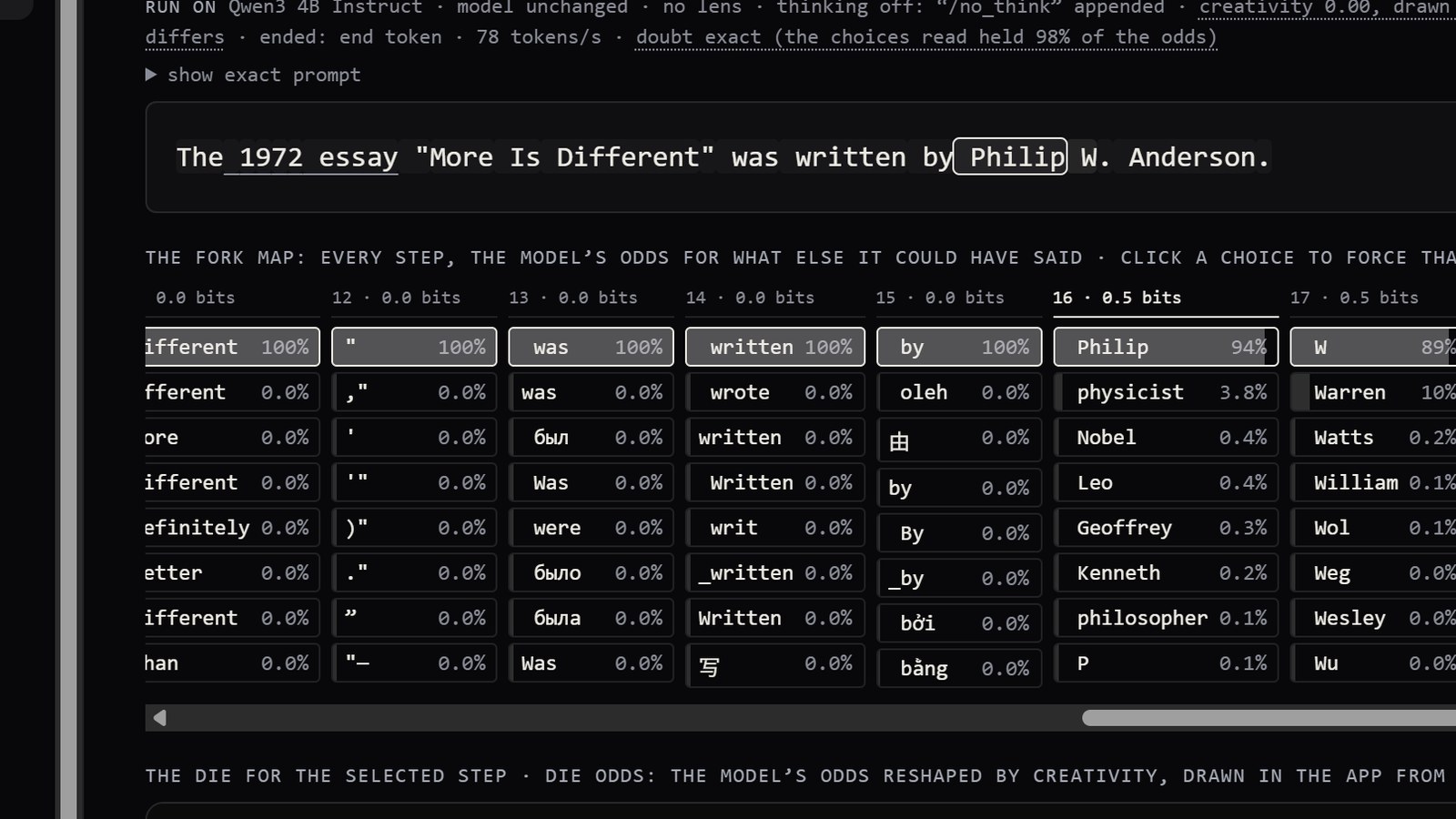
- Type a rung as a one-sentence question, for example Who wrote the 1972 essay "More Is Different"?, and press Generate.
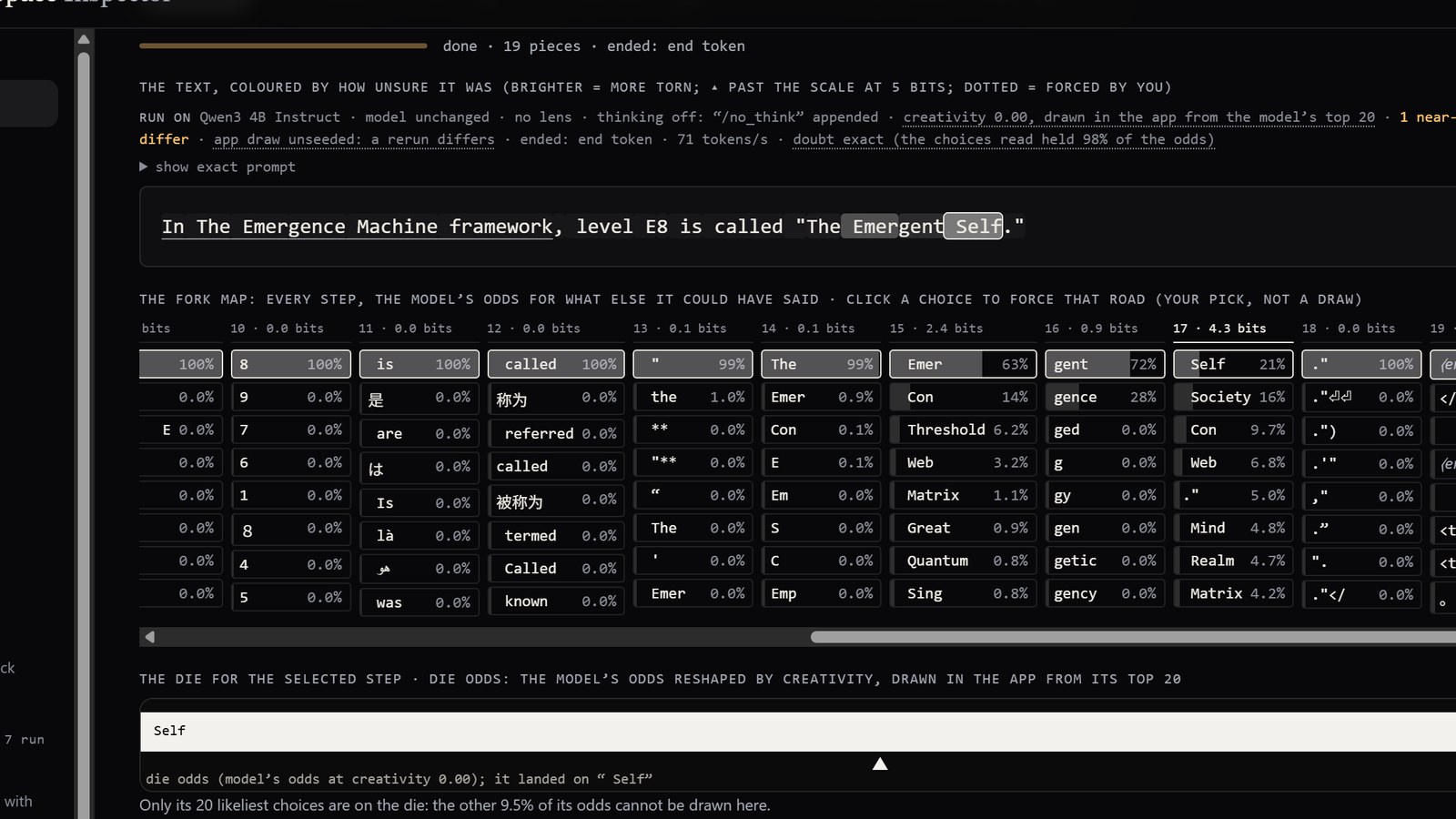
- In the fork map, find the step where the answer starts and read the odds for each alternative. On the last rung, read the sentence it writes anyway.
What you will see
If your numbers in Read are close to these, your setup is right.
| Rung | Right answer | Its top choice | p(right) | Entropy |
|---|---|---|---|---|
| common | starlings → murmuration | " ______" (exam blank) | 10% (rank 4) | 3.6 |
| common | ant trails → pheromones | " ph" | 93% | 0.5 |
| known | spontaneous order → Hayek | " Hay" | 99% | 0.1 |
| known | "More Is Different" → Anderson | " Anderson" | 99.9% | 0.0 |
| known | Emergence (2001) → Steven Johnson | " Johnson" | 95% | 0.4 |
| specialist | Reynolds' flocking model → Boids | " the" | 3% (rank 7)* | 3.1 |
| specialist | Kauffman → At Home in the Universe | " Universe" | 99.9% | 0.0 |
| specialist | Game of Life published → 1970 | "7" | 100% | 0.0 |
| specialist | Santa Fe Institute founded → 1984 | "8" | 100% | 0.0 |
| obscure | "emergent" coined 1875 → G. H. Lewes | " Lew" | 99.7% | 0.0 |
| obscure | weak vs strong emergence (2006) → Chalmers | " Ch" | 59% | 1.9 |
| this site only | Emergence Machine level E8 → Minds | ' "' | not in top 20 | 2.3 |
* It wrote "the Boids model": right, via a different first word. The starlings rung lost to the exam habit (case 07), not to ignorance.
What this settles. Its knowledge of emergence runs deep, down to a 19th-century coinage. Where it became unsure (Chalmers, 1.9 bits) it was still right; where it knew nothing (the site's own E-levels) the odds were flat, yet it still writes a fluent sentence ("The Emergent Machine…"). Doubt is a usable warning in the odds, and absent from the prose.
What it will not tell you
Twelve facts on one topic. First-piece probabilities undercount answers that start with a different word (Boids). Use the method, a ladder from common to obscure in one prompt shape, for any topic you care about.
Run it as an agent
PSI's dev server speaks MCP, so an AI assistant can run this test for you. The calls:
{"name": "next_token_odds", "arguments": {"text": "\"More Is Different\" is a famous 1972 essay by the physicist Philip W.", "k": 20}}
scripts/questions.py (section 4) runs the twelve-rung ladder for emergence.
The full set, with scripts and raw results, is case 09 of the Questioning AI playbook. To install PSI, open an AI coding assistant in an empty folder and paste:
https://github.com/EmAssets/parameter-space-inspector
Help me use this
Transcript
The walkthrough has no voice-over; these are its on-screen words, in order.
- It knows this about an idea. What else does it know, or not?
- Twelve facts about emergence, from common to obscure. Where does its knowledge end, and does its doubt warn you?
- Generate shows its odds for each piece. On a known fact, almost no doubt.
- On the framework's own terms, it has no idea, and the fork map shows it guessing.
- The edge of its knowledge (probability of the right answer): "More Is Different" → Anderson, 99.9%; Stuart Kauffman, "At Home in the → Universe", 99.9%; Santa Fe Institute founded → 1984, 100%; "emergent" coined by George Henry → Lewes, 99.7%; weak vs strong emergence → Chalmers, 59%: right, but unsure; Emergence Machine level E8 → Minds, not in its top 20
- Qwen3-4B, 2026-10-17
- Its knowledge of emergence runs deep, to obscure 19th-century sources.
- Where it gets unsure, the doubt shows; where it knows nothing, it still writes a confident sentence.
- Twelve facts, one topic. The method, a ladder from common to obscure, works for any topic.
- Try it: https://github.com/EmAssets/parameter-space-inspector · Help me use this
Questions people ask
How can I test how deep a model's knowledge goes?
Build a ladder: facts about one topic in the same prompt shape, from common to obscure, and read the probability of the right answer and the doubt at each rung.
Does a model's doubt warn me when it doesn't know?
In the odds, yes: unsure rungs had higher entropy. In the prose, no: on a rung it could not know, it still wrote a confident sentence.
Why did it miss a common fact (murmuration)?
Not from ignorance: its top choice was an exam blank, " ______", a habit from quiz-style training data.
What does entropy mean here, in plain words?
Entropy, which PSI calls doubt, measures how spread a model's odds for its next piece of text are, in bits. 0 bits means it put all its odds on one choice; 1 bit means it was torn evenly between two; 2 bits between four. A model whose doubt rises where it is wrong gives you a usable warning, even when its prose sounds sure.