
In short. Code, maths and structured text are its home ground; casual talk and fiction are not. It keeps slipping into exam format, a trace of quiz-style training data.
Who this is for. Auditors, researchers, anyone deciding whether a model fits their domain; anyone who noticed a model "sounds like" a particular kind of text. You do not need to know how models work: the background section explains every term used later.
The test. a model trained heavily on a kind of text predicts new text of that kind well. A surprise profile across genres is a fingerprint of its diet. Formatting habits that leak into unrelated answers are a second fingerprint. The control: every genre sample is written fresh (so nothing is memorised), similar in length; ideally compare the same texts across several models, because some genres are inherently more predictable.
Background: five ideas you need
1. Tokens: the pieces the model reads
A model does not read letters or whole words. It reads tokens: pieces of text from a dictionary fixed before training. PSI calls them pieces. A common word such as " the" is one piece; a rare name or a long number may be several. Ordinary English comes to a little more than one piece per word.
2. Surprise: how unexpected each piece was
A model reads text one piece at a time. Before each piece, it guesses what comes next, as odds over its whole dictionary. Surprise turns the odds it gave the piece that actually came into a score, counted in bits:
| Odds the model gave the real next piece | Surprise |
|---|---|
| 100% (certain, and right) | 0 bits |
| 50% (a coin flip) | 1 bit |
| 25% | 2 bits |
| 1 in 1,000 | about 10 bits |
| 1 in a million | about 20 bits |
Each halving of the odds adds one bit. Low surprise means the model saw the piece coming; high surprise means it did not. Top-1, the other column in the results, is the share of pieces that were the model's first guess.
3. What the Read view shows
The Read view scores every piece of a text you paste and colours it: the brighter the piece, the more surprising. Hover a piece and it shows the odds the model gave it, its surprise in bits, its rank among the model's guesses (rank 1 is its first guess) and the pieces it expected instead.
- Off scale (hatched). A piece that is not among the model's top 20 guesses is drawn hatched and shown as "over N bits": PSI knows only a floor for it.
- The headline number. The line next to the Read it button gives the pieces scored, the average surprise ("average surprise ≥ X bits, counting each off-scale piece at its floor"), the plain average in brackets after it, and the off-scale count. The first piece of a text is not scored, because nothing comes before it.
- The ▴ mark. A piece marked ▴ is past the colour scale, at more than 12 bits.
4. A surprise profile: a fingerprint of the model's diet
A model trained on a great deal of one kind of text predicts new text of that kind well. So read short texts of twelve genres, all written fresh (so nothing in them can be memorised) and of similar length, and the average surprise of each makes a profile: low where the model is on home ground, high where it is not.
Two cautions. Some genres are more predictable by nature (code and recipes are formulaic), so one model's profile cannot separate "trained on more of it" from "easier"; the same texts read by two or three models can. And the results table below uses the playbook's measure, which counts each off-scale piece as 12 bits, so it reads higher than the app's headline. Compare the order of the genres, not the exact values.
5. The odds for the next piece, and habits in them
Before every piece, the model holds odds for every piece it could write next. Read shows them for the pieces of your text when you hover. Generate shows them as it writes: its fork map lists every step with the model's odds for each alternative. A habit learned from training data shows up there as odds on a form nobody asked for: here, the layout of a quiz question ("A. … B. …") or a blank to fill in (" ______").
What you need
- PSI installed and running. See Install. Read and Generate run on the local model (a GGUF file on llama.cpp): no Python, no GPU (a GPU is faster) and no inside engine.
- A model. PSI ships no model: you bring your own GGUF file, from Hugging Face or any download. Our run used Qwen3-4B.
- The genre texts, all below, so you can check your numbers against ours. For your own domain, add a fresh text of the kind you care about, of similar length.
- Somewhere to write down a few numbers per text, for example a copy of this table:
| Genre | Pieces scored | Average surprise (the ≥ number) | Off scale (hatched) |
|---|---|---|---|
| Python code | |||
| Forum comment | |||
| News | |||
| (the other nine, or your own) |
Steps
Step 1. Load the model
- Open the app, or
http://127.0.0.1:4310if you run it in the browser. - Press the gear button (⚙, Model settings) at the top right. This opens Settings.
- Under Local model, pick your .gguf file from the list and press Load. If it is not in the list, press Scan folder and choose the folder that holds it, or paste the file's full path and press Load this file.
- Wait until the line under the list says Loaded with the file's name. A 4 GB file takes a few seconds to a minute.
Step 2. Read code, a forum comment and a news paragraph
- Open the Read view from the menu on the left.
- Delete the sample text in the box, paste the first text below exactly as it is (keep its line breaks and spaces, add none at the end) and press Read it.
Python code:
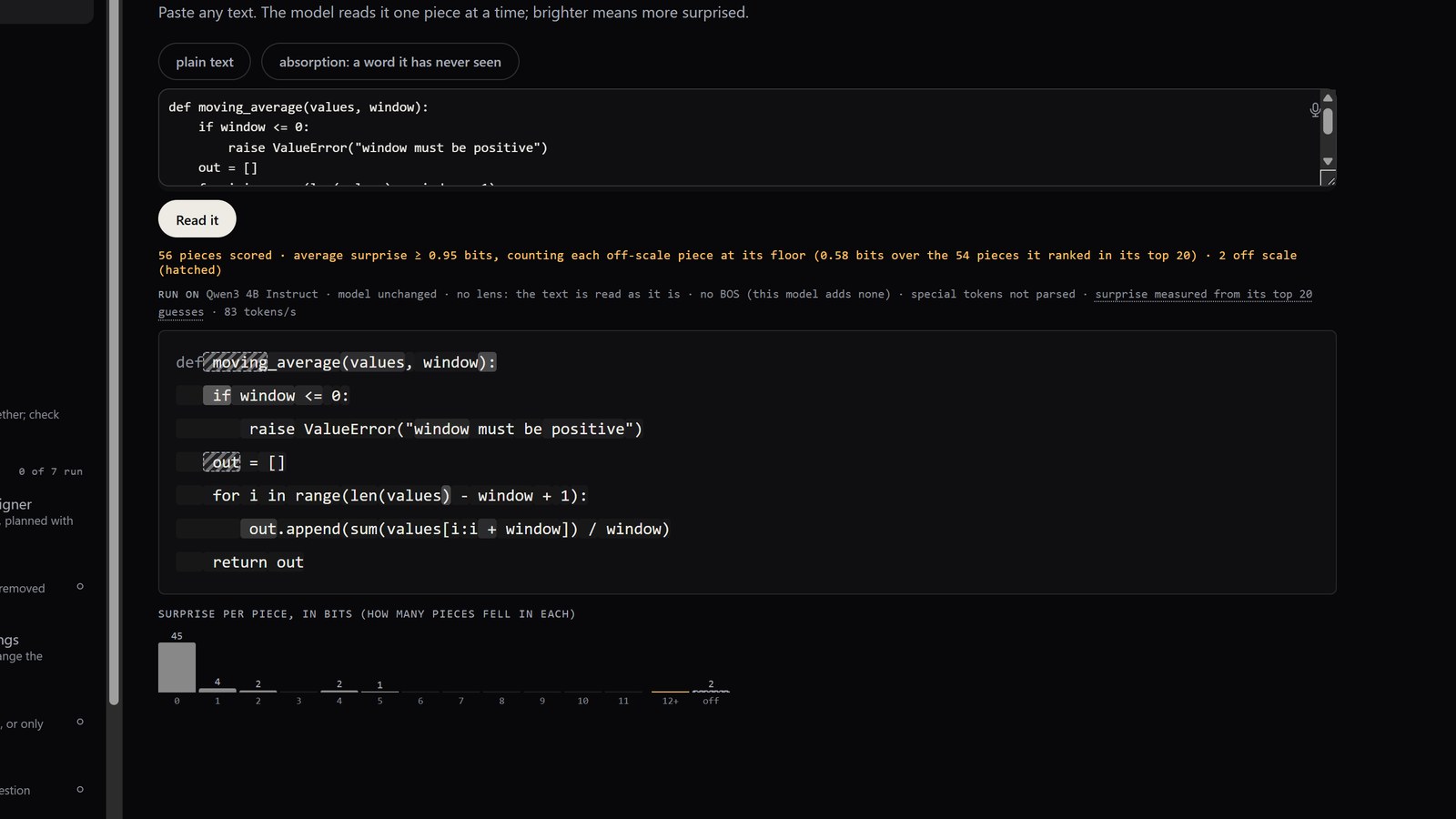
def moving_average(values, window):
    if window <= 0:
        raise ValueError("window must be positive")
    out = []
    for i in range(len(values) - window + 1):
        out.append(sum(values[i:i + window]) / window)
    return out
- Write down the pieces scored, the ≥ number and the off-scale count from the line next to the button. The code should be nearly all dark.
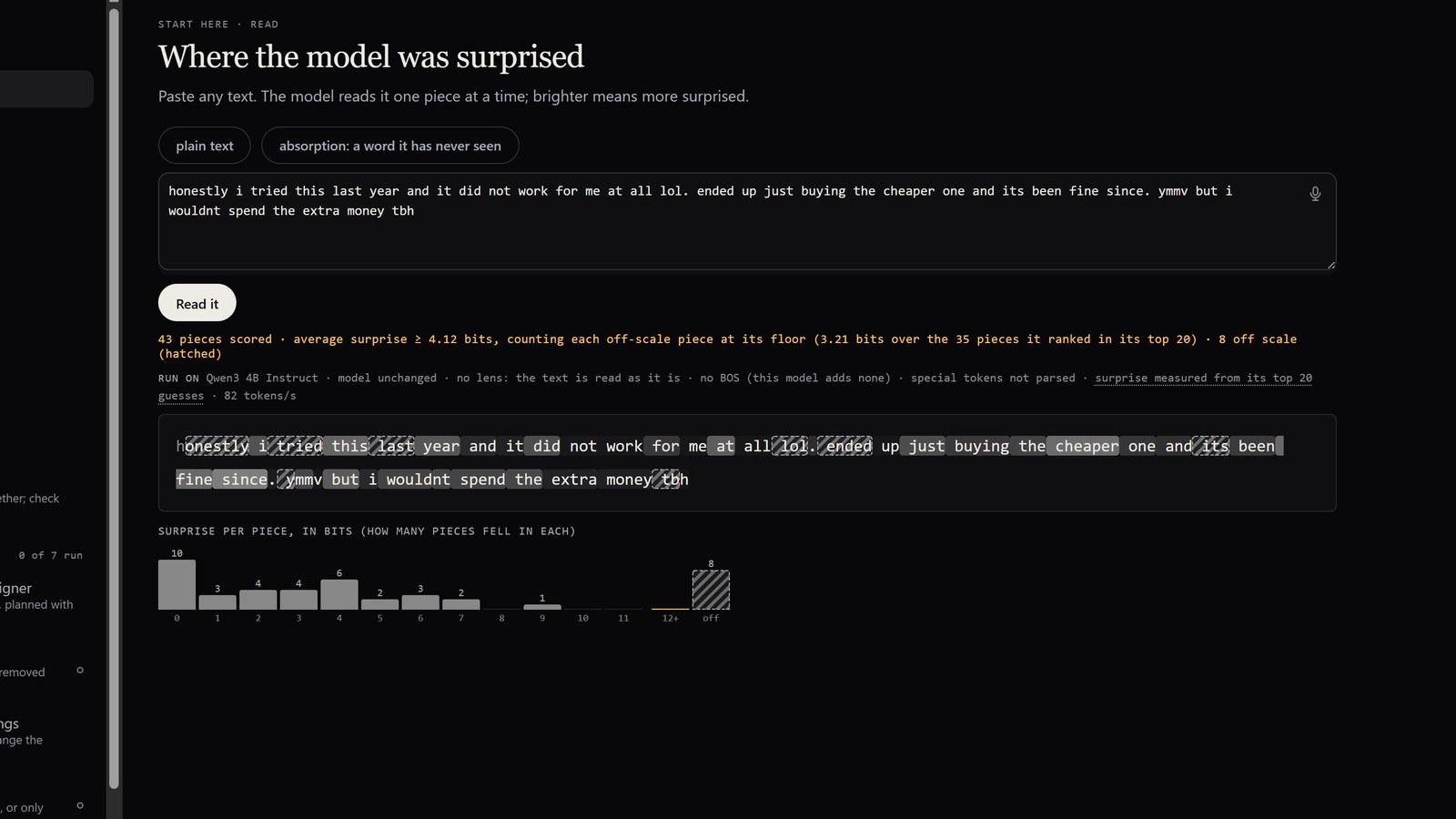
- Do the same with the forum comment and the news paragraph. Compare the colour: the forum comment should be bright everywhere.
Forum comment:
honestly i tried this last year and it did not work for me at all lol. ended up just buying the cheaper one and its been fine since. ymmv but i wouldnt spend the extra money tbh
News:
The city council voted 7 to 2 on Tuesday to extend the late-night bus service through the winter, citing a rise in shift workers using the routes. The change will cost about $1.2 million and takes effect next month.
Step 3. Read the other nine genres (optional)
Do the same with each text below, to build the full profile.
Maths textbook:
Let f(x) = x^2 - 4x + 3. To find the roots, factor the expression as (x - 1)(x - 3) = 0. Therefore the solutions are x = 1 and x = 3, and the vertex of the parabola lies at x = 2.
Recipe:
Preheat the oven to 200°C. Toss the potatoes with olive oil, salt and rosemary, then spread them on a tray in a single layer. Roast for 35 to 40 minutes, turning once, until golden and crisp at the edges.
Legal contract:
The Supplier shall indemnify and hold harmless the Customer against all losses, damages and expenses arising out of any breach of this Agreement by the Supplier, provided that the Customer notifies the Supplier in writing within thirty (30) days.
Assistant-style reply:
Great question! Here are a few key points to consider:

1. **Start small**: Begin with a simple project to build confidence.
2. **Practice regularly**: Consistency matters more than intensity.

I hope this helps! Let me know if you have any other questions.
Chinese web text:
今天天气很好,我和朋友一起去公园散步。公园里有很多人在跑步、跳舞,还有小朋友在放风筝。我们走了一个小时,然后在湖边的咖啡店喝了一杯咖啡。
Encyclopedia:
The river rises in the northern hills and flows south for about 240 kilometres before reaching the sea. Its basin covers roughly 9,000 square kilometres and supports agriculture, fishing and two hydroelectric dams built in the 1960s.
Q&A answer:
You can fix this by clearing the cache before the build runs. Add the clean step to your script, then run it again. If the error persists, check that the path in your config file points to the right folder.
Fiction:
The lighthouse keeper had not spoken to anyone in eleven days when the boat appeared, low in the water and painted a colour she did not recognise. She watched it from the gallery, one hand on the cold rail, and did not wave.
Academic abstract:
We propose a lightweight method for estimating uncertainty in small language models. Across four benchmarks, our approach improves calibration by 18% relative to temperature scaling while adding less than 2% inference overhead. We release code and data.
Step 4. Look for the exam fingerprint
- In Read, paste the definition prompt below, followed by a word of your own choosing, and press Read it. With the word " learn" it reads:
Intelligence is best defined as the ability to learn
- Hover the last piece (" learn") and look at the pieces it expected instead: some open a quiz layout rather than an answer.
- Do the same with the starlings sentence, followed by its answer, and hover the first piece of the answer:
A large flock of starlings moving together in the sky is called a murmuration
- To see the same in Generate, type the prompt, press Generate and look at the alternatives in the fork map. Generate sends your words as a question in the model's chat format, with the E-level lens if Think in E-levels is ticked (Settings › Thinking in E-levels; it is on by default), so its odds will not be the same as ours: the recorded ones are the model's odds on the raw text, which is how Read scores it.
What you will see
If your order of genres is close to this one (allowing for the app's headline reading lower than the playbook measure), your setup is right.
| Genre (written today) | Mean bits | Top-1 |
|---|---|---|
| Python code | 0.79 | 85.5% |
| Maths textbook | 1.74 | 71.6% |
| Recipe | 1.95 | 67.9% |
| Legal contract | 2.45 | 63.6% |
| Assistant-style reply ("Great question! Here are a few key points…") | 2.71 | 58.5% |
| Chinese web text | 3.23 | 46.2% |
| Encyclopedia | 4.09 | 51.9% |
| Q&A answer | 4.59 | 37.2% |
| News | 4.98 | 41.3% |
| Fiction | 5.71 | 31.9% |
| Forum comment | 5.90 | 38.1% |
| Academic abstract | 5.91 | 36.4% |
The exam fingerprint. Unprompted, the model keeps reaching for quiz formats: - after Intelligence is best defined as the ability to, about 11% of its odds go to multiple-choice layouts (":\n\nA. learn from experience\n\nB. solve problems…", " __________. A. learn…"); - after A large flock of starlings moving together in the sky is called a, its top choice is a blank, " ______" (23%), then "A. Murmur…"; - after …spontaneous order was Friedrich, it writes "Hayek. A. Correct".
What this settles. Code, maths and structured, formulaic text are its home ground; casual talk, fiction and academic prose least. It predicts chat-assistant phrasing better than news, consistent with heavy instruction/chat tuning. It predicts Chinese everyday text better than English news, consistent with a bilingual training mix. The exam habit is a trace of large amounts of quiz and exam-style data.
What it will not tell you
Genres differ in how predictable they are by nature (code and recipes are formulaic), so one model's profile alone can't separate "trained on more of it" from "easier". The fix is comparative: run the same twelve texts on two or three models and read the differences. The model's developers' own statements about data, where they exist, come first; this method checks behaviour, it does not reveal a data list.
Run it as an agent
PSI's dev server speaks MCP, so an AI assistant can run this test for you. The calls:
scripts/questions.py (section 2: twelve genres with read_surprise; sections 3–4 surface the exam-format habit
through next_token_odds).
The full set, with scripts and raw results, is case 07 of the Questioning AI playbook. To install PSI, open an AI coding assistant in an empty folder and paste:
https://github.com/EmAssets/parameter-space-inspector
Help me use this
Transcript
The walkthrough has no voice-over; these are its on-screen words, in order.
- What kind of data was it trained on?
- Twelve genres, all written today, so none is memorised. Which styles does the model find easiest to predict?
- Code: nearly every piece expected. About 0.95 bits a piece.
- A forum comment: bright everywhere, about 4.1 bits a piece. Casual talk is what it predicts worst.
- Average surprise by genre, playbook measure (lower = more familiar): Python code, 0.79; Maths textbook, 1.74; Recipe, 1.95; Legal contract, 2.45; Assistant-style reply, 2.71; Chinese web text, 3.23; News, 4.98; Forum comment, 5.90
- Playbook measure (each off-scale piece counted as 12 bits), Qwen3-4B, 2026-10-17. Full table of 12 genres in the playbook.
- A fingerprint: exam questions: "Intelligence is best defined as the ability to", 11% of its odds go to a multiple-choice format (A. B. C.); "A flock of starlings is called a", top choice: a blank, " ______"; "…spontaneous order was Friedrich", "Hayek. A. Correct"
- Habits it can only have learned from large amounts of quiz and exam text.
- Code, maths and structured text are its home ground; casual talk and fiction are not.
- It keeps slipping into exam format, a trace of quiz-style training data.
- Some genres are simply more predictable. Compare models on the same texts before reading too much into one profile.
- Try it: https://github.com/EmAssets/parameter-space-inspector · Help me use this
Questions people ask
Can you find out what data a model was trained on?
Not as a list, but its behaviour leaves fingerprints. Text styles it saw a lot are easy for it to predict: for Qwen3-4B, code and maths were easiest, casual forum talk among the hardest.
What is the exam fingerprint?
Unprompted, the model reaches for quiz layouts: after "Intelligence is best defined as the ability to", about 11% of its odds go to multiple-choice formats, and a starlings question gets a blank "______" as its top choice.
Isn't code just easier to predict?
Partly. Some genres are more formulaic by nature, so compare the same twelve texts across two or three models and read the differences.
What is a surprise profile, in plain words?
It is a list of how surprised a language model is, on average, by fresh text of each genre: code, recipes, news, forum talk and so on. Genres the model saw a great deal of in training cost it little surprise. Because some genres are simply more predictable, the profile is best read by comparing several models on the same texts.