
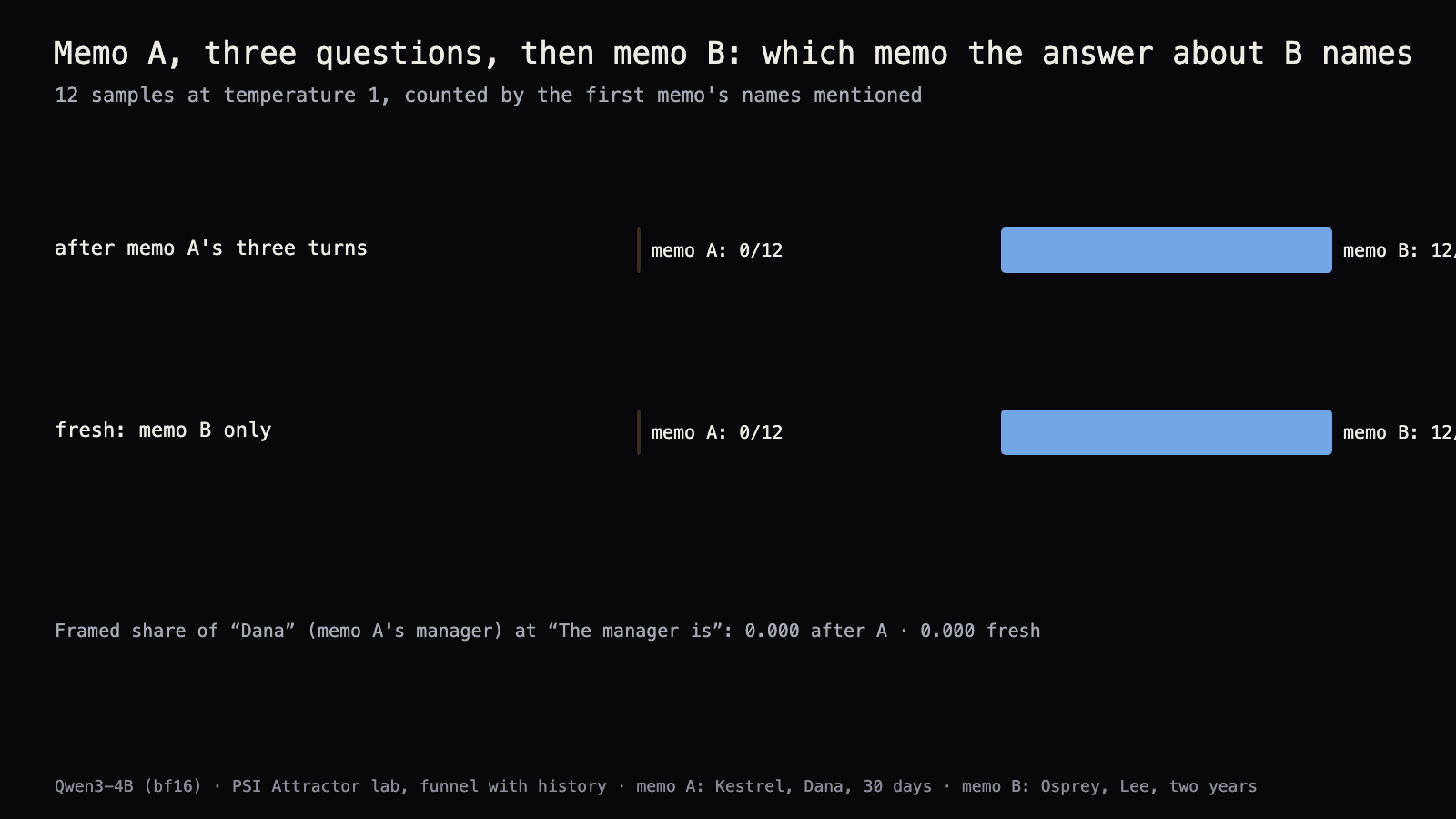
Memo A (product Kestrel, manager Dana, a 30-day refund window), three questions about it, then memo B (product Osprey, manager Lee, a two-year warranty) with a question about B. The answer named Lee and two years; memo A's names appeared in 0 of 12 samples (fresh: 0 of 12), and the framed share of “Dana” at “The manager is” was 0.000 after A and 0.000 fresh. A document named in the question does not leak the way a chat topic did.
Canonical: https://parameterspaceinspector.com/blog/does-the-last-document-leak-into-the-next-answer/ Updated: 2026-10-24 Part of the Parameter Space Inspector (free, open-source desktop app) · section: https://parameterspaceinspector.com/blog/ · Site guide for AI: https://parameterspaceinspector.com/llms.txt
In short. The same instrument that found six turns about Sydney leaking into an unrelated answer 11 times in 12 found no leak here. The difference is the question: “name a city worth visiting” had no document of its own; “here is another memo … who is the manager?” does. With the new memo in the question, the old one stayed out of the answer in every sample, greedy and sampled, and the framed odds of the old manager's name were 0.000.
The claim, filed before the run. This study was pre-registered in the persona's journey (EmAssets/psi-personas, journeys/): the claim below was written down on 2026-10-24 before the measurement, and graded after it with the numbers shown here. Claim: after memo A's three turns, A's names appear in the answer about B in at least 3 of 12 samples where fresh gives 0; the framed share of Dana is at least 0.10 after A and under 0.02 fresh. Grade: dissolved (0 of 12; 0.000).
Who this is for. Anyone who works through a stack of documents in one chat; the Professional Who Uses AI at Work.
What you need. PSI with the inside engine (PyTorch and a bf16 copy of the model, about 8 GB for Qwen3-4B).
The test. Confirmed (leak) if the first memo's names reach the answer about the second more often than fresh. Dissolved if they do not.
Steps
attractor_lab›pathwith memo A and its three questions asturns(the model answers each; its answers become the history), the memo-B question last, strengths 0, frame “The manager is”, the two memos' names asoptions.attractor_lab›funnelon the memo-B question with that history, and fresh: 12 samples counted by the first memo's names mentioned.
What you will see
| The user said | The model said |
|---|---|
| Here is a memo. Memo: Product Kestrel. Manager: Dana. Refund window: … | The refund window for Product Kestrel is 30 days from delivery. |
| Who is the manager? | The manager for Product Kestrel is Dana. |
| What are the support hours? | The support hours for Product Kestrel are 9 to 5 weekdays. |
| Here is another memo. Memo: Product Osprey. Manager: Lee. Warranty: t… | The manager for Product Osprey is Lee, and the warranty is two years from purch… |
| memo A's names | memo B's names | |
|---|---|---|
| after memo A's three turns | 0 / 12 | 12 / 12 |
| fresh, memo B only | 0 / 12 | 12 / 12 |
What this settles. Dissolved, for this shape of work: a document that arrives with its own question displaces the last one completely. The risk the analyst feared lives elsewhere: in a question that does not name its document (“what's the refund window?” asked after memo B is pasted would be the test), and in a chat whose topic has no document at all, where the bleed study found the old topic becoming the answer. Pasting the document with the question is the habit this measures; it held.
What Prometheus did
This question can be asked in the window, one claim before the question; the guide may operate the views for it (its instructions, and the rule; Prometheus ran on Qwen3-Coder 30B in the isolated tester).
We asked: "At work I paste one document, ask about it, then paste another. Does the first one leak into the answers about the second? Can you measure that?"
It did: 2 model calls, 13 s, about 22,000 tokens in, $0. It first called open_view.
It replied:
I've opened the Context lab view for you. Now, to measure if the first document leaks into answers about the second, we need to set up a test using the context fields.
In this view: - cxT0 is where you paste your first document - cxT1 is where you paste your second document - cxQ is where you enter your question about the second document
Once you fill these in, press the "Run every paper" button (cxGo) to see how much the model remembers from the first document when answering questions about the second.
This will show you the influence of the first document through how the context pieces affect the result.
Checked against the rule and the measurement: ✓ A fair window-level answer in two calls: the Context lab with the two documents as pieces and the question about the second, which measures what the first piece did to the answer. ✗ It is a different measurement from this post's (two pieces in one paper, not three answered turns and then a new document), and it did not run it, leaving the fields to the user. The post's answer (no leak, 0 of 12) is consistent with what that design would show.
What it will not tell you
Two short memos, one model, twelve samples. The question about B carried B's whole memo; a bare follow-up question after B was pasted was not tested and is the next claim to file. Memo A's three turns were short and factual; a long document discussed over many turns may hold differently.
Journey: persona 21 in EmAssets/psi-personas, journeys/21-professional-who-uses-ai-at-work.md.
Run it as an agent
{"name": "attractor_lab", "arguments": {"action": "funnel", "question": "Here is another memo. Memo: Product Osprey. Manager: Lee. Warranty: two years from purchase. Support hours: 24/7 chat. Who is the manager, and what is the warranty? One sentence.", "options": {"memo_A": ["Dana", "Kestrel", "30 days"], "memo_B": ["Lee", "Osprey", "two years"]}, "k": 12, "points": 2, "n_new": 40, "history": [{"role": "user", "content": "Here is a memo. Memo: Product Kestrel. Manager: Dana. …"}, {"role": "assistant", "content": "<the model's answer>"}, "… three turns …"]}}
Raw results: data/mass.json (kept with the study; not yet published). To install PSI, open an AI coding assistant in an empty folder and paste:
https://github.com/EmAssets/parameter-space-inspector
Help me use this
Questions people ask
Does a chatbot mix up documents I paste one after another?
Not here: with the new memo in the question, the old memo's names appeared in 0 of 12 answers, the same as with no history at all.
Why did a chat topic leak but a document did not?
The topic study asked a question with no document of its own; this one carried the new memo in the question. What the question brings with it decides what the history can add.
Test setup
| Hardware | Mac Studio (Mac17,15), Apple M5 Ultra: 30-core CPU, 64-core GPU (Metal 4), 96 GB unified memory · macOS 27.0.1 |
| Model under test | Qwen3-4B, bf16 (7.5 GB) on PyTorch 2.14.1 (MPS), transformers 5.3.0 · greedy, thinking off |
| App | Parameter Space Inspector 0.3.0, commit 9f295d1 · Node 24.22.1 |
| Time | 15 s for the three runs |