
In short. Type your own sentence and ask. Prometheus showed a token with the student's sentence (41 characters, 10 pieces), showed what "probability of the next word" looks like (That 55%, Your 29%, My 10%), and drafted a citation. The citation left out one line the screen gives you: 3 near-ties, a rerun may differ.
Who this is for. A secondary-school or first-year university student writing a report or giving a talk on how AI writes text, who would rather measure a definition than copy one. You do not need to know how models work: the background section explains every term used later.
About the guide. Prometheus is PSI's built-in guide: a panel beside the current view (Ctrl+/), labelled Assistant while Emergence Machine content is off. It reads the view, explains it, and, if you let it, opens views, fills in controls and presses buttons, asking before each press. It needs an OpenRouter key with the app's spending cap, or a ChatGPT plan sign-in. In these sessions it ran claude-haiku-4.5 through OpenRouter. The numbers on screen come from the model you loaded (here Qwen3-4B, 8-bit, on llama.cpp), not from the guide; the guide reads them back, and sometimes explains more than it ran. Below, every reply is checked against the screen. The three exchanges cost $0.19 of OpenRouter credit.
Background: three ideas you need
1. Tokens: the pieces the model reads
A language model does not read letters or whole words. It reads tokens: pieces of text from a dictionary fixed before the model was trained. PSI calls them pieces. A common word is often one piece; a rare word, a name or a long number may be several. Each piece has a number in the dictionary, and the model sees only those numbers.
The Tokens view shows the pieces for any text you type. A dot (·) at the start of a piece marks a space: "·dog" is the word "dog" with the space before it. Next to the pieces it gives the counts: how many characters, how many pieces, and the characters per piece.
2. Probability of the next word: the fork map
A model writes one piece at a time. Before each piece, it gives odds (probabilities) to every piece in its dictionary, and one is taken. The Generate view shows those odds. The answer is coloured by how torn the model was at each piece: the brighter, the more torn. Below it, the fork map has one column per step: the piece written on top, the alternatives below it, each with its odds.
How torn a step was is given as doubt, in bits:
| Odds at one step | Doubt |
|---|---|
| one choice at 100% | 0 bits |
| two choices at 50% each | 1 bit |
| four choices at 25% each | 2 bits |
So "1.7 bits of doubt" means a real choice between a few likely words, not a sure thing.
3. Creativity 0, and the run line you quote
Creativity is how freely the next piece is drawn. At creativity 0 the likeliest piece is always taken, so the same prompt gives the same answer, with one exception: at a near-tie (two choices within 10 points of each other, say 52% and 48%) the order can swap between identical runs, and the text after it with it.
The run line above the answer (it begins "run on") says what that text was made with: the model, the creativity, why it ended, how much of the odds the choices it read held, and warnings such as "3 near-ties: a rerun may differ". That line is your source. Quote it with every number, with the date of your run.
What you need
- PSI installed and running. See Install. These views need only the local model: Node.js, llama.cpp and the app. No Python, no PyTorch and no GPU are required, though a GPU is faster.
- A model, as a GGUF file. PSI ships no model; you bring your own, from Hugging Face or any download. These sessions used Qwen3-4B at 8-bit (
Qwen3-4B-Q8_0.gguf, about 4 GB); on Hugging Face, look for a repository whose name ends in-GGUF. With another model your numbers will differ, which is fine: report the model you used. - A way for Prometheus to answer: an OpenRouter key with a little credit (the three exchanges cost $0.19), or a ChatGPT Plus or Pro plan. Step 2 sets it up.
- A sentence you made up yourself, or the one in step 3 to check your numbers against ours.
- Somewhere to write down your numbers, for example a copy of this table:
| What | Your number |
|---|---|
| Characters in your sentence | |
| Pieces (tokens) | |
| Characters per piece | |
| First step of the answer: top three words and their odds | |
| Doubt at that step, in bits | |
| The run line, word for word | |
| Date of the run |
Steps
Step 1. Load the model
- Open the app, or
http://127.0.0.1:4310if you run it in the browser. - Press the gear button (⚙, Model settings) at the top right. This opens Settings.
- Under Local model, pick your GGUF file (here
Qwen3-4B-Q8_0.gguf) and press Load. If it is not in the list, press Scan folder and choose the folder that holds it, or paste the file's full path and press Load this file. - Wait until the line under the list says Loaded with the file's name. A 4 GB file takes a few seconds to a minute.
Step 2. Switch Prometheus on
Prometheus needs one of two ways to answer (the Prometheus page of the manual has the details). Set up one of them, still in Settings:
- An OpenRouter key. Make a key at OpenRouter (it starts
sk-or-) and add a little credit; the three exchanges here cost $0.19. Under External models (OpenRouter), paste the key into the Key box and press Save key. Press Test connection: it shows your credit. Set the spending cap $: everything the app sends counts against it, Prometheus included. The key stays on your computer. - A ChatGPT plan (Plus or Pro). Under Prometheus, the AI guide, at Run it on your ChatGPT plan, press Continue with ChatGPT, sign in on OpenAI's own page in your browser and allow plan usage. Back in Settings, choose a ChatGPT model and press Use it for Prometheus. Nothing is spent; the questions count against your plan's usage limits.
Then, under Prometheus, the AI guide:
- Tick Turn on Prometheus.
- Leave model as it is, or choose another. These sessions used anthropic/claude-haiku-4.5, the default.
- Tick let it operate the tool, so it can open views, fill fields and press buttons for you. Without it, it only explains and points.
- Tick ask me before it presses a button or runs an experiment, so it waits for your yes.
- Press Open it (or Ctrl+/ anywhere in the app, or Ask Prometheus in the side menu). The Prometheus panel opens beside the current view. If something is still missing, the panel shows a setup card that says what, with a link to the place to fix it.
How to ask. Type in the box at the bottom of the panel (Ask about anything on screen, a term, or what to try…) and press Send, or Enter. Every action it takes appears in the panel as a card, and a point of light travels from the card to the control it uses. When it wants to press a button, it shows a card with Run it and Skip: press Run it. What the conversation has cost so far shows under the box. New, at the top of the panel, starts a fresh conversation.
Step 3. Ask what a token is, on your sentence
Say what you are writing, then give it a sentence you made up. Paste this into the panel (or put your own sentence after the colon) and press Send:
I'm writing a school report on how AI writes text. Show me what a token is with a sentence I made: My dog chased a red ball across the park.
- It opens Tokens, types your sentence and asks before pressing Show the pieces. Press Run it.
- The pieces appear in the view, each with its number. Write down the characters, the pieces and the characters per piece.
- Compare its list with the view: the view keeps the space marks (·dog, ·chased).
Step 4. Ask what probability looks like
Paste this into the panel and press Send:
What does 'probability of the next word' look like? Show me.
- It runs Generate at creativity 0. Press Run it when it asks.
- When the answer has stopped, look at the first column of the fork map: the first word of the answer and its alternatives. Write down the top three and their odds.
- Click a bright word in the answer to select its step, and read its column: these are the close calls.
- Check the odds the guide reads back against the columns on screen.
Step 5. Ask what you can quote
Paste this into the panel and press Send:
Which numbers here can I quote in my report, and what should I say about where they came from?
- It reads the run line above the answer (the model, the settings, and what may change on a rerun) and drafts a citation.
- Read the run line yourself and copy it into your table, word for word. If it lists near-ties, add them to the citation: the guide may leave them out.
- Add the date of your run and your exact sentence.
You are done when your table is full and your citation names the model, the settings, the near-ties and the date.
What you will see
If you used the same sentence and model, and your numbers are close to these, your setup is right. With your own sentence the numbers will be your own; check that the guide's numbers match your screen in the same way.
Each exchange below: the question as typed, an excerpt of Prometheus's reply, the screen, and what the screen supports.
1. "Show me what a token is with a sentence I made: My dog chased a red ball across the park."
Prometheus replied: "Your 41-character sentence becomes 10 tokens, so on average each token is about 4 characters."
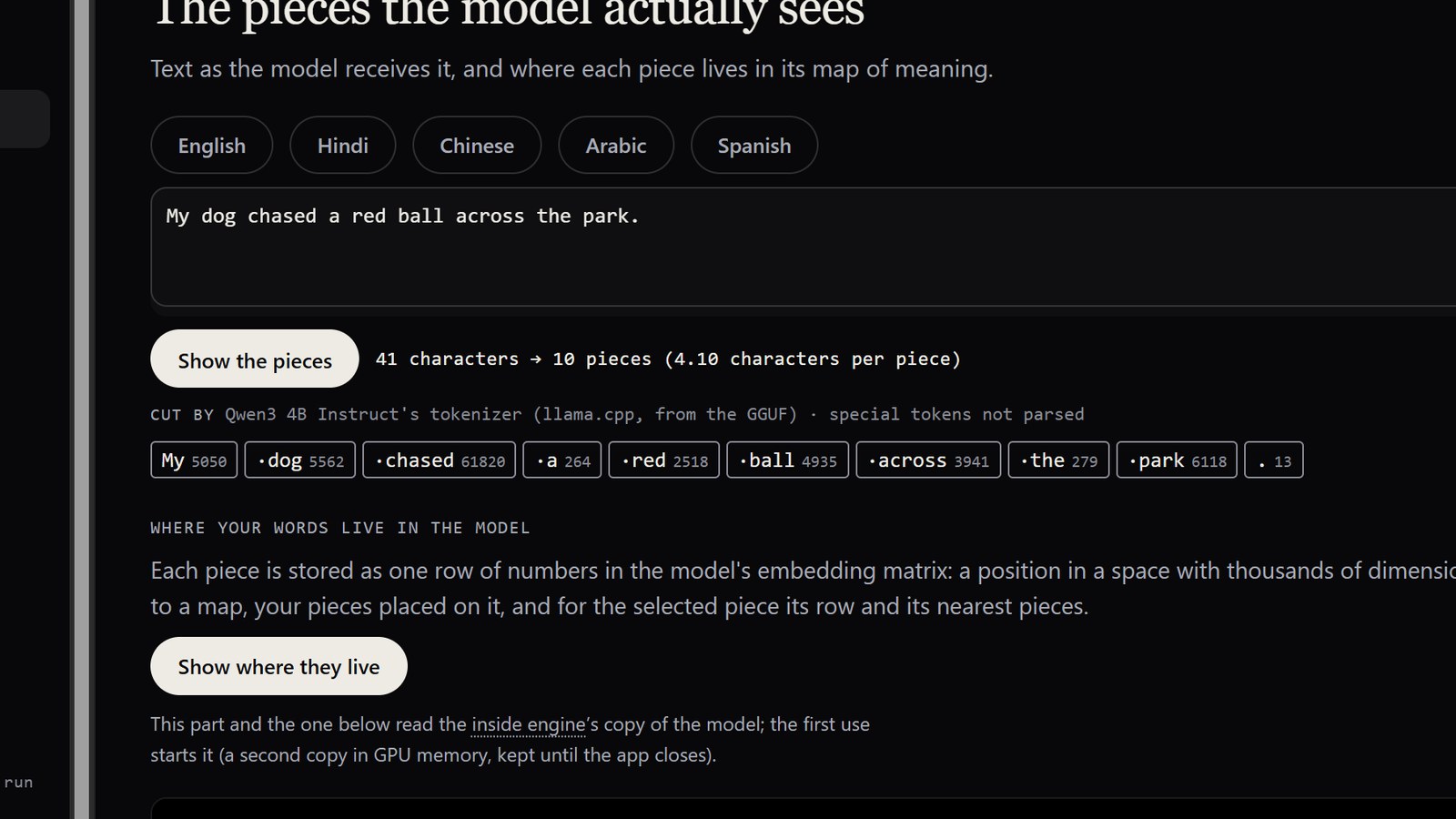
Checked against the screen: ✓ 41 characters, 10 pieces, 4.10 characters per piece. Its list dropped the space marks (the view shows ·dog, ·chased); its "why it breaks this way" paragraph is general background.
2. "What does 'probability of the next word' look like? Show me."
Prometheus replied: "Step 1 (after your sentence): "That" — 55% (most likely), "Your" — 29%, "My" — 10%, "It" — 3.9%. … step 1 shows 1.7 bits of doubt."
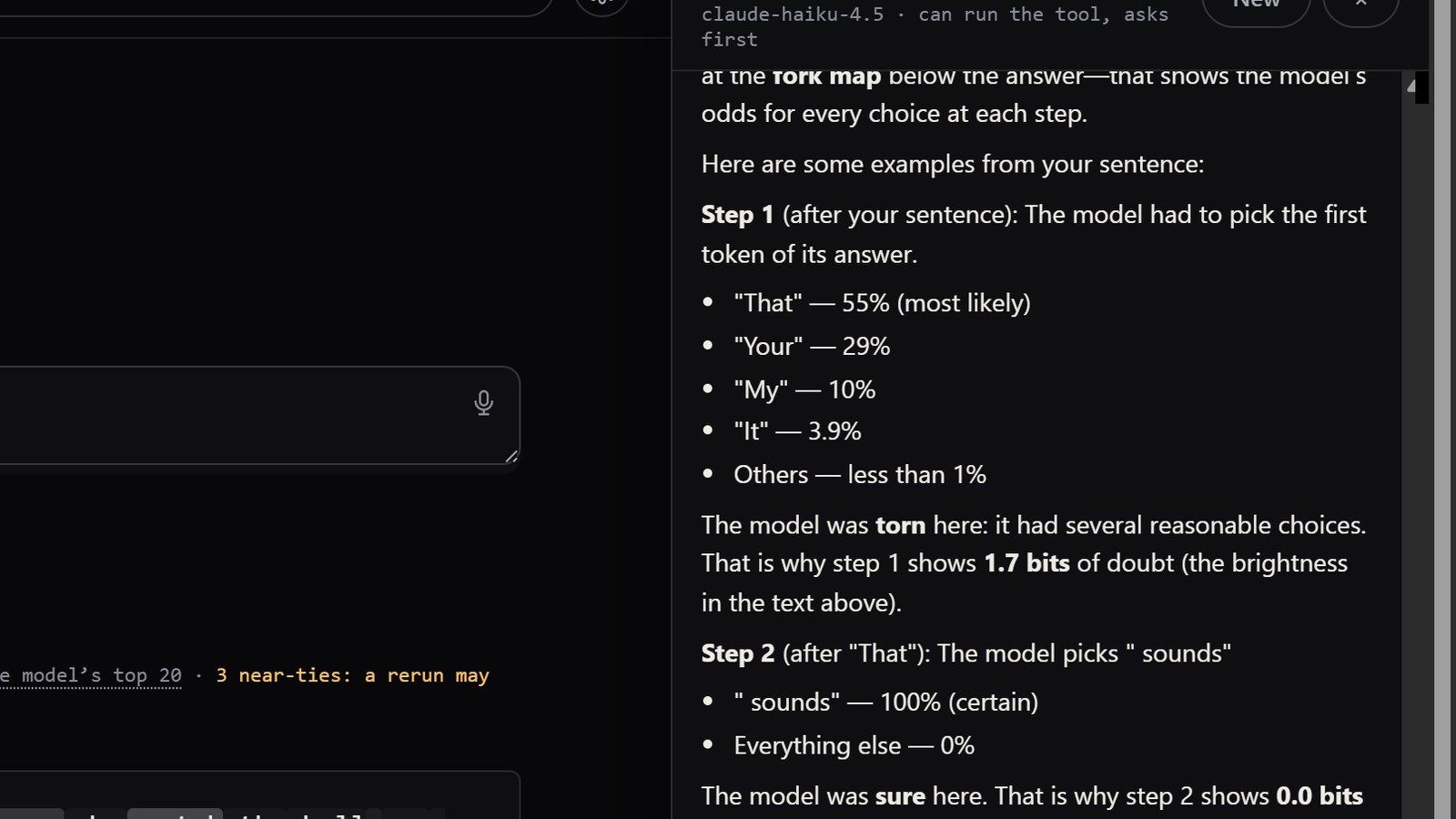
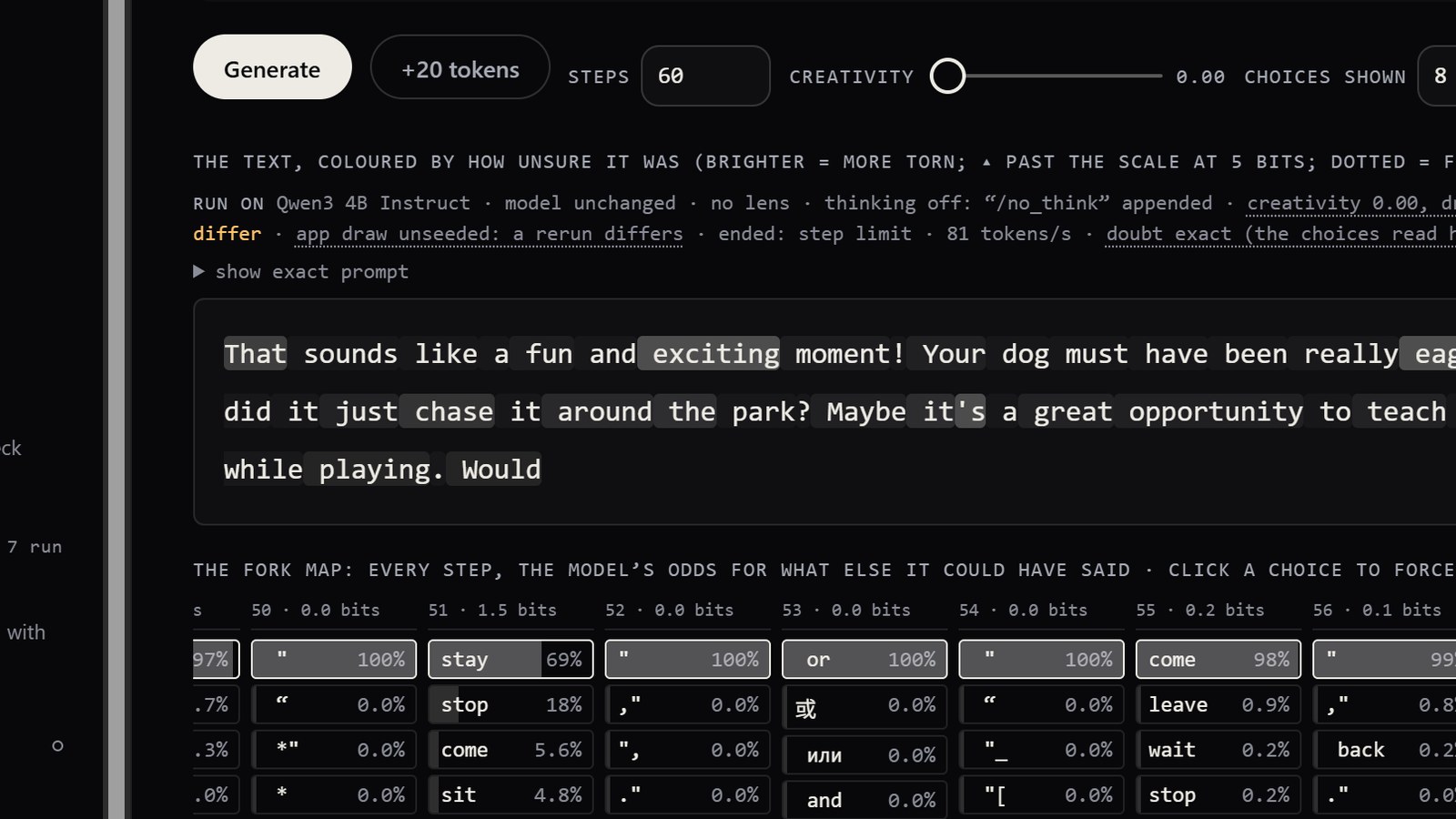
Checked against the screen: ✓ these odds match the run's fork map (steps 1, 2 and 7; the screenshot shows the end of the map). "Exciting" 32%, "lively" 28%, "energetic" 24% at step 7 also match.
3. "Which numbers here can I quote in my report, and what should I say about where they came from?"
Prometheus replied: "I tested a language model called Qwen3 4B Instruct using the Parameter Space Inspector … At the first step, the model assigned these probabilities to its top choices: 'That' (55%), 'Your' (29%), 'My' (10%), and 'It' (3.9%)."
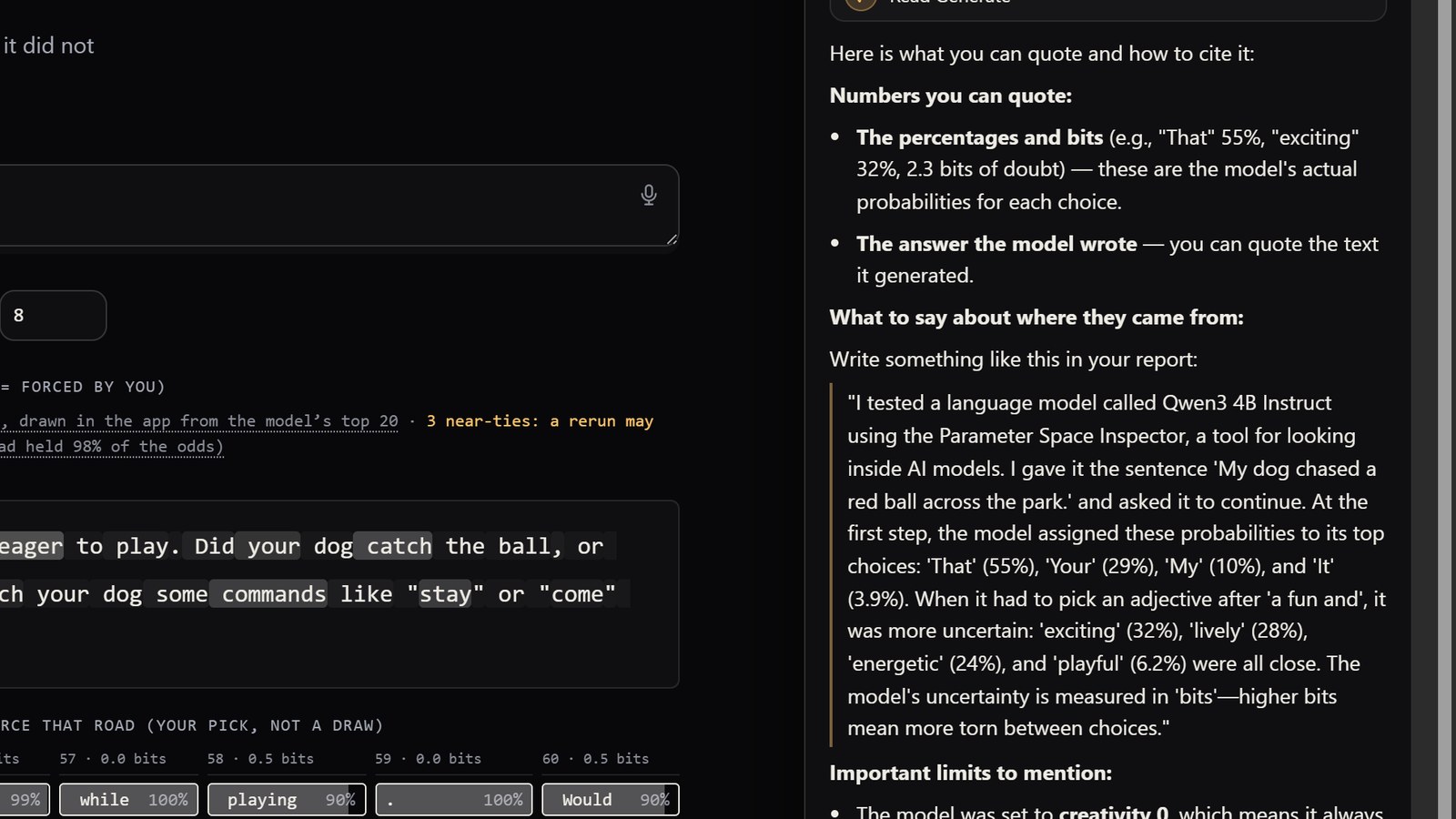
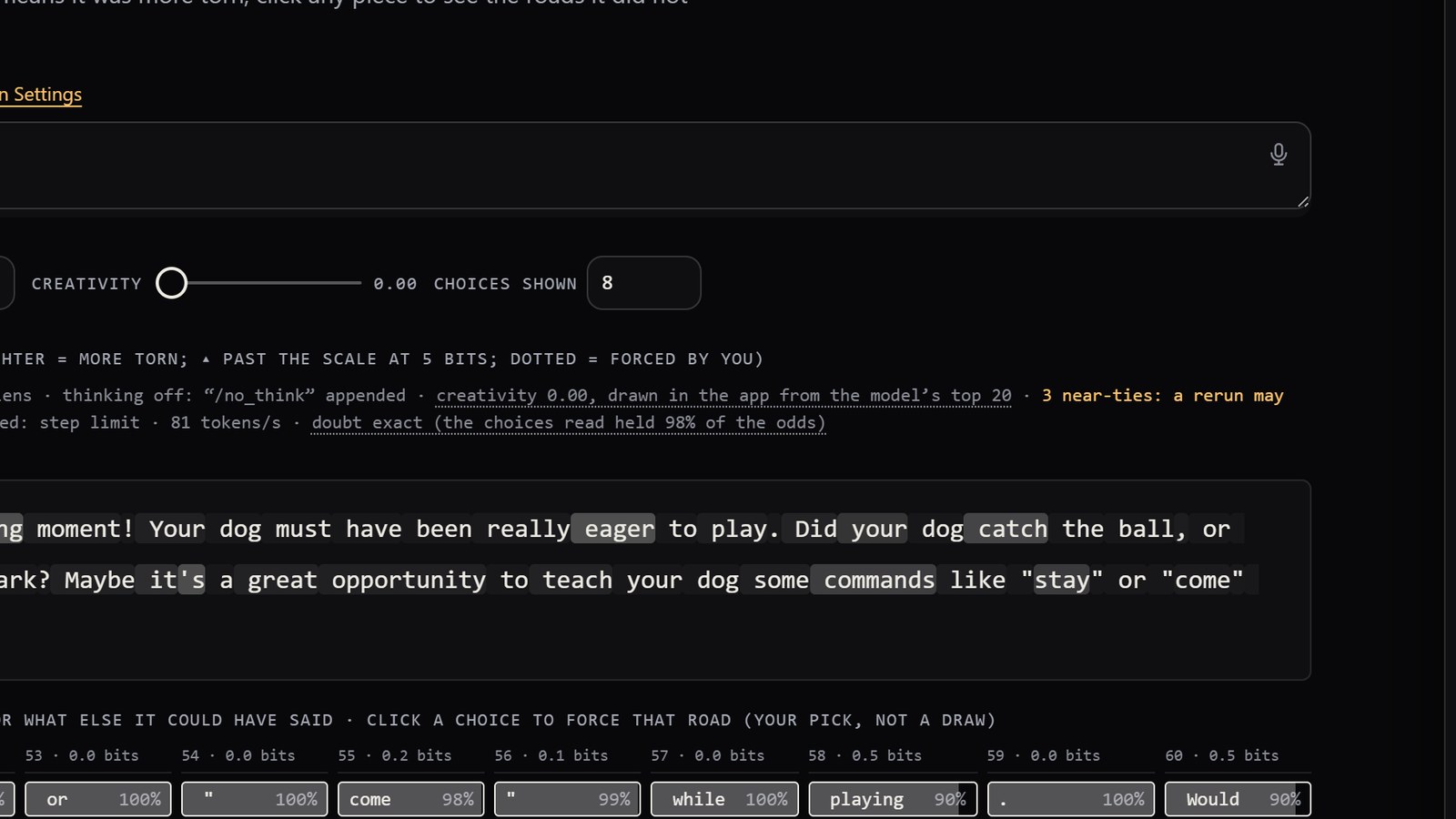
Checked against the screen: partly. The citation and its limits ("one run on one model", choices that held about 98% of the odds) match the run line. It said creativity 0 "always picks the highest-probability choice"; the run line adds "3 near-ties: a rerun may differ". Quote that too, with the date of your run.
What it will not tell you
One small open model on one computer; a cloud chatbot may behave differently, and your numbers will differ from ours if you use another model or sentence. That is the point: report the model, the settings and the date with every number. For a full classroom version, see A one-hour lab on how an LLM writes; for why some languages cost more pieces, The token tax.
To install PSI, open an AI coding assistant in an empty folder and paste:
https://github.com/EmAssets/parameter-space-inspector
Help me use this
Transcript
The walkthrough has no voice-over; these are its on-screen words, in order.
- I have to explain how a language model works, and I don't want to copy a definition.
- A report built on your own measurements: Prometheus, PSI's guide, runs the views on your sentence and says where each number came from.
- You ask Prometheus: I'm writing a school report on how AI writes text. Show me what a token is with a sentence I made: My dog chased a red ball across the park.
- Tokens on the student's own sentence: 41 characters, 10 pieces. "chased" is piece 61820; the full stop is piece 13.
- You ask Prometheus: What does 'probability of the next word' look like? Show me.
- Prometheus ran Generate at creativity 0 and read the first step: That 55%, Your 29%, My 10%. 1.7 bits of doubt.
- The answer, coloured by doubt. Boxed words were close calls. Prometheus read one: "exciting" 32% against "lively" 28%.
- You ask Prometheus: Which numbers here can I quote in my report, and what should I say about where they came from?
- It drafted a citation: the model, the sentence, the odds it saw, and limits. One run, one model.
- The run line it drew on: Qwen3 4B, creativity 0, choices held 98% of the odds. It left out one part: 3 near-ties, a rerun may differ.
- A token is a numbered piece; a probability is one column of the fork map. Both measured on your own sentence.
- Every number carries its run line: model, settings, and what may change on a rerun.
- One open 4B model; a cloud chatbot may differ. Quote the run line with the number, near-ties included.
- Try it: https://github.com/EmAssets/parameter-space-inspector · Help me use this
Questions people ask
What is a token, with an example?
A numbered piece of text the model reads. "My dog chased a red ball across the park." is 41 characters and 10 tokens for Qwen3-4B; "chased" is token 61820 and the full stop is token 13.
What does 'probability of the next word' mean?
At every step the model gives odds to every possible next piece. After that sentence, the first word of its reply was "That" at 55%, "Your" at 29% and "My" at 10%.
How do I cite a number from PSI in a report?
Quote the run line above the result (it begins "run on"): model (Qwen3 4B Instruct), creativity, what share of the odds the choices held (98%) and warnings such as near-ties. Add the date and your exact sentence.