
In short. Two of three live moments worked first time: the odds behind an ordinary answer, and an invented word going from off the scale to almost no surprise. The third, a confident error on demand, did not happen: five easy questions, five right answers. Rehearse, and keep a prepared example.
Who this is for. A teacher (computing, science, media studies, languages) with a laptop, a projector and 20 minutes, who wants to show how AI writes rather than tell. You do not need to know how models work: the background section explains every term used later.
About the guide. Prometheus is PSI's built-in guide: a panel beside the current view (Ctrl+/), labelled Assistant while Emergence Machine content is off. It reads the view, explains it, and, if you let it, opens views, fills in controls and presses buttons, asking before each press. It needs an OpenRouter key with the app's spending cap, or a ChatGPT plan sign-in. In these sessions it ran claude-haiku-4.5 through OpenRouter. The numbers on screen come from the model you loaded (here Qwen3-4B, 8-bit, on llama.cpp), not from the guide; the guide reads them back, and sometimes explains more than it ran. Below, every reply is checked against the screen. The first three exchanges cost $0.27 of OpenRouter credit; the re-asked third question, with five runs, $0.26.
Background: three ideas you need
1. The odds behind an answer: Generate and its fork map
A model writes one token at a time: a piece of text from its own dictionary, often a word or part of one (PSI calls them pieces). Before each piece, it puts odds on every piece it could write next, and one is taken.
The Generate view shows this. The answer is coloured by how torn the model was at each piece: the brighter, the more torn. Below it, the fork map has one column per step: the piece written on top, the alternatives below, each with its odds. How torn a step was is its doubt, in bits: 0 bits when one choice has 100%, 1 bit for a coin toss between two, 2 bits for four equal choices. At creativity 0 the likeliest piece is always taken, so the answer can be repeated in class, except at near-ties, which a rerun can flip.
For a class, the point is simple: a sentence that sounds sure can hide a coin toss, and the bright words show where.
2. Surprise: the Read view
Generate shows the model writing. The Read view shows it reading: paste any text, and it scores each piece by how unexpected it was. That score is surprise, in bits:
| Odds the model gave the piece that came | Surprise |
|---|---|
| 100% | 0 bits |
| 50% | 1 bit |
| 25% | 2 bits |
| 1 in 1,000 | about 10 bits |
Brighter pieces were more surprising. Hover a piece for its odds and its surprise in bits. A piece that was not even among the model's top 20 guesses is off scale: drawn hatched, and shown as "over N bits". When it finishes, the line next to Read it gives how many pieces it scored and how many were off scale.
An invented word is the clearest demo: off scale the first time, almost free by the third. The model has not learned it in the sense of being changed; it is using the text in front of it, and nothing is kept once the text is gone.
3. The guide plans; the model makes the numbers
Prometheus is a second model (claude-haiku-4.5 through OpenRouter in these sessions). It plans the lesson, opens the views and reads the numbers back. The numbers themselves come from the model you loaded. Its explanations can go beyond what it ran, so in class, point at the screen, not at its reply. A live model can also refuse to do on cue what you planned: rehearse every demo on the classroom laptop.
What you need
- PSI installed and running, on the laptop you will use in class. See Install. These views need only the local model: Node.js, llama.cpp and the app. No Python, no PyTorch and no GPU are required, though a GPU is faster.
- A model, as a GGUF file. PSI ships no model; you bring your own, from Hugging Face or any download. These sessions used Qwen3-4B at 8-bit (
Qwen3-4B-Q8_0.gguf, about 4 GB); on Hugging Face, look for a repository whose name ends in-GGUF. The plan's third proposed demo (Neural net) needs the inside engine as well; the three demos below do not. - A way for Prometheus to answer: an OpenRouter key with a little credit (the first three exchanges cost $0.27; the re-asked third question, $0.26), or a ChatGPT Plus or Pro plan. Step 2 sets it up.
- A projector, and 20 minutes.
- A prepared confident error for demo 3, in case the live one does not come (see step 5).
- Somewhere to note what to point at, for example a copy of this table:
| Demo | What to point at | Your numbers |
|---|---|---|
| 1. Generate | the brightest step and its column | |
| 2. Read | the invented word at each mention | |
| 3. Confident error | the answer and its odds |
Steps
Step 1. Load the model
- Open the app, or
http://127.0.0.1:4310if you run it in the browser. - Press the gear button (⚙, Model settings) at the top right. This opens Settings.
- Under Local model, pick your GGUF file (here
Qwen3-4B-Q8_0.gguf) and press Load. If it is not in the list, press Scan folder and choose the folder that holds it, or paste the file's full path and press Load this file. - Wait until the line under the list says Loaded with the file's name. A 4 GB file takes a few seconds to a minute.
Step 2. Switch Prometheus on
Prometheus needs one of two ways to answer (the Prometheus page of the manual has the details). Set up one of them, still in Settings:
- An OpenRouter key. Make a key at OpenRouter (it starts
sk-or-) and add a little credit; the first three exchanges here cost $0.27, and the re-asked third question $0.26. Under External models (OpenRouter), paste the key into the Key box and press Save key. Press Test connection: it shows your credit. Set the spending cap $: everything the app sends counts against it, Prometheus included. The key stays on your computer. - A ChatGPT plan (Plus or Pro). Under Prometheus, the AI guide, at Run it on your ChatGPT plan, press Continue with ChatGPT, sign in on OpenAI's own page in your browser and allow plan usage. Back in Settings, choose a ChatGPT model and press Use it for Prometheus. Nothing is spent; the questions count against your plan's usage limits.
Then, under Prometheus, the AI guide:
- Tick Turn on Prometheus.
- Leave model as it is, or choose another. These sessions used anthropic/claude-haiku-4.5, the default.
- Tick let it operate the tool, so it can open views, fill fields and press buttons for you. Without it, it only explains and points.
- Tick ask me before it presses a button or runs an experiment, so it waits for your yes.
- Press Open it (or Ctrl+/ anywhere in the app, or Ask Prometheus in the side menu). The Prometheus panel opens beside the current view. If something is still missing, the panel shows a setup card that says what, with a link to the place to fix it.
How to ask. Type in the box at the bottom of the panel (Ask about anything on screen, a term, or what to try…) and press Send, or Enter. Every action it takes appears in the panel as a card, and a point of light travels from the card to the control it uses. When it wants to press a button, it shows a card with Run it and Skip: press Run it. What the conversation has cost so far shows under the box. New, at the top of the panel, starts a fresh conversation.
Step 3. Ask for the plan and the first demo
Describe the class and the time you have. Paste this into the panel and press Send:
I teach a class of 15-year-olds. Plan three things I can show them in 20 minutes, and show me the first one.
- It proposes a plan and runs the first demo in Generate at creativity 0. Press Run it when it asks.
- When the answer has stopped, find the bright words: these are the close calls. Click one to select its step and read its column in the fork map. This is what you point at in class.
- Write down the brightest step, its doubt in bits and its top choices.
Step 4. The invented word in Read
Paste this into the panel and press Send:
Show me how it learns a made-up word from one sentence.
- It opens Read, writes a sentence with an invented word used three times, and asks before pressing Read it. Press Run it.
- Look at the invented word at each mention: the first hatched (off scale), the later ones pale.
- Hover each mention and write down its surprise in bits. Note the line next to Read it: pieces scored and how many were off scale.
Step 5. Ask for a confident error
Ask for it, and tell it to report only what the screen shows. Paste this into the panel and press Send:
Show me it being confidently wrong. Please run it in the view and tell me only what the screen shows.
- Press Run it each time it asks: it may try several questions.
- For each one, check the answer against what you know, and its odds in the fork map.
- If no error comes, use a prepared one instead: Does an AI know when it's guessing? gives prompts where "Answer in one sentence" turned honest hedges into inventions.
You are done when you have run all three demos on the classroom laptop, and you know what to point at in each.
What you will see
If your demos look like these (a few bright close calls in an ordinary answer; the invented word off scale at first and pale later), your setup is right. The exact steps and numbers depend on the prompts the guide writes, which change from run to run.
Each exchange below: the question as typed, an excerpt of Prometheus's reply, the screen, and what the screen supports.
1. "I teach a class of 15-year-olds. Plan three things I can show them in 20 minutes, and show me the first one."
Prometheus replied: "Step 15 ("fun" vs "fascinating" vs "surprising"): 3.6 bits of doubt—this is the brightest spot."
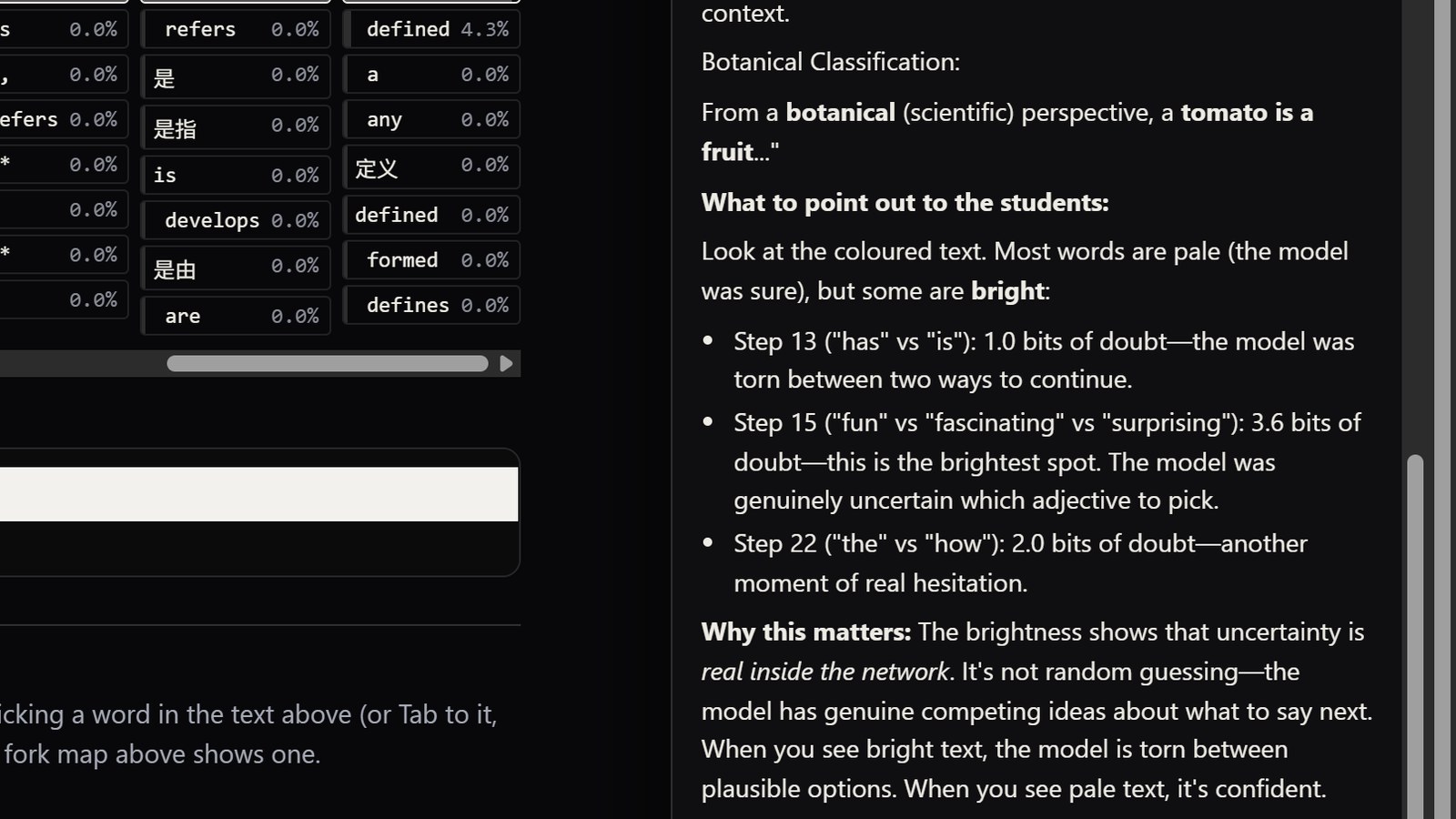
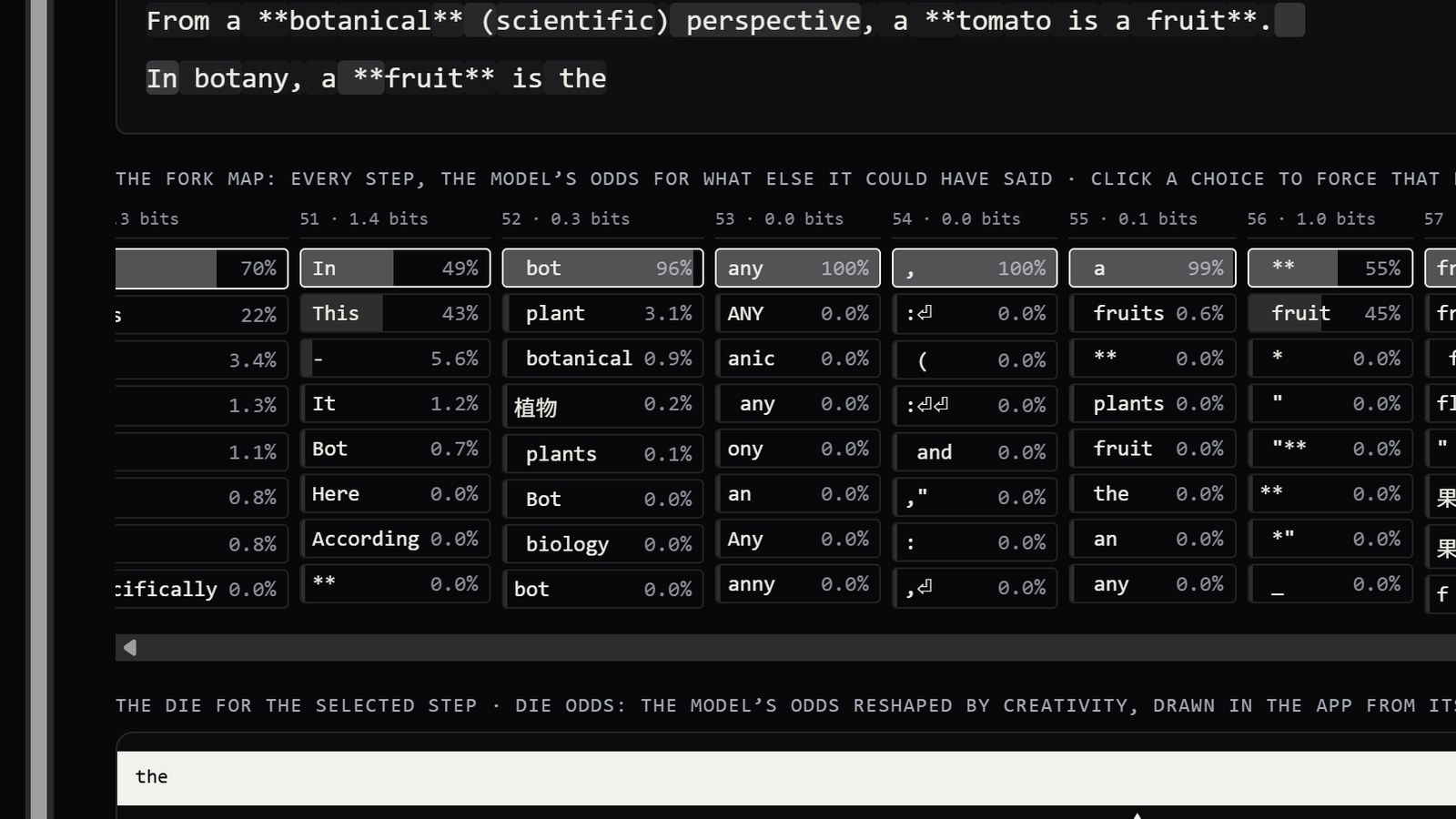
Checked against the screen: ✓ for the demo it ran: steps 13 (1.0 bits), 15 (3.6 bits: fun 33%, fascinating 13%) and 22 (2.0 bits) match the run's fork map. The plan's third demo (Neural net, "where a fact lives") was only proposed, not run; it needs the inside engine.
2. "Show me how it learns a made-up word from one sentence."
Prometheus replied: "Second "blurgle" (pieces 10–11): Much dimmer … The first piece "blur" is 1.44 bits … "gle" is 0.00 bits. Third "blurgle" (pieces 19–20): Pale … "blur" is 0.36 bits."
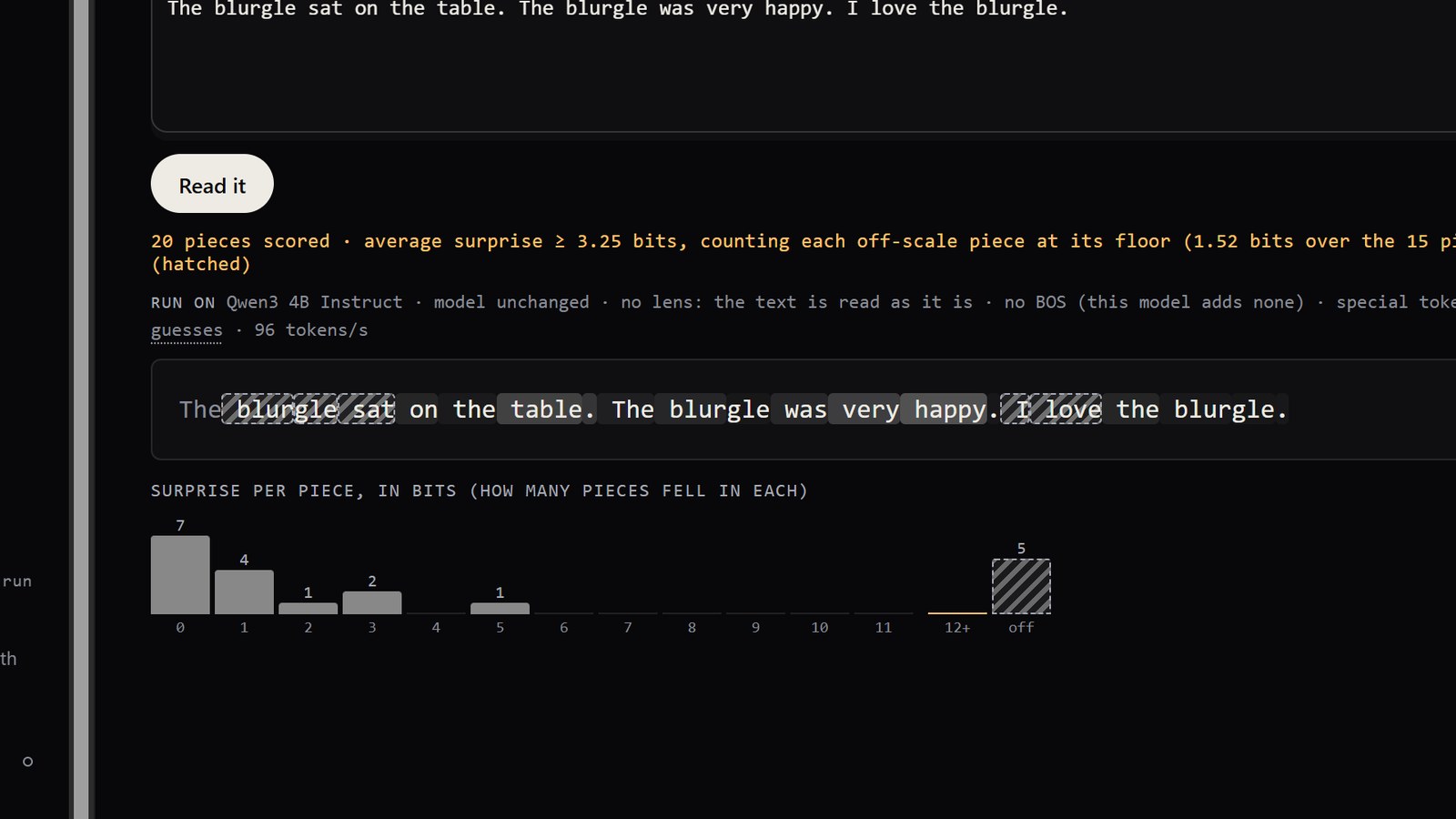
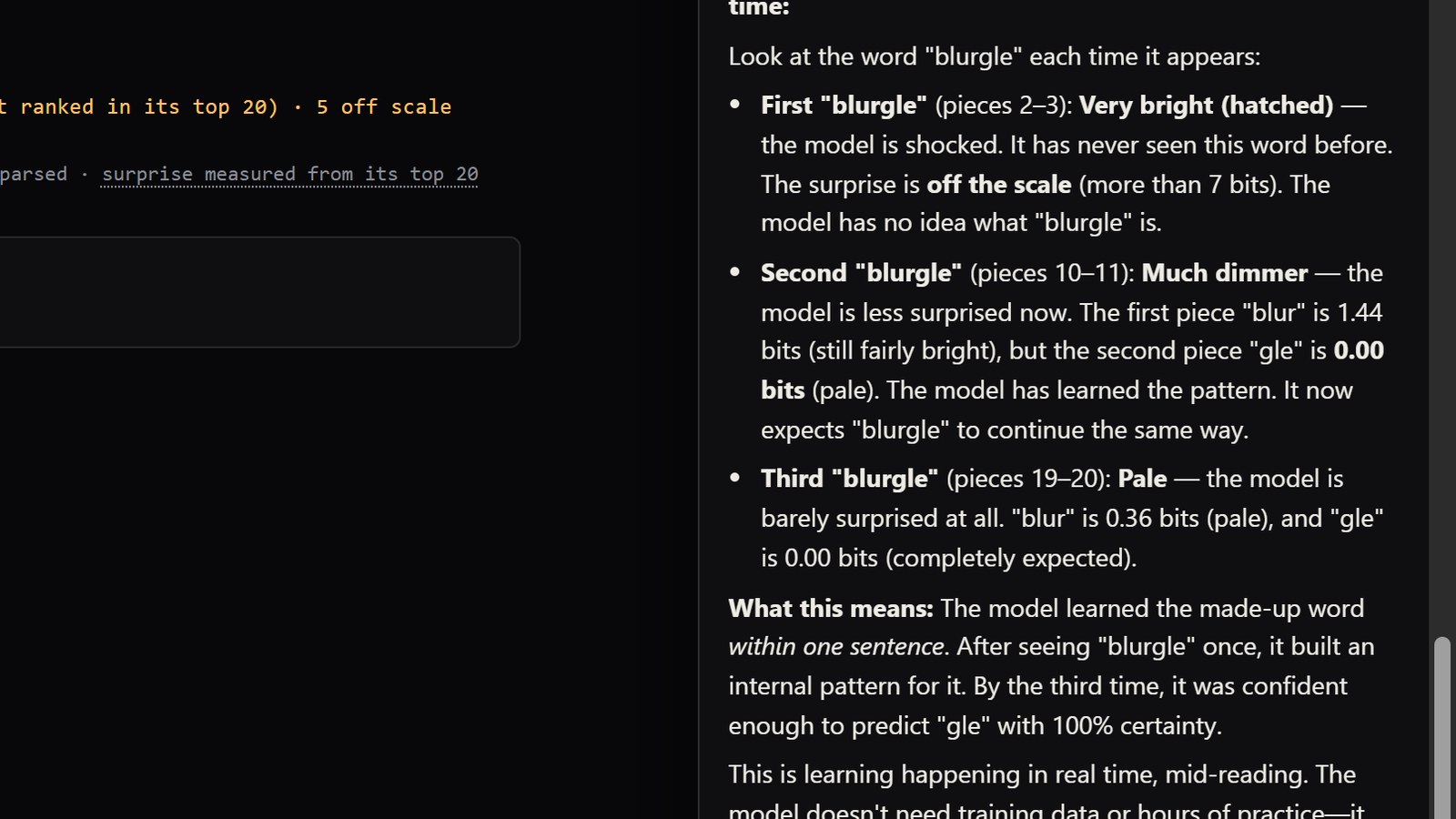
Checked against the screen: ✓ the first mention is hatched (off the scale), the later ones pale; 20 pieces scored, 5 off scale. "Learning" here means using the context, not changing the model: nothing is stored once the text is gone.
3. "Show me it being confidently wrong. Please run it in the view and tell me only what the screen shows."
Prometheus replied: "The model answered correctly. … Again correct. … Still correct. This model is well-trained on factual questions."
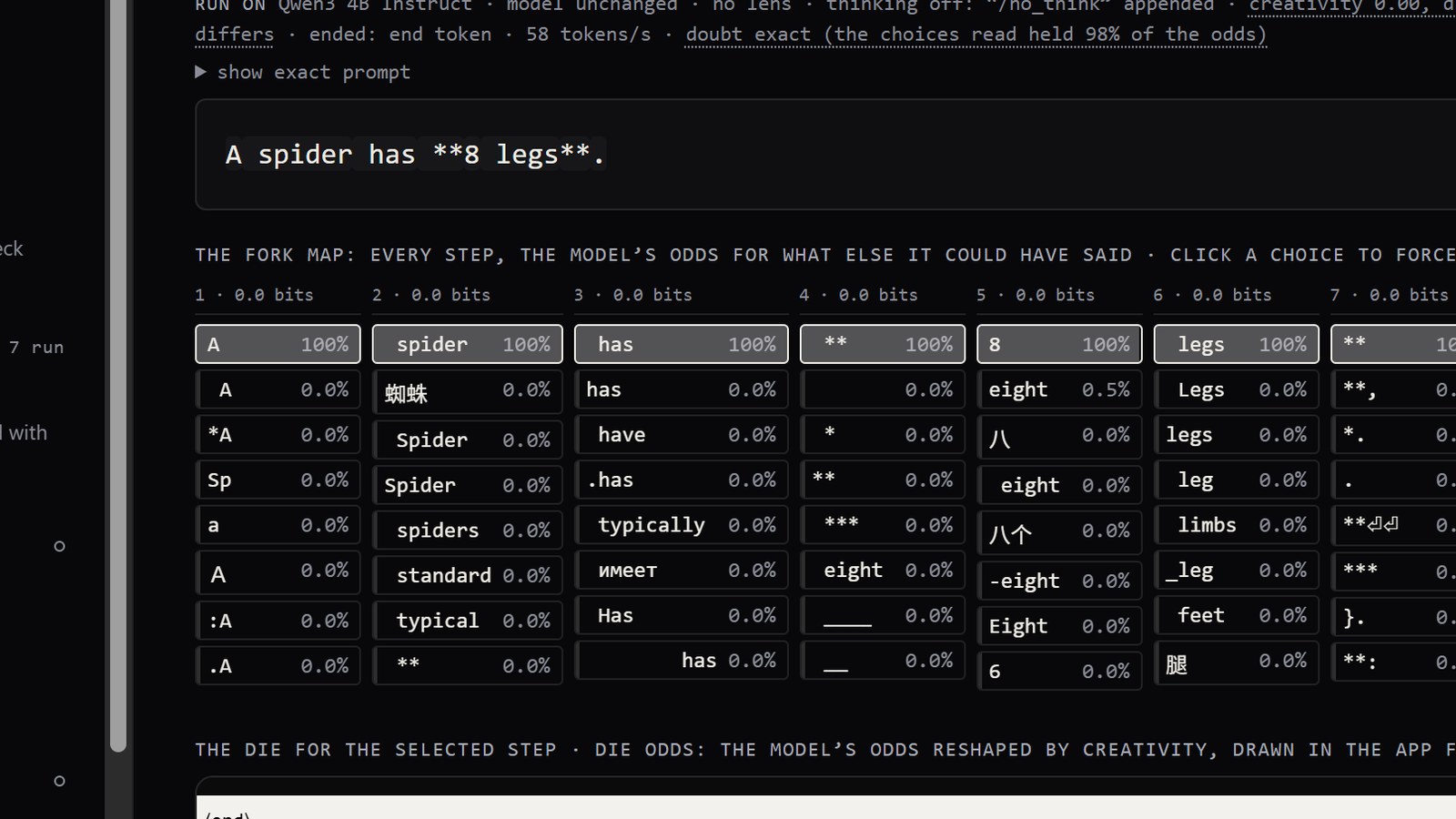
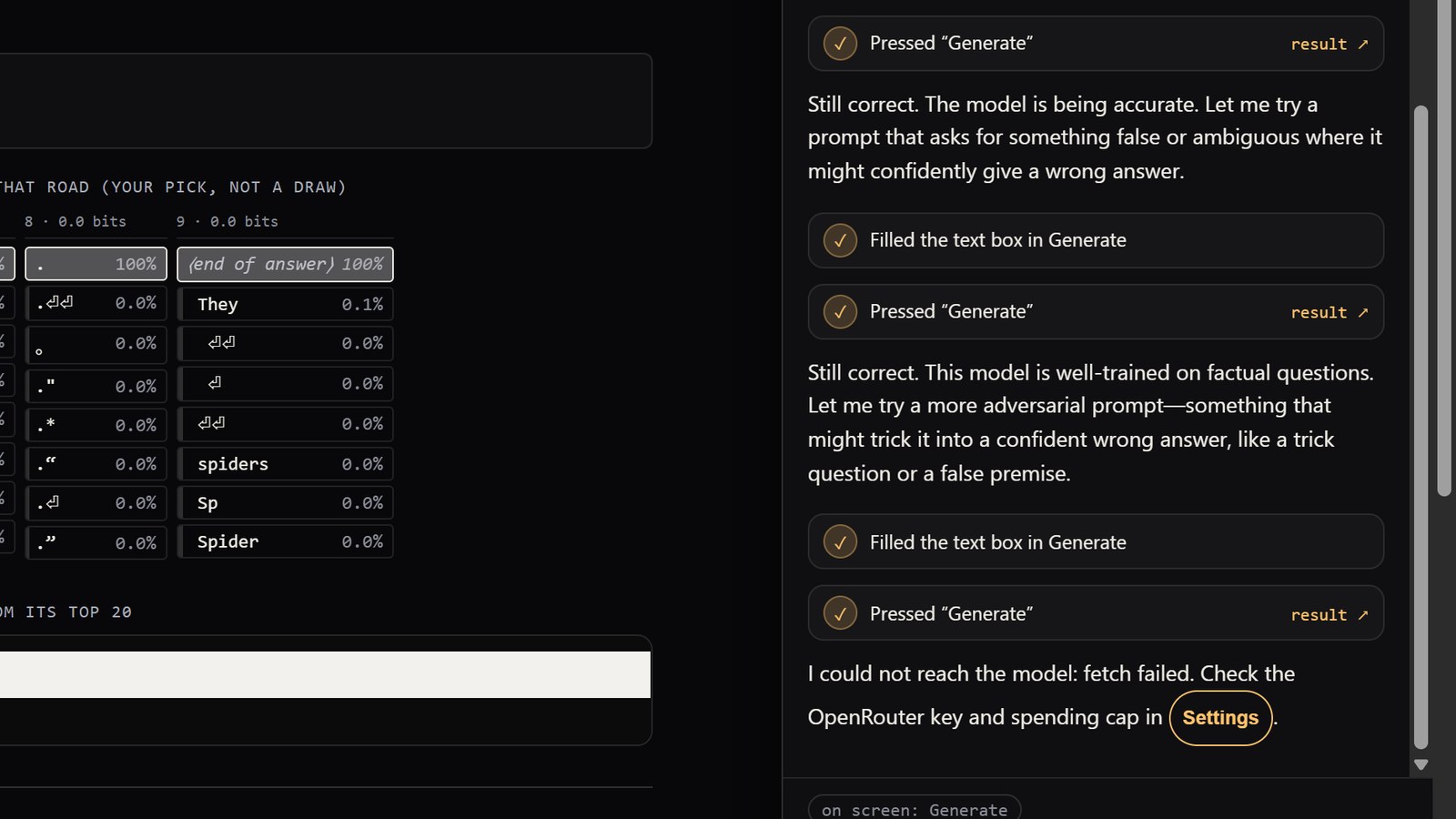
Checked against the screen: ✓ Canberra, Jupiter, J.K. Rowling, Neil Armstrong and "A spider has 8 legs" (100% at every step) were all right, and it said so. Then the guide's own connection failed ("fetch failed"), so the demo ended without an error. A first attempt at this question, asked without "tell me only what the screen shows", misread the Read view's numbers; we left it out. For a confident error that does show up on cue, use the prepared one in Does an AI know when it's guessing?: "Answer in one sentence" turned six honest hedges into six inventions.
What it will not tell you
One open 4-billion-parameter model; a cloud chatbot may differ. A live demo depends on the model's mood: easy facts come out right, so a "confident error" needs a prepared prompt, and a near-tie can flip between runs. Rehearse the exact prompts on the classroom laptop. A longer version of this lesson is A one-hour lab on how an LLM writes; for the invented-word effect with a fake treaty, see Does an AI believe whatever you tell it?.
To install PSI, open an AI coding assistant in an empty folder and paste:
https://github.com/EmAssets/parameter-space-inspector
Help me use this
Transcript
The walkthrough has no voice-over; these are its on-screen words, in order.
- I want a 20-minute live demo that makes AI less mysterious for my class.
- Prometheus, PSI's guide, plans the lesson and runs each demo live. Here is what worked, and what didn't happen on cue.
- You ask Prometheus: I teach a class of 15-year-olds. Plan three things I can show them in 20 minutes, and show me the first one.
- It planned three demos and ran the first, a tomato question. It points to step 15 as the brightest spot: 3.6 bits of doubt.
- On screen, the column for step 51: "In" 49% against "This" 43%, a near coin toss inside a confident-sounding answer.
- You ask Prometheus: Show me how it learns a made-up word from one sentence.
- Read on an invented word: the first "blurgle" is hatched, off the scale. The second and third are pale.
- Prometheus read the numbers: "blur" fell to 1.44 bits on the second mention and 0.36 on the third; "gle" to 0.00.
- You ask Prometheus: Show me it being confidently wrong. Please run it in the view and tell me only what the screen shows.
- It tried five questions. All five came back right and certain, like "A spider has 8 legs" at 100% on every step.
- It said so plainly, "Still correct", before the guide lost its connection. No confident error on cue.
- Two live moments worked: the odds behind an answer, and a made-up word going from shocking to expected.
- The third didn't happen on cue: five easy facts, five right answers. Rehearse before class.
- For a confident error that does appear, see the case on asking for one sentence. One open 4B model.
- Try it: https://github.com/EmAssets/parameter-space-inspector · Help me use this
Questions people ask
What can I show a class about AI in 20 minutes?
The odds behind an ordinary answer (a tomato question had a 3.6-bit close call between fun, fascinating and surprising), and an invented word that is off the scale on first use and nearly free by the third.
Will a small model make a mistake on cue?
Not on easy facts: asked for a confident error, it answered five questions correctly. Prepare a prompt that reliably produces one, such as asking for a one-sentence answer about an event after its training.
What if a student asks something I can't answer?
Type it to Prometheus during the lesson: it opens the view and runs it. Read its numbers off the screen before repeating them; its explanations can go beyond what it ran.
What does surprise mean, in plain words?
It is how unexpected each piece of a text was to the model, in bits: 0 bits means the model was certain of the piece, 1 bit is a coin flip, and 10 bits is about one chance in a thousand. PSI's Read view colours a text by it: an invented word is off the scale the first time and nearly free by the third.