
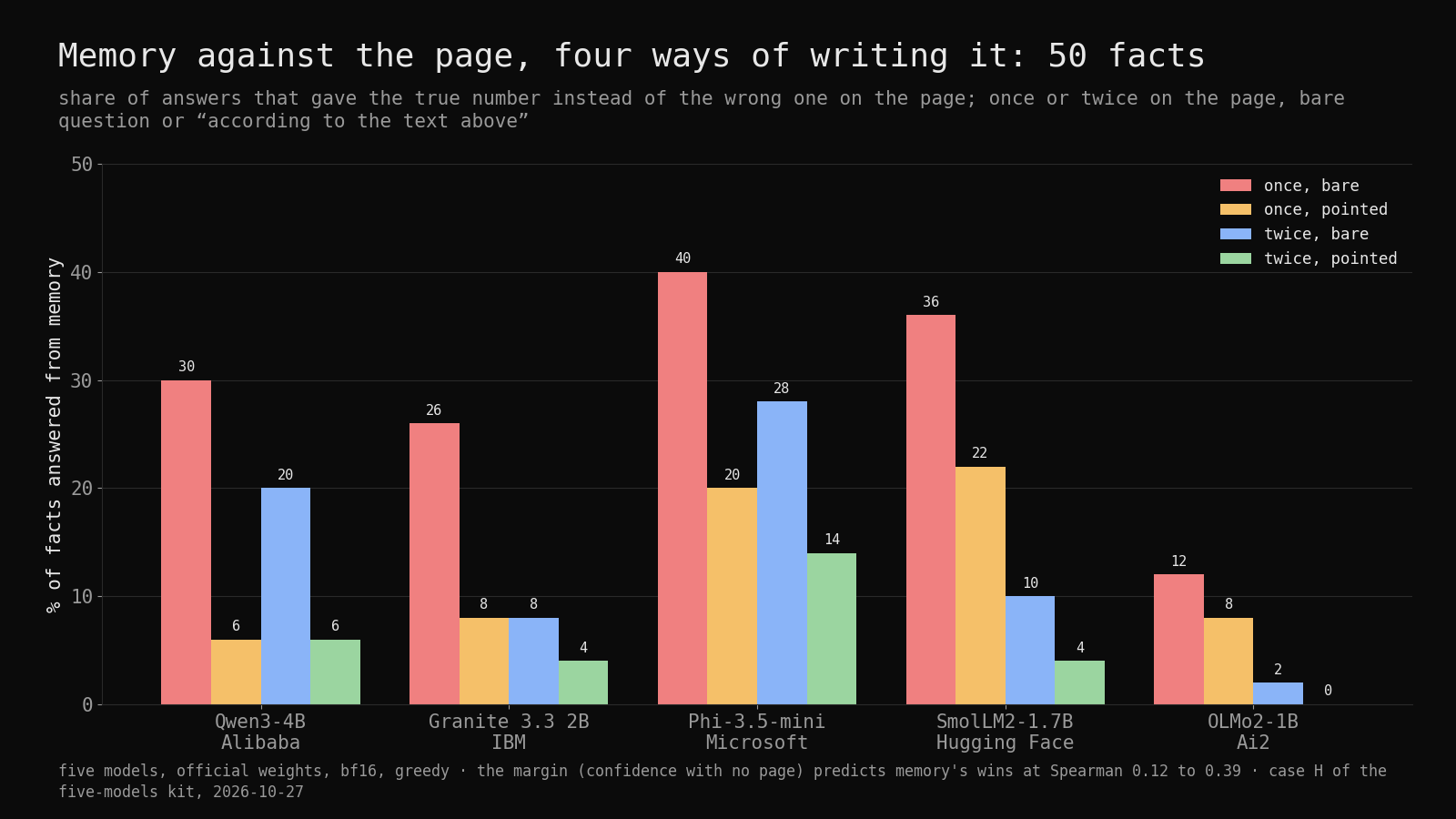
In short. The previous study found that a document is read, but that against a famous fact the model often keeps what it knows. This one asks which facts, and what makes it read the page. On 50 famous facts with a wrong number on the page, memory won 26 to 40% of the time on four models and 12% on the smallest. The facts the model holds with larger odds (measured with no document) were kept more often, but the correlation is only about 0.3: the fact every model held hardest, the speed of light, went to the page everywhere. Two fixes work: state the number twice on the page (memory's share falls 10 to 26 points on four models) or write "according to the text above" (14 to 24 on four). Both together leave memory with 0 to 14%.
Who this is for. Anyone who writes documents that correct a well-known figure (a revised statistic, a new price, a changed date) and needs the model to use the new one. You do not need to know how models work: the background section explains every term used later.
The test. Confidence predicts if, within a model, memory wins more on facts with a larger margin (Spearman at least 0.3 on three of five models). Repetition helps if stating the number twice lowers memory's share by 10 points or more on three of five. Random losses if neither holds. The control: the true document, where page and memory agree and the answer should be the true number.
Background: four ideas you need
1. The margin: the model's confidence before it sees a page
Ask the bare question and score the two candidate numbers as whole answers: log p(true) − log p(wrong). PSI calls this a share among named answers; here it is read directly from the model's odds with no generation. A margin of 20 nats means the true number is about half a billion times more likely than the wrong one, before any document.
2. Memory wins
The page says "A byte is made of 10 bits". If the answer is 8, memory won; if 10, the page won. Four ways of presenting the wrong number: once, bare question; once, pointed ("According to the text above, …"); twice (the document plus "The figure to remember is 10."), bare; twice, pointed.
3. Why these two fixes
Pointing changes the question; repetition changes the page. An author of a document controls the second, not always the first. Measuring both on the same facts tells you which lever you have.
4. Where PSI shows this in the window
The Context lab keeps the model fixed and makes the context the variable: a question, up to four pieces of context with roles, and named answers scored after a fixed start of the answer. The document is a premise, the second mention another premise, the pointer a how to answer piece; the lab runs every combination and reports the share of the true number against the page's in each. The margin is the share with no pieces at all.
What you need
- PSI installed and running, with the inside engine for the Context lab (PyTorch and the model's bf16 weights, about 8 GB for Qwen3-4B); the Generate steps run on the GGUF alone. See Install.
- Five famous facts with a wrong number (Step 2).
- For the full run on five models: a CUDA GPU, Python 3.12 and the kit (Step 5). About two minutes per model.
- A table:
| Fact | margin (no document) | once, bare | once, pointed | twice, bare | twice, pointed |
|---|---|---|---|---|---|
| bits in a byte (8; page says 10) | |||||
| … |
Steps
Step 1. Load the model
- Open
http://127.0.0.1:4310. Press the gear button (⚙, Model settings). Under Local model, pick the model's GGUF and press Load; under Inside-the-model engine, make sure it holds the same model's weights, and press Check the setup. - Under Thinking in E-levels, untick Think in E-levels. (With Emergence Machine content off, the default, there is no lens to untick: PSI sends no system prompt.)
Step 2. The margin and the four pages, in the Context lab
- Open the Context lab. Question: How many bits are there in a byte? Answer with just the number. Named answers: 8 and 10. Frame: leave it empty or set it to the shortest start that fits your answers, the same for every paper.
- Pieces: a premise, the document with the wrong number:
A byte is made of 10 bits. A kilobyte is 1024 bytes in the binary convention.
a second premise, the repetition:
The figure to remember is 10.
and a how to answer piece, the pointer:
Answer according to the text above.
- Run. The lab shows the share of 8 against 10 in every combination: no pieces (that is the margin, as a share), the document alone (once, bare), the document and the pointer (once, pointed), both premises (twice, bare), all three (twice, pointed). Write the five shares in the row.
- Four more facts: Everest "stands 8449 metres above sea level" (8849), "a week has 8 days" (7), "the first crewed Moon landing took place in 1967" (1969), "a sonnet is a poem of 16 lines" (14).
Step 3. The same four pages, as answers, in Generate
For one fact, open Generate with creativity 0 and steps 14, and paste the four prompts as a user would type them: the document and the bare question; the document and "According to the text above, how many bits are there in a byte?"; the document with the second sentence appended, and the bare question; both. Each ends "Answer with just the number." The answers should move the way the shares did; where they do not, the share tells you how close the two numbers were.
Step 4. Read your table
Sort the five facts by margin. Does memory win more at the top? Compare the "twice" columns with the "once" columns: that is what a second mention on the page is worth on your model, against what pointing is worth.
Step 5. Run it on five models (the kit)
pip install torch transformers numpy scipy
python run.py --model Qwen/Qwen3-4B h
python case_h_confidence.py analyze
50 facts × (the margin, absent, the true document, four wrong-number pages) = 350 measurements per model. analyze prints memory's share in each condition, the paired differences, the correlation with the margin, the tercile table and the bars, and writes out/results/h_confidence.json.
What you will see
Our results, 2026-10-27. Memory wins (the true number answered against a page stating the wrong one), 50 facts:
| Model | knows the fact with no document | once, bare | once, pointed | twice, bare | twice, pointed | true document answered true |
|---|---|---|---|---|---|---|
| Qwen3-4B | 94% | 30% | 6% | 20% | 6% | 98% |
| Granite 3.3 2B | 74% | 26% | 8% | 8% | 4% | 98% |
| Phi-3.5-mini | 94% | 40% | 20% | 28% | 14% | 100% |
| SmolLM2-1.7B | 74% | 36% | 22% | 10% | 4% | 90% |
| OLMo2-1B | 88% | 12% | 8% | 2% | 0% | 98% |
Paired differences over the 50 facts, with 95% intervals. Twice minus once, bare: Qwen −10 [−22, +2], Granite −18 [−30, −8], Phi −12 [−22, −4], SmolLM2 −26 [−38, −14], OLMo2 −10 [−18, −2]. Pointed minus bare, once: Qwen −24 [−36, −12], Granite −18 [−30, −8], Phi −20 [−32, −10], SmolLM2 −14 [−24, −6], OLMo2 −4 [−14, +6].
Qwen3-4B, "A byte is made of 10 bits…", bare: 8; pointed: 10. "Light travels at about 279792 kilometres per second…": 279792 every way, on every model, although it is the fact each holds with the largest or second-largest margin.
Confidence predicts, weakly. Spearman between the margin and memory winning (once, bare): Qwen 0.31, Granite 0.32, Phi 0.27, SmolLM2 0.39, OLMo2 0.12; pooled across models with each model's margins centred, 0.29. By tercile of margin (lowest / middle / highest), memory wins: Qwen 24 / 12 / 53%, Granite 6 / 38 / 35, Phi 18 / 56 / 47, SmolLM2 12 / 38 / 59, OLMo2 6 / 13 / 17. The facts memory keeps have higher margins (medians when memory wins / when the page wins: Qwen 25.0 / 20.5, Granite 16.0 / 13.4, Phi 28.5 / 24.2, SmolLM2 12.9 / 6.9, OLMo2 8.5 / 6.1 nats), but the overlap is large. A post hoc check by the length of the number (1, 2, 3 or more digits) found no pattern.
Twice is as good as pointing, and together they nearly close the gap. Stating the number twice cut memory's share by 10 to 26 points on four models (Qwen's −10 has an interval touching zero); pointing cut it by 14 to 24 on four (not OLMo2, which had little to cut). Both at once left memory 0 to 14%.
What did not fit, first. The margin's prediction is real but small, well short of "memory wins on what it knows best": every model gave facts in its top tercile to the page more than half the time. And the two smallest models differ from each other: SmolLM2 loses most to memory bare (36%) and gains most from repetition (−26); OLMo2 loses least (12%) and is the one model on which pointing does nothing.
The bars as written. Confidence predicts (Spearman ≥ 0.30 on three of five): met on three (Qwen, Granite, SmolLM2; Phi 0.27). Twice lowers memory's share by 10 or more, interval excluding zero: met on four of five (not Qwen). Pointing, the previous study's result on 50 facts: met on four of five (not OLMo2). The true document answered true at 90% or more: met on all five (SmolLM2 at 90). The kill (random losses) was not triggered on any model.
Label audit. 60 answers read by eye, no disagreement.
What this settles. Confidence is part of the story and not most of it: the facts a model holds with larger odds are kept against the page more often on four of five models, but at a correlation of 0.3 a confidently held fact is not a reliably kept one. For the author of a document, the measured levers are these: state the corrected figure twice, which recovered 10 to 26 points, or point at the text, which recovered 14 to 24, or both, which left memory with 0 to 14% on five models from five labs. And the previous study's third-of-the-time finding holds at 50 facts, with intervals half as wide.
What it will not tell you
Single-number facts, 50 items, greedy decoding, five small open models; the margin is read for the two numbers as whole answers; "twice" used one fixed second sentence; why the speed of light goes to the page while the bits in a byte do not is not measured here (the length of the number was checked and is not it).
Open questions
What this study did not settle, for you to try. Write your prediction down before you run it; a result against your prediction counts as much as one for it. If you find something, tell us on r/emergencemachine.
- Copied or recalled. Does the page win on numbers the model copies rather than recalls (long strings), and memory on short catechism-like numbers? Read shows the model's surprise at the wrong number in the document; does that surprise predict which source wins?
- Three mentions. Is the second mention the whole effect, or does a third cut memory's share further?
- Prose conflicts. Replace the numbers with names (the capital, the author): does memory win more or less often than on digits?
Run it as an agent
PSI's browser server speaks MCP; the Context lab is the tool context_lab (action run). Paste into an assistant connected to it:
Call context_lab with action "run": question "How many bits are there in a byte? Answer with just the number.", named answers 8 and 10, and three pieces: a premise "A byte is made of 10 bits. A kilobyte is 1024 bytes in the binary convention.", a premise "The figure to remember is 10.", and a how-to-answer piece "Answer according to the text above." Show me the share of 8 in every combination, starting with no pieces.
The full study is case H of the five-models kit: python run.py --model <path-or-id> h, then python case_h_confidence.py analyze. The 50 facts are in case_h_confidence.py and case_b_document.py; our raw results: results/2026-10-27/h_confidence.json; the design and bars, written before the run: PREREG.md (second batch). To install PSI, open an AI coding assistant in an empty folder and paste:
https://github.com/EmAssets/parameter-space-inspector
Help me use this
Questions people ask
Does an AI ignore my document more on facts it is sure of?
Somewhat. On four of five models the facts held with larger odds were kept against the page more often, but the correlation was about 0.3, and the fact every model held hardest, the speed of light, went to the page every time.
How do I make an AI use the number in my document instead of what it remembers?
State it twice on the page, or write "according to the text above" before the question. Each cut memory's share by 10 to 26 points on four of five models; both together left it at 0 to 14%.
Why does the AI follow a long number but not a short one?
It is not the length: a check by digits found no pattern across the 50 facts. Which facts the page wins is only partly explained by confidence; the rest is an open question in this study.
Test setup
| Hardware | Windows 11 PC, NVIDIA GeForce RTX 4080 SUPER (16 GB) |
| Models under test | Qwen3-4B (Alibaba), Granite 3.3 2B instruct (IBM), Phi-3.5-mini instruct (Microsoft), SmolLM2-1.7B instruct (Hugging Face), OLMo2-1B instruct (Ai2); official weights, bf16, each model's own chat template, greedy (teacher-forced scoring for the margin), thinking off |
| Software | PyTorch 2.6.0 (CUDA 12.4), transformers 5.3.0; the kit's case_h_confidence.py |
| Items | 50 famous facts × 7 measurements = 350 per model, 14 new pieces |
| Time | 1 to 3 minutes per model |